
Automatically apply for jobs with Zippia
Upload your resume to get started.
Control analyst skills for your resume and career

15 control analyst skills for your resume and career
1. Internal Controls
- Reviewed documentation and testing of internal controls and coordinated work and project management for third party consultants and internal control professionals.
- Developed global compliance and process adherence program to ensure internal controls and operational requirements are in place and operating effectively.
2. Risk Assessments
The process of analyzing and identifying the acts or events that have the potential to negatively affect an individual, asset, or business is called risk assessment. Risk assessments are important because they form an integral part of an organization as well as occupational safety plans
- Initiated strategic development of technology risk assessments and access management evaluations to incorporate current industry best practices.
- Performed budgetary analysis and qualitative risk assessments for business unit review.
3. SOX
- Audit journal entries within Global Business Services division to ensure supporting documentation and approvals comply with SOX internal control standards.
- Reviewed SOX 404 actual control description on quarterly basis for its operational effectiveness.
4. Internal Audit
Internal audit is an evaluation process that ensures that a company's risk management, governing body, and other internal processes are running effectively. People who perform internal audits must be highly qualified, have experience, and knowledge to work accordingly with the international standards and the code of ethics.
- Develop and maintain a collaborative relationship with Internal Audit and other risk and control professionals across the organization.
- Identified internal auditor candidates and developed audit schedules, training requirements, and audit review processes.
5. Customer Service
Customer service is the process of offering assistance to all the current and potential customers -- answering questions, fixing problems, and providing excellent service. The main goal of customer service is to build a strong relationship with the customers so that they keep coming back for more business.
- Manage operational responsibilities with Customer Services Manager, and ensured follow through on the completion/implementation of the designated operational/risk activities.
- Developed service part scheduling tool and met with production superintendents weekly to ensure on-time delivery to Ford Customer Service Division.
6. Strong Analytical
- Demonstrated strong analytical and business problem solving skills; able to understand complex business system functionality and develop strategies.
- Applied strong analytical and organizational skills including thoroughness and attention to detail to accommodate changing priorities and work assignments.
Choose from 10+ customizable control analyst resume templates
Build a professional control analyst resume in minutes. Our AI resume writing assistant will guide you through every step of the process, and you can choose from 10+ resume templates to create your control analyst resume.7. Project Management
- Standardized project management practices for the entire organization, eliminating several outdated and inefficient processes.
- Prepare quarterly program Estimate-At-Completion, profit/loss analysis, monthly project management, and forecasting.
8. Corrective Action
- Report Audit Findings to Quality and Operations personnel/management and coordinate to resolve findings and helped to develop preventive/corrective action plans.
- Coordinated with several departments to prepare and ensure supplier corrective actions and performance surveillance was initiated and completed.
9. External Auditors
- Responded to internal and external inquires and obtained supporting documentation as requested by internal/external auditors in timely manner.
- Provided external auditors with quarterly reports which quantified and gave status of existing incidents.
10. Variance Analysis
- Developed in depth understanding of financial statements, accounting procedures, internal and external reporting requirements and variance analysis.
- Prepared budget recommendations based on variance analysis and created comparison models for buy / lease decisions.
11. Reconciliations
- Managed accounting operations, accounting close, account reporting and reconciliations as a Treasury Reconciliation Analyst.
- Developed consolidated statements and all reconciliations to utilize as a basis for the opening balance sheet.
12. Financial Analysis
- Prepare financial reports for lubricants management team in addition to shipping and ocean transportation financial analysis and reports.
- Prepared corporate reports with detailed financial analysis for the support of potential modifications to contract budgets and estimate-at-completion.
13. Sarbanes-Oxley
The Sarbanes-Oxley Act (or SOX Act) is a U.S. government law that expects to secure financial backers by making corporate divulgences more solid and transparent. The Act was created as a result of bookkeeping errors.
- Implemented, monitored and assessed the Company's Reconciliation Monitoring program, prepared them for annual Sarbanes-Oxley reporting.
- Updated management on Sarbanes-Oxley and other internal control efforts monthly.
14. Logistics
Logistics is a complete organization and implementation of a problem. Logistics are often considered in a complex business operation, as some works need detailed plannings. Logistics are also used in military action.
- Position required knowledge and understanding of, supply chain management, logistics, production scheduling and inventory planning and management.
- Coordinate the logistics of expedited parts between off-site warehouse and plant to maintain uninterrupted production.
15. Process Improvement
- Participated in progressively changing in and outside the Financial Control team, which included process improvement and cost reduction initiatives.
- Implement process improvements to current procedures to increase efficiency and accuracy while maintaining compliance with Federal and Investor Guidelines.
5 Control Analyst resume examples
Build a professional control analyst resume in minutes. Browse through our resume examples to identify the best way to word your resume. Then choose from 5+ resume templates to create your control analyst resume.

What skills help Control Analysts find jobs?
Tell us what job you are looking for, we’ll show you what skills employers want.
What skills stand out on control analyst resumes?
Hanna Kim Ph.D.
Associate Professor, Chair, Adelphi University
I say "try to" as the reality is that having faculty in all 4 subfields is not possible for many reasons. (The 4 subfields are cultural anthropology, archeology, biological anthropology (sometimes physical anthropology), and anthropological linguistics. These subfields are mirrored in graduate school where students going for PhDs will be focused on 1 subfield.)
For undergraduates with an anthropology degree seeking employment, I can speak only from the faculty side, not the employer side. My students report these factors as relevant to their being hired (and accepted into competitive schools in museum studies, social work, law school, etc.:
Analytical skills; clear writing; ability to synthesize large amounts of reading and data into well-supported arguments and interpretations; open-mindedness toward different identities and ways of being.
A hugely important skill that anthropology graduates have is the ability to be presented with a complex situation or problem, and to be able to chart a plan on how to approach the problem, gather data and other necessary information to solve the problem, and then to come up with a solution or possible strategies. Too often, particularly in situations involving human behavior, what is needed is a stronger grasp of social and cultural factors that could impede the desired outcome. Students of anthropology know that ways of doing things, and even seeing and thinking, are profoundly influenced by categories of thought that are culturally situated. This means that problem solving has to consider a network of variables that have an impact on behavior. Anthropology students, I would argue, would embrace this complexity rather than be hesitant to acknowledge it in favor of a more expedient and, in the long run, less successful solution.
What soft skills should all control analysts possess?
Hanna Kim Ph.D.
Associate Professor, Chair, Adelphi University
What hard/technical skills are most important for control analysts?
Hanna Kim Ph.D.
Associate Professor, Chair, Adelphi University
What control analyst skills would you recommend for someone trying to advance their career?
A.J. Arreguin
Professor, Our Lady of the Lake University
Students should volunteer with small/local businesses or create their brand (start a blog or become a niche social media influencer) to practice and build on their experience. Once the student/graduate does that, they should keep a weekly log with analytics to help them understand how to improve moving forward. This will be beneficial when applying for a communication/public relations job during an interview. The degree gets the student/graduate the talk, but the experience lands them the job.
What type of skills will young control analysts need?
Lise Abrams Ph.D.
Professor of Linguistics and Cognitive Science; Coordinator of Cognitive Science, Pomona College
List of control analyst skills to add to your resume
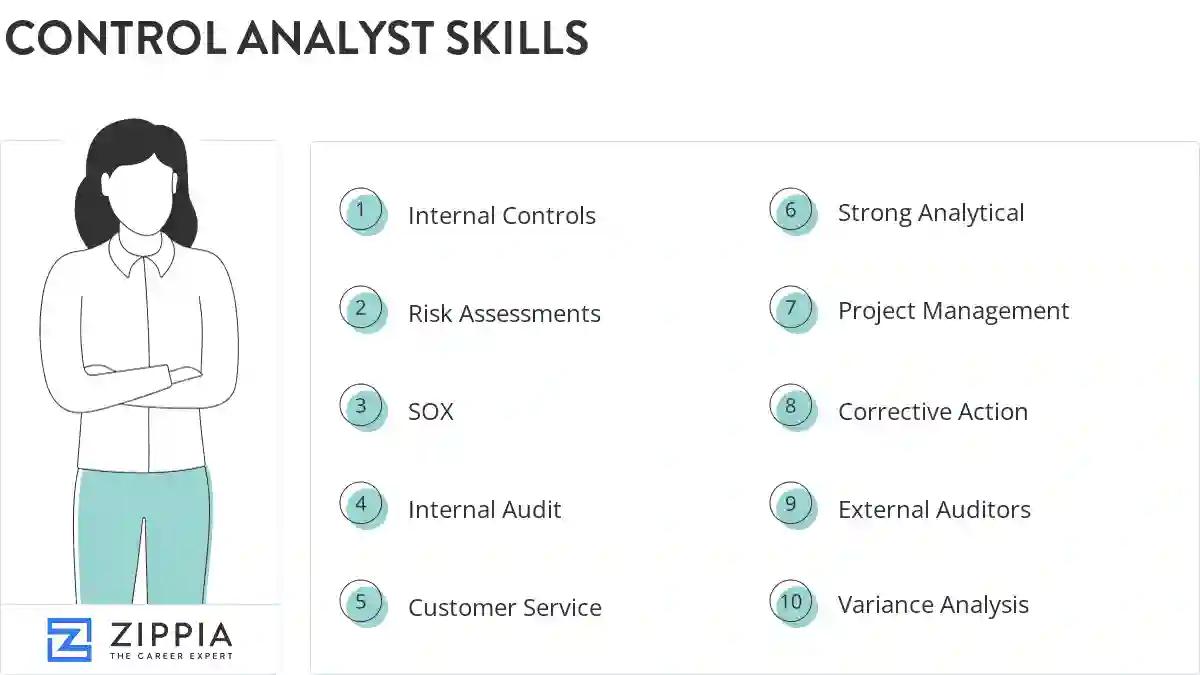
The most important skills for a control analyst resume and required skills for a control analyst to have include:
- Internal Controls
- Risk Assessments
- SOX
- Internal Audit
- Customer Service
- Strong Analytical
- Project Management
- Corrective Action
- External Auditors
- Variance Analysis
- Reconciliations
- Financial Analysis
- Sarbanes-Oxley
- Logistics
- Process Improvement
- Management System
- Audit Findings
- Financial Statements
- Excellent Organizational
- Data Analysis
- Securities
- GAAP
- Balance Sheet
- Data Entry
- Business Processes
- Pivot Tables
- SharePoint
- Derivative
- SQL
- Treasury
- Financial Reports
- Work Breakdown Structure
- ERP
- Financial Data
- General Ledger
- MRP
- Data Integrity
- ISO
- Windows
- Sigma
- BOM
- Equities
- AML
- Earned Value Management
- Test Results
- Cash Flow
- Cost Analysis
- Cost Savings
- ECO
Updated January 8, 2025
