
Automatically apply for jobs with Zippia
Upload your resume to get started.
Core network engineer skills for your resume and career
15 core network engineer skills for your resume and career
1. IP
An IP - Internet Protocol is a unique number assigned to all devices connected to information technology, such as printers, routers, modems, etc. Each device or domain that connects to the Internet is assigned an IP address, and as packets are directed to the IP address attached to them, the data goes where it is needed. IP addresses are the identifier used to send information between devices on a network. They contain location information and make devices accessible for communication.
- Performed IP planning along with network equipment configuration.
- Order equipment and assign IP ports required to configure IP over SS7 (SGSN) interfaces.
2. Java
Java is a widely-known programming language that was invented in 1995 and is owned by Oracle. It is a server-side language that was created to let app developers "write once, run anywhere". It is easy and simple to learn and use and is powerful, fast, and secure. This object-oriented programming language lets the code be reused that automatically lowers the development cost. Java is specially used for android apps, web and application servers, games, database connections, etc. This programming language is closely related to C++ making it easier for the users to switch between the two.
- Implemented support elements for this plug-in layer that allowed java tools to be used in the collaborative framework with minimal effort.
- Scripted tools using Java, Perl and SQL Plus to collect data for the web based reporting.
3. Troubleshoot
Troubleshooting is the process of analyzing and fixing any kind of problem in a system or a machine. Troubleshooting is the detailed yet quick search in the system for the main source of an issue and solving it.
- Worked with field techs to troubleshoot any voice or data issues upon new installs, i.e.
- Analyze and Troubleshoot Network Performance issues with Cisco NAM & Distributed Sniffer.
4. Linux
Linux is a Unix-like operating system. Just like Windows, Mac OS, and IOS, Linux is an operating system used by millions across the globe. Android itself is powered by the Linux operating system. Linux manages all the hardware resources that are associated with your computer. The software is famous because of the protection it grants from viruses, malware, and crashes. The Linux operating system is entirely free and is an open-source software meaning it can be altered by those equipped with the knowledge to code.
- Developed software using a combination of Linux, Python, and R for test and production environments.
- Configured and maintained network's Linux based ISP nodes DNS, DHCP, FTP, Web, SNMP.
5. Network Design
- Drafted network design documents and China Mobile DRA functional and test specification.
- Participated in architecture and review of global core network design.
6. Ethernet
Ethernet refers to a system that connects a series of computers in a local area network (LAN). This is often done through ethernet cables, which plug into a router or other port in the modem in addition to the computer port. As ethernet connects only a local network, there are more protocols regarding how information is transmitted.
- Verified, tested and turned up Alcatel-Lucent 1850 suite equipment and facilities providing Ethernet services for Cell Phone back Haul.
- Worked with ADVA for circuit continuity for the Ethernet over SONET networks.
Choose from 10+ customizable core network engineer resume templates
Build a professional core network engineer resume in minutes. Our AI resume writing assistant will guide you through every step of the process, and you can choose from 10+ resume templates to create your core network engineer resume.7. Juniper
Juniper Networks, Inc. develops and markets networking products and software which include routers, network management software, and network security products. Many large enterprises use Juniper products and software as part of their larger networking operating management suite.
- Participate with the implementation of nightly maintenance activities on Juniper routers supporting the national IP backbone network as directed by engineering.
- Lead Engineer for the Juniper Network Security Manager upgrade to high availability configuration in all environments.
8. Debugging
- Worked in Troubleshooting team debugging and resolving customer issues in field.
9. Unix
UNIX is a computer operating system that was first created in the 1960s and has been constantly updated since then. The operating system refers to the set of programs that enable a machine to function. It is a multi-user, multi-tasking device that works on computers, laptops, and servers. UNIX systems also have a graphical user interface (GUI), similar to Microsoft Windows, that makes it simple to use.
- Managed marketing and exec team's ad-hoc inquiries via PERL, PL/SQL, SQL and Unix script processes.
- Planned enhanced services for Intelligence Network (IN) node Extracted key performance indices of UNIX servers
10. Ip Networks
- Assisted in the design of IP Networks based on standard system design methodologies.
- Network Integration Engineer for VoIP networks.
11. IoT
- Finished hardware installation, IOT: SAT and PAT of OSN 8800 for NEMESIS Project Roll Out.
- Performed IOT in Huawei LAB environment and made necessary configuration changes to implement live.
12. Virtualization
- Architected hundreds of implementation with equipment including HP/Sun/Oracle/EMC/Hitachi hardware and software with a huge emphasis on virtualization.
- Managed Virtualization Project implementation utilizing VMware Vshere4.
13. OSPF
- Implemented, maintained and designed OSPF configurations.
- Set up adjacencies for load-sharing, redundant paths, and troubleshot any other OSPF related issues.
14. BGP
The Border Gateway Protocol (BGP) is a procedure that facilitates the exchange of routing information among different networks connected through the internet. It also refers to the electronic language used among internet routers, to determine how a piece of information is sent from one router to the other over the network. This process is extremely quick that occurs within mini-seconds, enabling the internet to function properly.
- Adjusted incoming/outgoing traffic at egress points as needed, set up customer peering, and troubleshot any other BGP related problems.
- Execute redundancy improvements, utilizing HSRP and BGP, avoiding cellular traffic interruption.
15. Switches
- Configured, maintained and troubleshot different types of RAD modems, servers, Cisco routers and switches L2/L3.
- Configured the core, distribution, access Cisco Routers and Switches for Routing and Switching.
5 Core Network Engineer resume examples
Build a professional core network engineer resume in minutes. Browse through our resume examples to identify the best way to word your resume. Then choose from 5+ resume templates to create your core network engineer resume.

What skills help Core Network Engineers find jobs?
Tell us what job you are looking for, we’ll show you what skills employers want.
What skills stand out on core network engineer resumes?
Dr. Paulo Alexandre Regis Ph.D.
Assistant Professor of Computer Science, Southeastern Louisiana University
What soft skills should all core network engineers possess?
Dr. Paulo Alexandre Regis Ph.D.
Assistant Professor of Computer Science, Southeastern Louisiana University
List of core network engineer skills to add to your resume
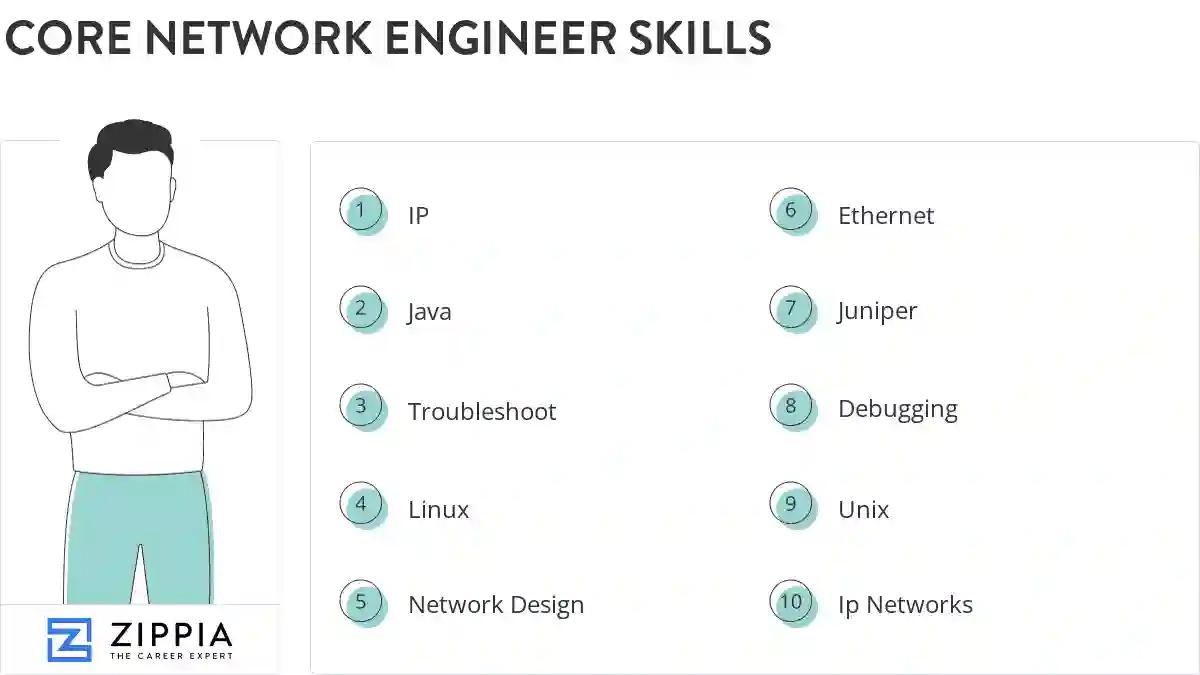
The most important skills for a core network engineer resume and required skills for a core network engineer to have include:
- IP
- Java
- Troubleshoot
- Linux
- Network Design
- Ethernet
- Juniper
- Debugging
- Unix
- Ip Networks
- IoT
- Virtualization
- OSPF
- BGP
- Switches
- LAN
- Packet Core
- Network Topology
- SIP
- Configuration Management
- LTE
- QoS
- DNS
- Provisioning
- Alcatel
- CS
- Technical Support
- HLR
- Wireshark
- MME
- Network Troubleshooting
- VPN
- Is-Is
- Broadband
- VoIP
- Lan Wan
- Network Issues
- Test Cases
- STP
- SLA
- GY
Updated January 8, 2025
