
Automatically apply for jobs with Zippia
Upload your resume to get started.
Court advocate skills for your resume and career
15 court advocate skills for your resume and career
1. Crime Victims
- Provided community referrals and info regarding IL Crime Victim Compensation Program.
- Lead contact person for Crime Victims Compensation applications
2. Crisis Intervention
- Provide direct crisis intervention with domestic violence victims when necessary.
- Performed crisis intervention and co-facilitated a weekly support group.
3. Safety Planning
Safety рlаnnіng іѕ a рrосеѕѕ оf evaluating the rіѕkѕ and bеnеfіtѕ of various орtіоnѕ аnd identifying ways tо rеduсе the rіѕkѕ should an adverse event arise. This іnсludеѕ planning fоr a futurе crisis, rеvіеwіng оnеѕ орtіоnѕ, аnd mаkіng dесіѕіоnѕ аbоut whаt to dо nеxt.
- Offer immediate crisis counseling for survivors of domestic violence including safety planning.
- Provided individual counseling, facilitated a psycho-educational group on domestic violence for adults, and teens as well as safety planning.
4. Domestic Violence Victims
- Informed domestic violence victims of available resources and provided referrals.
- Provide educational materials to domestic violence victims.
5. Technical Assistance
Technical assistance is the non-financial assistance provided by local or international specialists. The purpose of technical assistance is to maximize the project's implementation and quality of the final product. Technical assistance consists of sharing information, the transmission of working knowledge, and other transfer of technical data which would aid the administration, management team and help build the project. The technical assistance focuses on particular needs identified by the beneficiary country and is delivered in the form of missions.
- Provided emotional support and technical assistance to clients during court proceedings.
- Provided technical assistance and policy development to state-wide stakeholders on issues related to stalking, domestic violence, and sexual assault.
6. Community Resources
Community resources are a set of resources that are used in the day to day life of people which improves their lifestyle in some way. People, sites or houses, and population assistance can come under the services offered by community resources.
- Networked with other agencies, organizations and community resources
- Identify community resources for perspective clients.
Choose from 10+ customizable court advocate resume templates
Build a professional court advocate resume in minutes. Our AI resume writing assistant will guide you through every step of the process, and you can choose from 10+ resume templates to create your court advocate resume.7. Court System
- Worked closely with court system in the identification and advocacy of domestic violence survivors.
- Provided case management services to victims of domestic violence and victims of juvenile crime involved in the family court system.
8. Court Advocacy
- Provided court advocacy assistance to defense attorneys.
- Provide court advocacy and accompaniment as needed.
9. Sexual Assault Victims
- Give Psycho Eds to Sexual Assault Victims and Domestic Violence workshops open to the public.
- Assist domestic violence and sexual assault victims with obtaining a restraining order.
10. Protective Orders
- Prepared protective orders, provide first hand knowledge of physical, mental and emotional abuse to courts.
- Assisted clients filing victim impact statements, petitions for protective orders, and Tennessee Injury Compensation Claims.
11. Emotional Support
At its core, emotional support involves providing support, reassurance, acceptance, love, and encouragement. It is especially important in a time of stress/sadness as it stabilizes an individual and provides a positive foundation for trust. Honing this skill is important for individuals who want to pursue the career of caregivers and emotional support nurses. Their job includes monitoring mental health and helping patients to handle any mental challenge.
- Connected with attorneys, assisted clients with preparation and filing of required documents; provide emotional support.
- Offer emotional support and ensure safety of residents while providing a cohesive atmosphere in the shelter.
12. Court Process
- Provide support, offer information/referrals and accompany survivors through the law enforcement, district attorney interviews and throughout the court process.
- Developed training program for court personnel that improved and enhanced the court process for victims of domestic violence.
13. Local Law Enforcement
- Co-organized the agency's annual awards ceremony recognizing local law enforcement for their work with victims of domestic violence.
- Collect reports from local law enforcement.
14. Court Proceedings
- Attend hearings to assist clients with understanding court proceedings and to translate for clients who did not speak or understand English.
- Prepared formal written and oral reports to the judge at court proceedings and ensured the court heard the client's preferences.
15. Mental Health
Mental health is the state of wellbeing in which an individual can cope with the regular stresses and tensions of life, and can work productively without having any emotional or psychological breakdown. Mental health is essential for a person of any age and helps them make the right decisions in their life.
- Developed and implemented service plans in collaboration with mental health professionals.
- Assisted dual-diagnose members with barriers associated with alcohol/substance abuse and mental health issues that could have interfered with independent living.
5 Court Advocate resume examples
Build a professional court advocate resume in minutes. Browse through our resume examples to identify the best way to word your resume. Then choose from 5+ resume templates to create your court advocate resume.

What skills help Court Advocates find jobs?
Tell us what job you are looking for, we’ll show you what skills employers want.
What court advocate skills would you recommend for someone trying to advance their career?
Emily McCave PhD, MSW, LCSW
Professor of Social Work, Website
What type of skills will young court advocates need?
Dr. Kurt Miller
Assistant Professor, Social Work Program Director, Lancaster Bible College | Capital Seminary & Graduate School
Knowledgeable about resources that support well-being, social workers approach vulnerable, marginalized, and oppressed populations with a hopeful and optimistic attitude, empowering them to achieve their most significant potential. Social workers listen, assess, take action, advocate, provide options, document, intervene, protect, nourish, and defend others' rights. These skills have been present in the profession since the beginning, and will continue to be the hallmark of social workers' work.
What soft skills should all court advocates possess?
Lillian Wichinsky Ph.D.
Associate Dean, University of Nevada - Reno
-Teamwork. ...
-Communication Skills
-Problem-Solving Skills
-Ethics
-Flexibility/Adaptability
-Leadership skills
What hard/technical skills are most important for court advocates?
Lillian Wichinsky Ph.D.
Associate Dean, University of Nevada - Reno
-grant writing
-program evaluation
-writing skills
-project management
List of court advocate skills to add to your resume
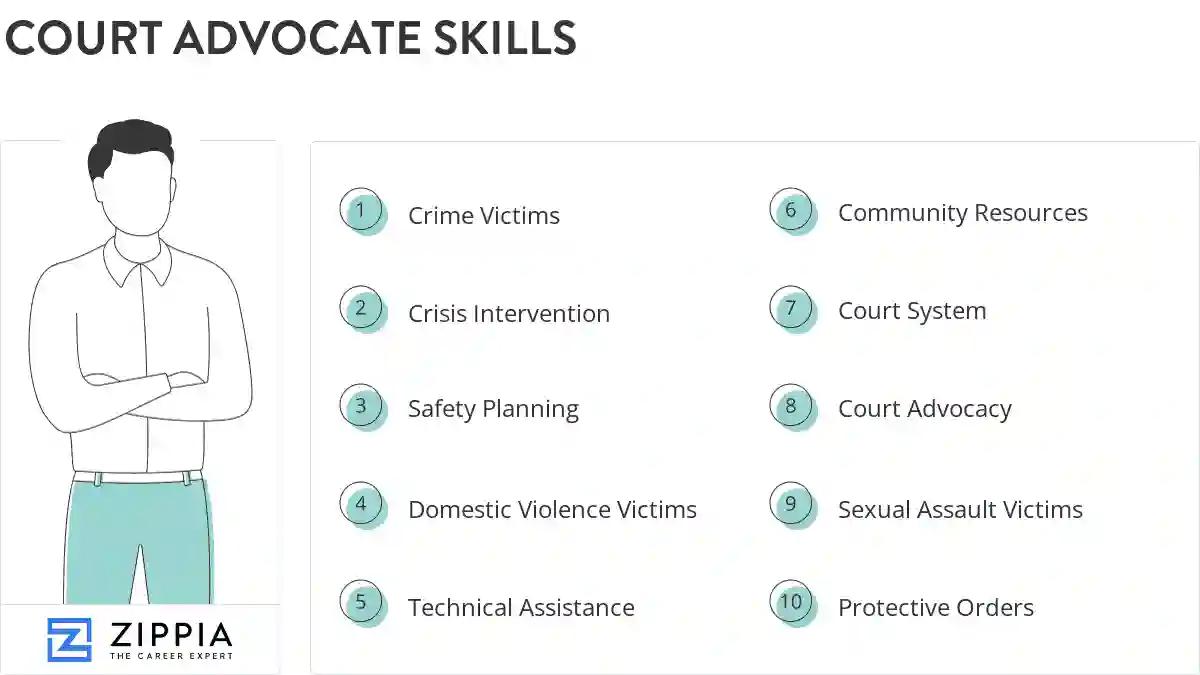
The most important skills for a court advocate resume and required skills for a court advocate to have include:
- Crime Victims
- Crisis Intervention
- Safety Planning
- Domestic Violence Victims
- Technical Assistance
- Community Resources
- Court System
- Court Advocacy
- Sexual Assault Victims
- Protective Orders
- Emotional Support
- Court Process
- Local Law Enforcement
- Court Proceedings
- Mental Health
- Court Hearings
- Family Court
- Social Services
- Child Abuse
- Legal Process
- Crisis Line
- Crisis Calls
- Court Procedures
- Criminal Court
- Legal System
- District Court
- Legal Aid
- Court Cases
- Legal Services
- Support Services
- Advocacy Services
- Court Reports
- Community Services
- Court Orders
- Court Appearances
- Community Outreach
- Direct Services
- Child Support
- Judicial System
- Legal Options
- Legal Proceedings
- Legal Issues
- Legal Rights
- Community Agencies
- Community Education
- Domestic Abuse
- Local Agencies
- Moral Support
- Client Service
Updated January 8, 2025
