What does a cryogenics engineer do?
Cryogenics engineer responsibilities
Here are examples of responsibilities from real cryogenics engineer resumes:
- Manage Terraform and refactore from monolithic to application specific components.
- Perform multiple augments installing and adding new devices/servers along with adding configurations for video streaming using Unix and checking router configurations.
- Develop QEMU wrapper API to redirect virtual hardware accesses into SystemC-based android emulator.
Cryogenics engineer skills and personality traits
We break down the percentage of Cryogenics Engineers that have these skills listed on their resume here:
- Routine Maintenance, 100%
Completed routine maintenance forms and records/interpreted and apply technical manuals and schematics.
Creativity. To carry out their duties, the most important skill for a cryogenics engineer to have is creativity. Their role and responsibilities require that "mechanical engineers design and build complex pieces of equipment and machinery." Cryogenics engineers often use creativity in their day-to-day job, as shown by this real resume: "conducted an inventory of all sites operated from indianapolis switches. "
Listening skills. Another essential skill to perform cryogenics engineer duties is listening skills. Cryogenics engineers responsibilities require that "mechanical engineers often work on projects with others, such as architects and computer scientists." Cryogenics engineers also use listening skills in their role according to a real resume snippet: "communicated design criteria and specifications and helped troubleshoot the build. "
Math skills. This is an important skill for cryogenics engineers to perform their duties. For an example of how cryogenics engineer responsibilities depend on this skill, consider that "mechanical engineers use the principles of calculus, statistics, and other advanced subjects in math for analysis, design, and troubleshooting in their work." This excerpt from a resume also shows how vital it is to everyday roles and responsibilities of a cryogenics engineer: "developed a visual c++ (mfc) based application to calculate real time statistics for gps sessions. ".
Mechanical skills. For certain cryogenics engineer responsibilities to be completed, the job requires competence in "mechanical skills." The day-to-day duties of a cryogenics engineer rely on this skill, as "mechanical skills allow engineers to apply basic engineering concepts and mechanical processes to the design of new devices and systems." For example, this snippet was taken directly from a resume about how this skill applies to what cryogenics engineers do: "served on two training committees; training committee for mechanical equipment department and a committee for rotating equipment. "
Problem-solving skills. A commonly-found skill in cryogenics engineer job descriptions, "problem-solving skills" is essential to what cryogenics engineers do. Cryogenics engineer responsibilities rely on this skill because "mechanical engineers need good problem-solving skills to take scientific principles and discoveries and use them to design and build useful products." You can also see how cryogenics engineer duties rely on problem-solving skills in this resume example: "solved stress, thermal, and flow fea problems for design of 2500 hp helium screw compressors. "
The three companies that hire the most cryogenics engineers are:
- Blue Origin2 cryogenics engineers jobs
- Country-Wide Insurance1 cryogenics engineers jobs
- Mevion Medical Systems1 cryogenics engineers jobs
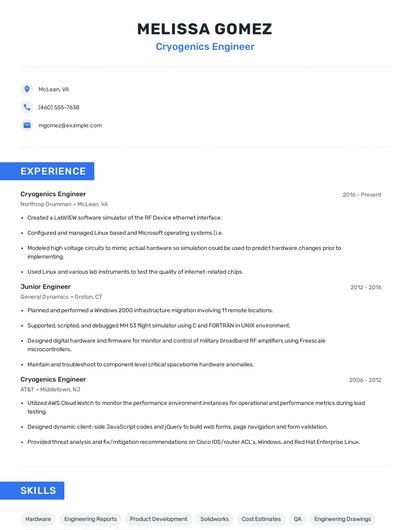
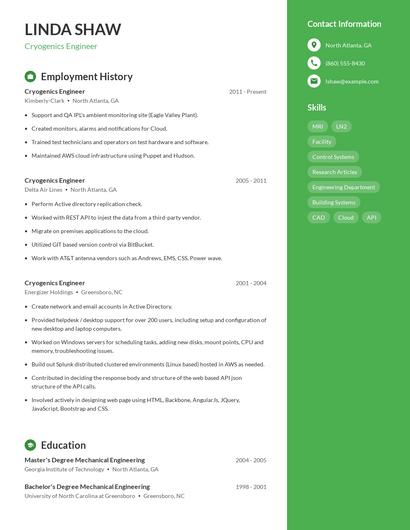
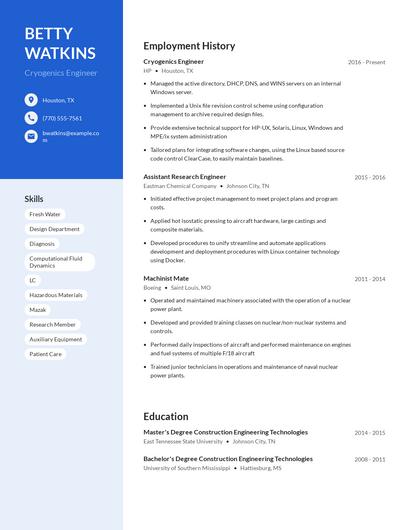
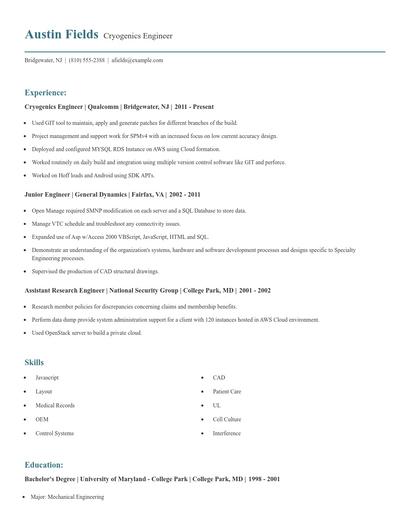
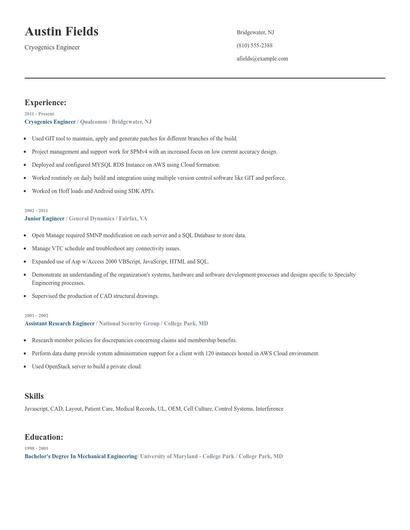
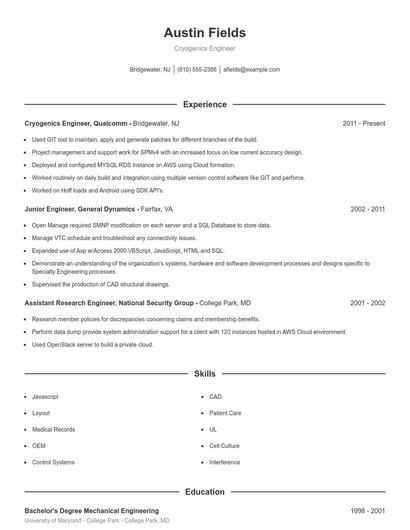
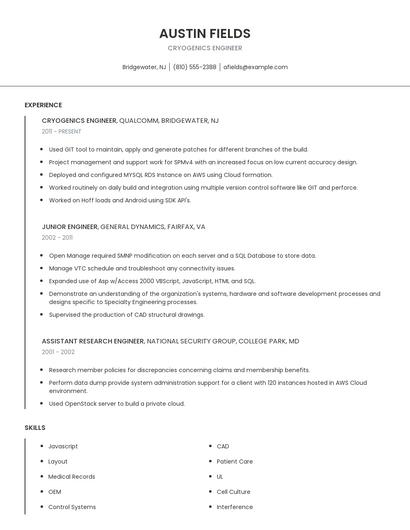
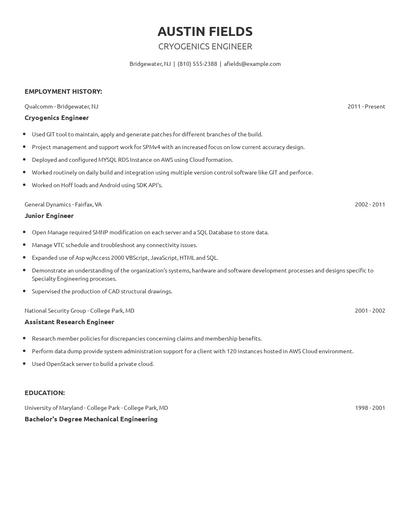
Choose from 10+ customizable cryogenics engineer resume templates
Build a professional cryogenics engineer resume in minutes. Our AI resume writing assistant will guide you through every step of the process, and you can choose from 10+ resume templates to create your cryogenics engineer resume.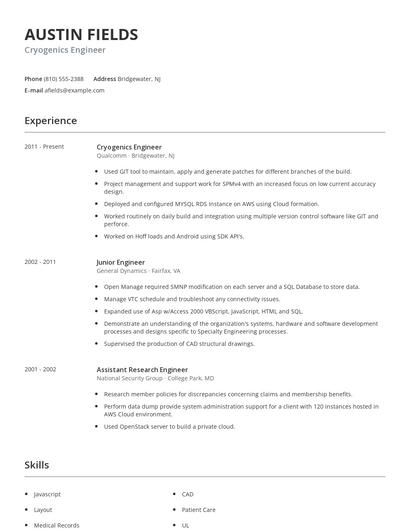
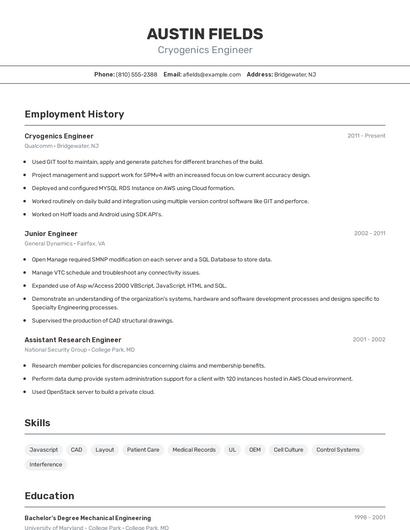
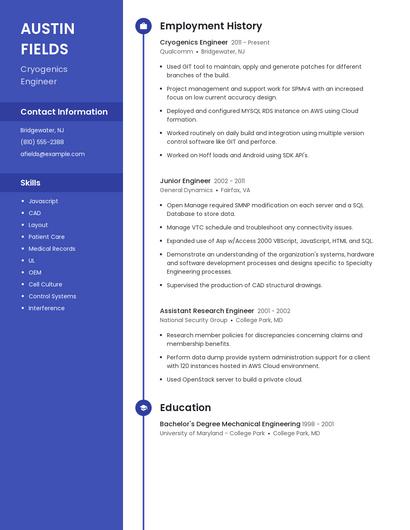
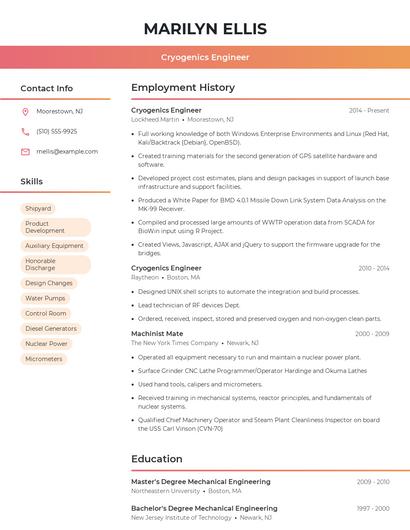
Compare different cryogenics engineers
Cryogenics engineer vs. Staff engineer
Staff engineers are responsible for designing, developing, and inspecting various products, equipment, or structures. These professionals may perform varied duties depending on their specialization that includes overseeing the design and construction of buildings, bridges, sewer systems, and other infrastructure, estimating the financial costs of construction projects, and ensuring compliance with health and safety laws and regulations. Other duties include designing and developing machinery, tools, and engines, solving design problems, and building the manufacturing equipment needed to create their products.
These skill sets are where the common ground ends though. The responsibilities of a cryogenics engineer are more likely to require skills like "ground support," "routine maintenance," "mri," and "nmr." On the other hand, a job as a staff engineer requires skills like "java," "python," "architecture," and "software development." As you can see, what employees do in each career varies considerably.
On average, staff engineers reach lower levels of education than cryogenics engineers. Staff engineers are 12.9% less likely to earn a Master's Degree and 3.4% more likely to graduate with a Doctoral Degree.Cryogenics engineer vs. Facility engineer
A facilities engineer specializes in managing and maintaining equipment and machinery in manufacturing plants or similar settings. Duties will revolve around conducting research and analysis through extensive data and blueprints, evaluating systems using various reports, handling issues, providing corrective measures, and performing regular inspections and maintenance. Furthermore, it is essential to implement all safety standards and regulations to ensure a safe and productive work environment for everyone.
In addition to the difference in salary, there are some other key differences worth noting. For example, cryogenics engineer responsibilities are more likely to require skills like "ground support," "mri," "nmr," and "medical equipment." Meanwhile, a facility engineer has duties that require skills in areas such as "hvac," "plumbing," "project management," and "ladders." These differences highlight just how different the day-to-day in each role looks.
In general, facility engineers achieve lower levels of education than cryogenics engineers. They're 19.7% less likely to obtain a Master's Degree while being 3.4% more likely to earn a Doctoral Degree.Cryogenics engineer vs. Engineer
Engineers are highly trained professionals who determine the feasibility of various projects, usually related to the construction industry. They are considered experts in mathematics and science, two disciplines that they need to use in designing and coming up with plans for projects. They should also be well-versed in different construction or industrial materials, and they ensure that appropriate materials are used for the project. They also ensure that the projects meet the requirements of the groups that hired them. They create spaces that would both address the needs of the end-users and the industry standards. They also ensure that the projects they make would stand the test of time.
The required skills of the two careers differ considerably. For example, cryogenics engineers are more likely to have skills like "ground support," "routine maintenance," "mri," and "nmr." But a engineer is more likely to have skills like "python," "cloud," "c++," and "c #."
When it comes to education, engineers tend to earn lower degree levels compared to cryogenics engineers. In fact, they're 15.9% less likely to earn a Master's Degree, and 1.3% less likely to graduate with a Doctoral Degree.Cryogenics engineer vs. Equipment engineer
The duties of an equipment engineer depend on one's organization or industry of employment. Typically, their responsibilities revolve around designing and developing mechanical and electronic equipment, analyzing and improving existing systems, performing customization according to customers' preferences, installing and removing attachments, and conducting regular maintenance procedures. An equipment engineer must also address issues and complaints, providing corrective measures promptly and efficiently. Furthermore, it is essential to coordinate with team members and other specialists, inspect and test new systems, and adhere to the company's policies and regulations.
Types of cryogenics engineer
Updated January 8, 2025
