
Automatically apply for jobs with Zippia
Upload your resume to get started.
Data and reporting analyst skills for your resume and career
15 data and reporting analyst skills for your resume and career
1. Power Bi
- Created multiple data visualization solution for initial Power BI business preview.
- Developed Reporting solutions using Power BI.
2. Data Analysis
- Write business requirements for marketing group; perform statistical data analysis and reporting on consumer internet usage.
- Performed light data analysis to determine the effectiveness of marketing campaigns and business operations.
3. Dashboards
The dashboard is a data management tool used for business intelligence. Dashboards, store, organize and display the scattered data in one system providing easy access to information whenever required. The data is displayed using advanced data visualization techniques, allowing users to understand the intricate patterns in their data. Dashboards make it easier to draw parallels between different data metrics and help in the identification of data trends.
- Developed interactive dashboards from static templates and proved the Tableau visualization abilities.
- Created dashboards by extracting data from different sources using parameters and calculations.
4. Visualization
- Convey information through interactive dashboards and visualization by effectively utilizing agile methodology to collect, analyze, and synthesize data.
- Provided end to end management of multiple projects from conceptualization and visualization to technology mapping and final execution of projects.
5. BI
- Collaborate with business analysts, database and BI developers in performing various data focused activities.
- Utilized technologies, processes, and applications to analyze internal structured data to conduct Business Intelligence (BI) Analysis.
6. Data Collection
Data collection means to analyze and collect all the necessary information. It helps in carrying out research and in storing important and necessary information. The most important goal of data collection is to gather the information that is rich and accurate for statistical analysis.
- Research and determine the appropriate data-sources and methodology for data collection and interpretation.
- Performed research, tracking, data collection, spreadsheets and database creation to assess and provide recommendations for improved reporting capabilities.
Choose from 10+ customizable data and reporting analyst resume templates
Build a professional data and reporting analyst resume in minutes. Our AI resume writing assistant will guide you through every step of the process, and you can choose from 10+ resume templates to create your data and reporting analyst resume.7. SQL Server
- Redesigned, coded, scheduled reports with use of SSMS, SSRS, querying, stored procedures and SQL Server Agent.
- Developed, enhanced, performance improvement, validation, and test of SQL Server SSRS reports for financial Client.
8. SAS
SAS stands for Statistical Analysis System which is a Statistical Software designed by SAS institute. This software enables users to perform advanced analytics and queries related to data analytics and predictive analysis. It can retrieve data from different sources and perform statistical analysis on it.
- Worked extensively with SAS Macros and Transact-SQL Queries for generating Clinical Indicators quarterly reports.
- Designed analysis methodology, conducted correlation analysis in SAS and Excel.
9. Data Quality
- Performed cross-functional coordination for process execution and coordinated with multiple vendors to ensure accurate data quality and transfers.
- Implemented a data quality initiative to ensure quality and accuracy of proprietary exposure data.
10. Analyze Data
Analyze data or data analysis refers to the practice of studying, organizing, and transforming data to make it more useful. It also includes the cleansing of non-useful information which helps in better decision making regarding any particular matter. Analyze data is a practice that is used widely in the field of business, social sciences, and science.
- Analyze data to understand business impact, correlations/discrepancies, and to propose changes/alternate solutions.
- Analyze data and reporting solutions to understand business impact, correlations or discrepancies.
11. Pivot Tables
A pivot table is a technique used in data processing to arrange and rearrange statistics to prioritize useful information. The aim of a pivot table is to summarize the findings and interpretations of the data extracted. Pivot tables take information from a database or spreadsheet to report sums, average, and other such statistics. This technique is integral to data analysis since it turns the data to view it from different lenses and perspectives.
- Create tables, queries, forms and reports in MS Access and use of pivot tables in MS Excel environments.
- Provided accounting systems support: Excel: pivot tables, macros, functions, MS Access, PowerPoint.
12. Strong Analytical
- Leveraged strong analytical skills to evaluate relationships between customers and their usage/financing habits to identify and record trends or correlations.
- Demonstrated strong analytical skills in identifying and resolving data exchange issues.
13. Macro
- Design, create and program custom macros and Visual Basic for Applications solutions to help meet the business needs.
- Helped develop macros in Excel to find pricing discrepancies among securities skewing performance.
14. HR
HR stands for human resources and is used to describe the set of people who work for a company or an organization. HR responsibilities revolve around updating employee records and carrying out management processes like planning, recruitment, evaluation, and selection processes. HR is a key contributor to any company or organization's growth as they are in charge of hiring the right employees, processing payrolls, conducting disciplinary actions, etc.
- Developed and implemented custom Crystal reports resulting in a dynamic and useful report library for HR and payroll system users Nationwide.
- Served as liaison with Legal Counsel (internal as well as external) to create HR Data litigation reports.
15. ETL
- Assist in design, develop, implement, execute, maintain ETL process for Enterprise Data Warehouse and Data Marts.
- Developed and deployed ETL, analysis, and reporting tools in Python, Go, and JS.
5 Data And Reporting Analyst resume examples
Build a professional data and reporting analyst resume in minutes. Browse through our resume examples to identify the best way to word your resume. Then choose from 5+ resume templates to create your data and reporting analyst resume.

What skills help Data And Reporting Analysts find jobs?
Tell us what job you are looking for, we’ll show you what skills employers want.
What skills stand out on data and reporting analyst resumes?
Hanna Kim Ph.D.
Associate Professor, Chair, Adelphi University
I say "try to" as the reality is that having faculty in all 4 subfields is not possible for many reasons. (The 4 subfields are cultural anthropology, archeology, biological anthropology (sometimes physical anthropology), and anthropological linguistics. These subfields are mirrored in graduate school where students going for PhDs will be focused on 1 subfield.)
For undergraduates with an anthropology degree seeking employment, I can speak only from the faculty side, not the employer side. My students report these factors as relevant to their being hired (and accepted into competitive schools in museum studies, social work, law school, etc.:
Analytical skills; clear writing; ability to synthesize large amounts of reading and data into well-supported arguments and interpretations; open-mindedness toward different identities and ways of being.
A hugely important skill that anthropology graduates have is the ability to be presented with a complex situation or problem, and to be able to chart a plan on how to approach the problem, gather data and other necessary information to solve the problem, and then to come up with a solution or possible strategies. Too often, particularly in situations involving human behavior, what is needed is a stronger grasp of social and cultural factors that could impede the desired outcome. Students of anthropology know that ways of doing things, and even seeing and thinking, are profoundly influenced by categories of thought that are culturally situated. This means that problem solving has to consider a network of variables that have an impact on behavior. Anthropology students, I would argue, would embrace this complexity rather than be hesitant to acknowledge it in favor of a more expedient and, in the long run, less successful solution.
What soft skills should all data and reporting analysts possess?
Hanna Kim Ph.D.
Associate Professor, Chair, Adelphi University
What hard/technical skills are most important for data and reporting analysts?
Hanna Kim Ph.D.
Associate Professor, Chair, Adelphi University
What data and reporting analyst skills would you recommend for someone trying to advance their career?
A.J. Arreguin
Professor, Our Lady of the Lake University
Students should volunteer with small/local businesses or create their brand (start a blog or become a niche social media influencer) to practice and build on their experience. Once the student/graduate does that, they should keep a weekly log with analytics to help them understand how to improve moving forward. This will be beneficial when applying for a communication/public relations job during an interview. The degree gets the student/graduate the talk, but the experience lands them the job.
What type of skills will young data and reporting analysts need?
Zhixin Wu Ph.D.
Associate Professor, DePauw University
List of data and reporting analyst skills to add to your resume
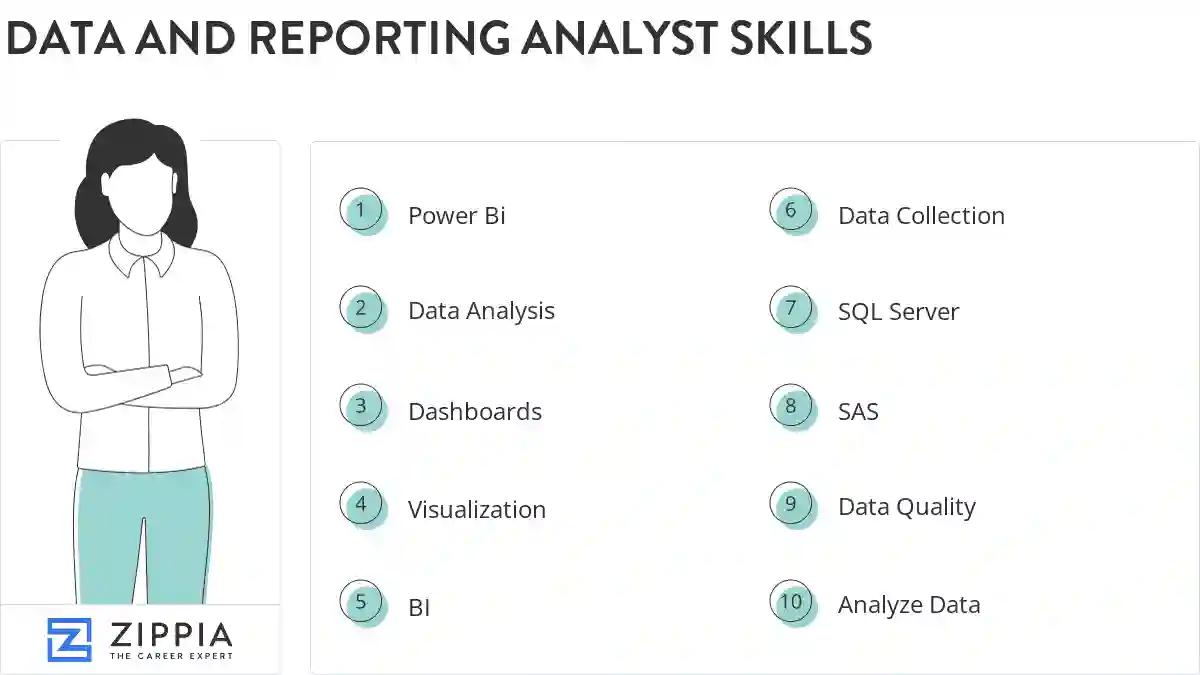
The most important skills for a data and reporting analyst resume and required skills for a data and reporting analyst to have include:
- Power Bi
- Data Analysis
- Dashboards
- Visualization
- BI
- Data Collection
- SQL Server
- SAS
- Data Quality
- Analyze Data
- Pivot Tables
- Strong Analytical
- Macro
- HR
- ETL
- SSRS
- VBA
- Data Integrity
- Data Warehouse
- Business Decisions
- Cognos
- Salesforce
- Ssis
- CRM
- KPIs
- Extraction
- SharePoint
- Data Validation
- QA
- Ad-Hoc Reports
- Data Warehousing
- PL/SQL
- Business Processes
- T-SQL
- Report Development
- Data Extraction
- Access Database
- Financial Data
- Data Entry
- Business Rules
- Financial Reports
- Technical Support
- SSAS
- Brainstorming
- Windows
- Teradata
- Java
- ERP
- Shared Services
- Oracle Sql
Updated January 8, 2025
