What does a data security analyst do?
A data security analyst's job is to protect computer systems and networks in a company. They are often the solitary individuals standing between a company's networks and potential hackers, and their abilities are highly in demand at this moment. The job role includes installing and uninstalling various security network programs, and these programs safeguard sensitive data by using firewalls with the use of data-encryption technology. In addition, they also help to implement security protocols depending on the need of the company, and they must be updated regularly to remove bugs and add new features.
Data security analyst responsibilities
Here are examples of responsibilities from real data security analyst resumes:
- Provide support for manage IP security services customers in a 24x7 UNIX operations center.
- Manage quality control team of senior auditors, budgets, HIPAA compliance reports to CMS, monthly audit tracking/reporting.
- Provide architecture and design guidance in network segmentation and isolation of PCI data and equipment in order to achieve PCI compliance.
- Manage centralized and decentralize correlation servers for intrusion detection and log monitoring.
- Log analysis & managing the accuracy of DLP identification to lowering/avoiding false positives and negatives.
- Conduct system testing and implementation of the mainframe encryption.
- Develop and submit programs that extract data from SQL to reports and resolve security issues as needed.
- Install PC hardware, printers and devices.
- Review and archive security logs using McAfee SIEM.
- Evaluate and trouble shoot PC software and hardware.
- Publish online standards and procedures for UNIX account creations.
- Influence Symantec decision from McAfee due to cost and support.
- Create PowerPoint slides for training, emergency planning, and briefings.
- Implement patches through SQL scripts base on requirement changes or bug resolutions.
- Perform daily security administration tasks on VM, UNIX and MVS platforms.
Data security analyst skills and personality traits
We calculated that 10% of Data Security Analysts are proficient in Data Security, Incident Response, and Access Management. They’re also known for soft skills such as Problem-solving skills, Detail oriented, and Analytical skills.
We break down the percentage of Data Security Analysts that have these skills listed on their resume here:
- Data Security, 10%
Maintained and documented internal data security controls consistent with audit requirements, including policies, procedures, and individual access authorizations.
- Incident Response, 8%
Participated in incident response, disaster recovery annual event and planning.
- Access Management, 6%
Serve as an administrator to the gateway utility tool for all account and access management requests for the company.
- Encryption, 5%
Managed encryption software administration and support utilizing SafeGuard management center.
- SQL, 5%
Implemented patches through SQL scripts based on requirement changes or bug resolutions.
- Security Procedures, 4%
Documented security procedures/policies and practices and made recommendations for improvements.
Most data security analysts use their skills in "data security," "incident response," and "access management" to do their jobs. You can find more detail on essential data security analyst responsibilities here:
Problem-solving skills. To carry out their duties, the most important skill for a data security analyst to have is problem-solving skills. Their role and responsibilities require that "information security analysts must respond to security alerts and uncover and fix flaws in computer systems and networks." Data security analysts often use problem-solving skills in their day-to-day job, as shown by this real resume: "delivered various risk assessments and issues reports to ensure corrective solutions and improvement plans are derived. "
Detail oriented. Another soft skill that's essential for fulfilling data security analyst duties is detail oriented. The role rewards competence in this skill because "because cyberattacks can be difficult to detect, information security analysts must pay careful attention to computer systems and watch for minor changes in performance." According to a data security analyst resume, here's how data security analysts can utilize detail oriented in their job responsibilities: "maintain and implement detailed architecture, standards, and data security strategies for each assigned project. "
Analytical skills. Another skill that relates to the job responsibilities of data security analysts is analytical skills. This skill is critical to many everyday data security analyst duties, as "information security analysts must carefully study computer systems and networks and assess risks to determine how security policies and protocols can be improved." This example from a resume shows how this skill is used: "completed information security risk assessments and analysis for all systems and applications of the company. "
The three companies that hire the most data security analysts are:
- Gartner22 data security analysts jobs
- Robert Half5 data security analysts jobs
- Ruby Receptionists
5 data security analysts jobs
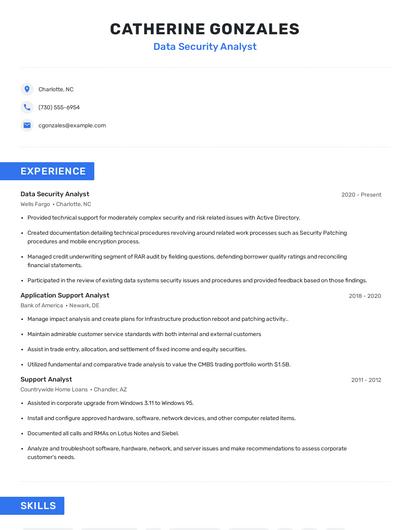
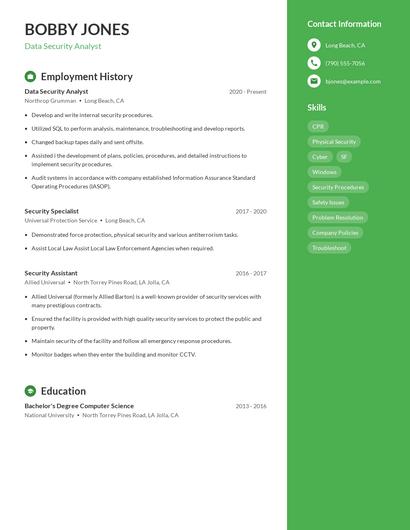
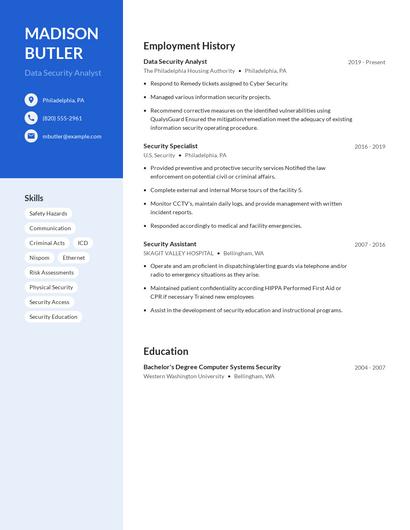
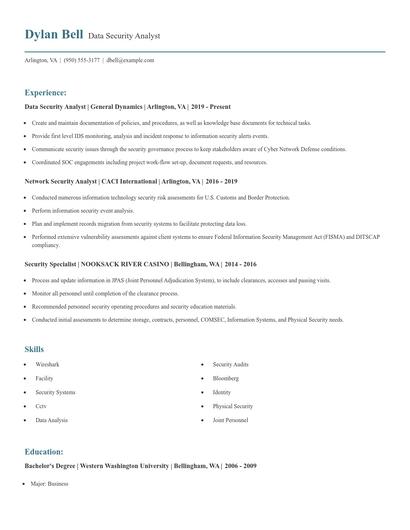
Choose from 10+ customizable data security analyst resume templates
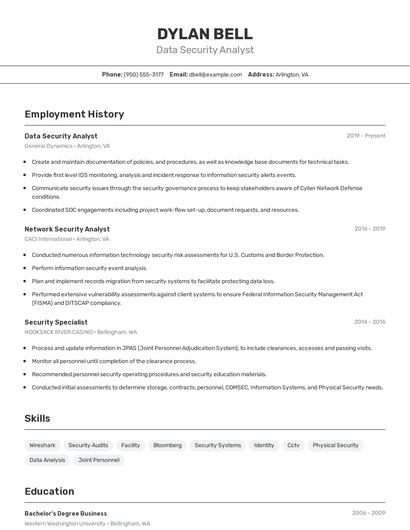
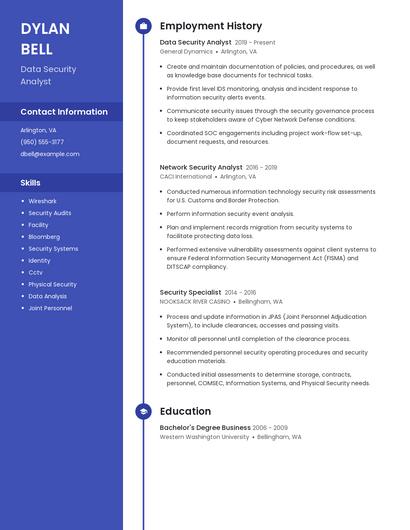
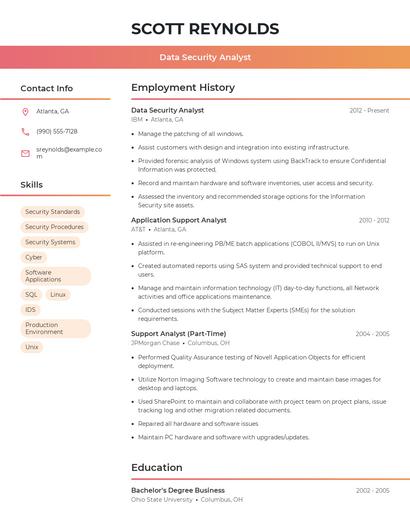
Build a professional data security analyst resume in minutes. Our AI resume writing assistant will guide you through every step of the process, and you can choose from 10+ resume templates to create your data security analyst resume.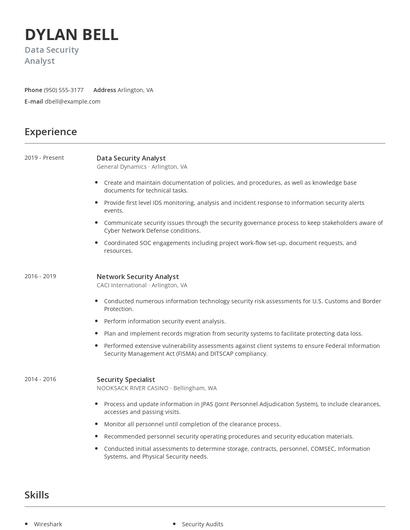
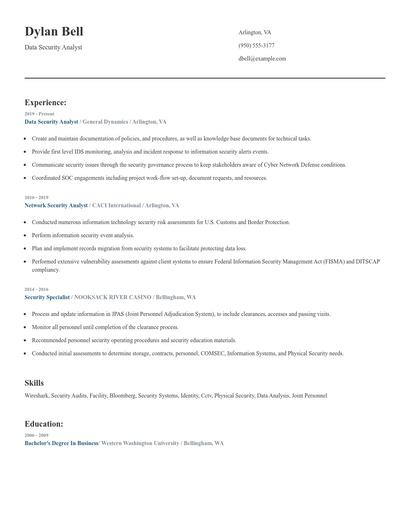
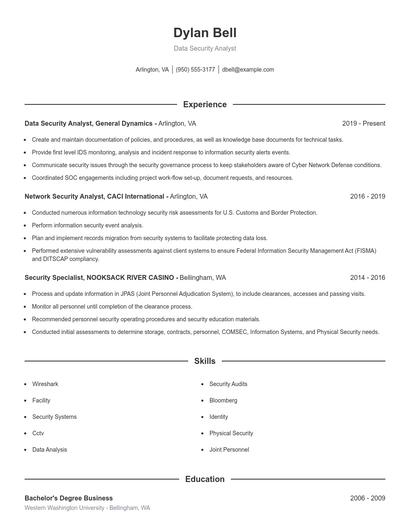
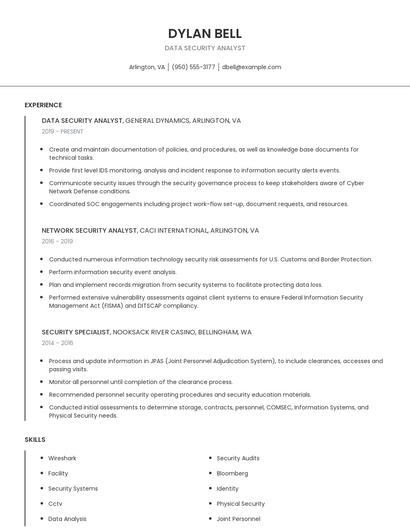
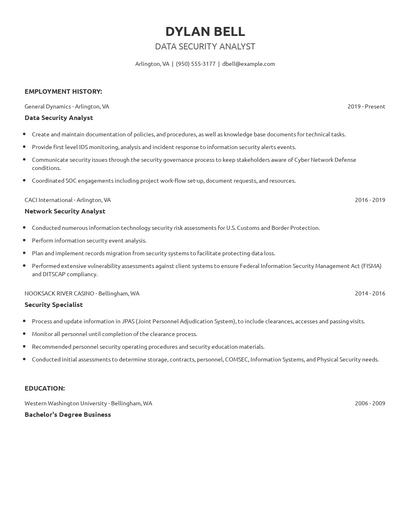
Compare different data security analysts
Data security analyst vs. Information assurance engineer
Information assurance engineers are responsible for protecting an organization's data. They act as a team of security specialists that use their skill in securely operating and keeping data to protect the organization's most essential asset. Their main role is to guarantee the quality, security, and retrievability of the organization's information. Also, they outline security systems that make certain the integrity, confidentiality, and accessibility of data. Additionally, they secure IT infrastructure, maintain hardware and software updated, establish security standards, and monitor threats like breaches.
There are some key differences in the responsibilities of each position. For example, data security analyst responsibilities require skills like "data security," "access management," "sql," and "security procedures." Meanwhile a typical information assurance engineer has skills in areas such as "rmf," "iam," "windows," and "acas." This difference in skills reveals the differences in what each career does.
Information assurance engineers tend to make the most money working in the professional industry, where they earn an average salary of $97,153. In contrast, data security analysts make the biggest average salary, $123,800, in the start-up industry.On average, information assurance engineers reach similar levels of education than data security analysts. Information assurance engineers are 4.1% more likely to earn a Master's Degree and 0.3% more likely to graduate with a Doctoral Degree.Data security analyst vs. Information systems security officer
An information systems security officer's role is to perform preventive measures to protect a company's data and systems from hackers or cyber-attacks. Their responsibilities revolve around assessing the existing security measures to identify any vulnerabilities or inconsistencies, recommending and implementing changes to improve security systems, and developing new strategies and programs for data protection. There are also instances when an information systems security officer must manage and maintain information in databases, train new employees, and create new security policies, all while adhering to the company's vision and mission.
Each career also uses different skills, according to real data security analyst resumes. While data security analyst responsibilities can utilize skills like "data security," "access management," "sql," and "security procedures," information systems security officers use skills like "rmf," "isso," "windows," and "security posture."
Information systems security officers earn a higher average salary than data security analysts. But information systems security officers earn the highest pay in the professional industry, with an average salary of $89,615. Additionally, data security analysts earn the highest salaries in the start-up with average pay of $123,800 annually.Average education levels between the two professions vary. Information systems security officers tend to reach similar levels of education than data security analysts. In fact, they're 1.1% more likely to graduate with a Master's Degree and 0.3% more likely to earn a Doctoral Degree.What technology do you think will become more important and prevalent for data security analysts in the next 3-5 years?
Erik Johnson Ph.D.
Assistant Professor of Economics, Carthage College
Data security analyst vs. Senior security engineer
A senior security engineer is responsible for maintaining the safety and security of the organization's systems and network database to prevent unauthorized access and avoid data breaches. Senior security engineers inspect the efficiency of networks, perform system configuration, and increase the optimal performance of complex systems. They also implement policies and procedures for compliance with the proper utilization of information directories. They also conduct regular maintenance of networks, create update reports, and resolve glitches and security threats.
Some important key differences between the two careers include a few of the skills necessary to fulfill the responsibilities of each. Some examples from data security analyst resumes include skills like "data security," "access management," "security procedures," and "security systems," whereas a senior security engineer is more likely to list skills in "cloud security," "windows," "security engineering," and "security solutions. "
Senior security engineers make a very good living in the manufacturing industry with an average annual salary of $126,467. On the other hand, data security analysts are paid the highest salary in the start-up industry, with average annual pay of $123,800.When it comes to education, senior security engineers tend to earn higher degree levels compared to data security analysts. In fact, they're 5.1% more likely to earn a Master's Degree, and 0.5% more likely to graduate with a Doctoral Degree.Data security analyst vs. Information security officer
Information security officers are responsible for planning and implementing policies to safeguard an organization's computer network and data from different types of security breaches. Their duties typically include identifying computer network vulnerabilities, developing and executing a plan to secure and protect the network, and tracking computer network usage to ensure adherence to security policies. In addition, information security officers are also expected to conduct penetration tests to look for flaws and work closely with the IT and management departments to improve security.
Types of data security analyst
Updated January 8, 2025
