
Automatically apply for jobs with Zippia
Upload your resume to get started.
Dimensional integration engineer skills for your resume and career
15 dimensional integration engineer skills for your resume and career
1. Data Analysis
- Performed CMM data analysis to identify root cause and resolved build issues.
- Performed root cause and data analysis.
2. Dimensional Issues
- Document case studies of real time dimensional issues for future reference.
- Support plant in root causing dimensional issues at various stages such as proto and pilot.
3. CAD
- Gained proficiency in CAD, design control, Chemical compatibility, Geometric dimensions and tolerance, Statistical analysis.
- Utilized SolidEdge for generating CAD data, and extensively operated in TeamCenter and SAP for documentation and data management.
4. CATIA
- Create GD&T drawings for vehicle components used in the assembly of hybrid cars using ASME Y14.5-2009 and CATIA V5.
- Created Catia V5 v18 2D GD&T Drawings for all assembly and components.
5. Dimensional Analysis
- Support and perform dimensional analysis of various Chrysler and Jeep Engine Platforms.
6. Lean Manufacturing
- Involved in supplier and customer related issues resolve quality issues, implemented lean manufacturing.
- Worked in developing Lean Manufacturing techniques for process improvements beginning with material and processes to overhauling floor layout and equipment upgrades.
7. R
R is a free software environment and a language used by programmers for statistical computing. The R programming language is famously used for data analysis by data scientists.
- Batch data processing and statistic analysis with R script programming, such as Gage R&R and t-test.
- Collected weather data and analyzed in the R language to estimate the power available daily.
8. Assembly Plant
- Performed onsite evaluations of key assembly processes at the Valmet assembly plant for build issue resolution.
- Supported launch from manufacturing validation through start of production at Wilmington vehicle assembly plant.
9. SPC
SPC stands for "statistical process control," a method that uses statistical tools and charts to analyze a process or procedure over time. This could reveal an error in production or an internal system by highlighting data points outside the expected results. These anomalies, likely caused by outside sources, can then be studied and remedied.
- Utilize high-end computer software systems for Statistical Process Control (SPC).
- Supervised toolmakers and SPC technicians.
10. BIW
- Managed and supervised of BIW, Closures, Doors and Hardware lay out, exterior and interior component.
11. Design Changes
- Developed and implemented design changes in seat adjustment mechanisms to greatly improve occupant safety in automotive crash testing.
- Traveled throughout the world training and investigating operator interaction and recommended design changes to further improve machine design.
12. Quality Issues
- Provide guidance in applying systematic problem-solving methodologies to identify, prioritize, communicate, and resolve supplier quality issues.
- Resolved supplier quality issues by using root cause analysis and 8-D quality management Philosophy.
13. T Drawings
- Developed work instruction and training modules for creation of GD&T drawings.
- Managed GD&T drawings for exteriors on the ND05, DR05, DR06/DH programs
14. Measurement Points
- Assist other engineering departments in determining tolerances, datums & measurement points for vehicle parts and assemblies.
15. PPAP
- Participated in cross functional team for PPAP documentation review and final customer approval.
- Conduct engineering reviews and buy-off meetings to support the PPAP process across all program suppliers.

What skills help Dimensional Integration Engineers find jobs?
Tell us what job you are looking for, we’ll show you what skills employers want.
List of dimensional integration engineer skills to add to your resume
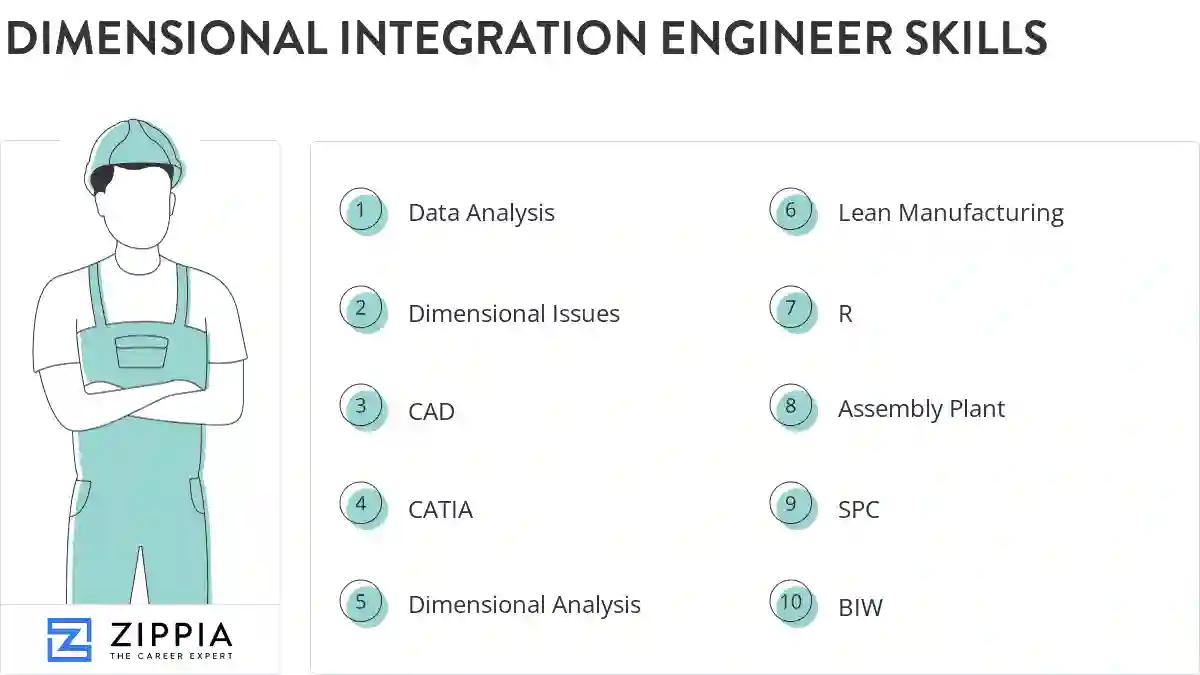
The most important skills for a dimensional integration engineer resume and required skills for a dimensional integration engineer to have include:
- Data Analysis
- Dimensional Issues
- CAD
- CATIA
- Dimensional Analysis
- Lean Manufacturing
- R
- Assembly Plant
- SPC
- BIW
- Design Changes
- Quality Issues
- T Drawings
- Measurement Points
- PPAP
- Analysis Tools
- Design Reviews
- Assembly Line
- CMM
- Chrysler
- Dimensional Variation
Updated January 8, 2025
