
Automatically apply for jobs with Zippia
Upload your resume to get started.
Direct service professional skills for your resume and career
15 direct service professional skills for your resume and career
1. Direct Care
Direct care is the act of identifying people with special needs and offering the necessary care for them.
- Direct Care Professional- Facilitated games and other activities to engage individuals.
- Provide direct care and supervision of clients with developmental disabilities.
2. CPR
Cardiopulmonary resuscitation or CPR is a medical procedure that involves chest compression to help a patient breathe. This artificial ventilation helps in keeping the brain function in place and regulates blood throughout the body. CPR is a lifesaving procedure that is used in emergencies.
- Certified Abuse And Neglect, CPR Certified, Medication Certified, Certified Daniel's Law.
- Obtained my training in Oregon Intervention System, CPR, First Aid, Medication Administration and Therap computer program.
3. Mental Health
Mental health is the state of wellbeing in which an individual can cope with the regular stresses and tensions of life, and can work productively without having any emotional or psychological breakdown. Mental health is essential for a person of any age and helps them make the right decisions in their life.
- Provided training and assistance to clients with intellectual disabilities, mental health issues and social adjustment difficulties.
- Certified in all Missouri Department of Mental Health criterion, including expansive knowledge of HIPAA procedures.
4. Development Disabilities
- Developed monthly club topics for advocacy, relationship, and volunteer for adults with development disabilities.
- Work in Mora and Cambridge group homes for individuals with development disabilities.
5. Direct Support
Direct support is a one-on-one service that helps with daily life skills and tasks that strengthen one's independence. A direct support professional is responsible for a variety of tasks related to the general care of people with physical, cognitive, or developmental disabilities. The goal is to assist people to reach their full potential and to integrate and get engaged in their community.
- Direct Support Professionals teach important life skills and encourage the people they support to be as independent as possible.
- Direct Support- working with children and adults with developmental disabilities in their home.
6. DSP
Digital signal processing, DSP, is the use of digital processing to perform a variety of signal processing operations, primarily audio signals. It is about developing algorithms that can improve a signal in a certain way or extract useful information. It is mainly found in audio signals, voice processing, RADAR, seismology, audio, SONAR, voice recognition, and some financial signals.
- Certified Direct Service Professional (DSP) issued through the Illinois Department of Human Services.
- United States While working as a DSP I provided individuals with emotion and social support.
Choose from 10+ customizable direct service professional resume templates
Build a professional direct service professional resume in minutes. Our AI resume writing assistant will guide you through every step of the process, and you can choose from 10+ resume templates to create your direct service professional resume.7. Money Management
- Guided individuals with money management and weekly budgeting.
- Assisted individuals with daily activities and assist them with money management and self- help skills.
8. Hippa
HIPAA, which stands for Health Insurance Portability and Accountability Act, is a United States federal statue created, enacted, and turned to law in 1996, which whose primary purposes were to modernise the healthcare systems in the United States, secure and generally enhance the management of that personal information of patients that was in the hands of healthcare facilities, such as hospitals and insurance companies, and to enable the providing of healthcare and insurance to more people.
- Assisted service recipients in daily living needs, compliant with HIPPA guidelines, completed documentation and records while maintained filing systems.
- Maintain confidentiality of all individuals in compliance with HIPPA Law.
9. Meal Preparation
- Assist in daily activities such as medical administration, community programs, exercise, meal preparation, and weekly health maintenance.
- Coordinate, organize and/or assist with household activities such as light housekeeping and meal preparation.
10. Crisis Intervention
- Provided crisis intervention and behavioral guidance to individuals with intellectual and developmental disabilities within an independent living setting.
- Utilized crisis intervention under various circumstances.
11. Role Model
A role model is a person with desirable qualities who inspires other people to emulate their example.
- Serve as a role model of appropriate socialization, interaction, and communication skills.
- Assisted residents with day-to-day activities and acted as a role model for positive interpersonal relationship with others.
12. Mental Illness
- Provide exceptional service to individual with mental illness and disabilities.
- Provided services to clientele (25) with diverse issues including intellectual, developmental and physical disabilities, and mental illness.
13. Intellectual Disabilities
- Provided service for residence with intellectual disabilities with everyday living assistance.
- Implemented home and community goals while supporting Individuals with Intellectual Disabilities.
14. Administer Medications
- Administer medications ensuring directed dosage is followed exactly.
- Assist with activities of daily living-Provide transportation to clients-Scheduling appointments for clients-Preparing/serving meals-Administer medications and observe responses and changes
15. Community Integration
Community integration pertains to the different procedures that help patients integrate and become well-functioning members of a community.
- Facilitated socialization and community integration to encourage a more meaningful day, life.
- Encouraged consumers to access and use community resources to promote community integration.
5 Direct Service Professional resume examples
Build a professional direct service professional resume in minutes. Browse through our resume examples to identify the best way to word your resume. Then choose from 5+ resume templates to create your direct service professional resume.

What skills help Direct Service Professionals find jobs?
Tell us what job you are looking for, we’ll show you what skills employers want.
List of direct service professional skills to add to your resume
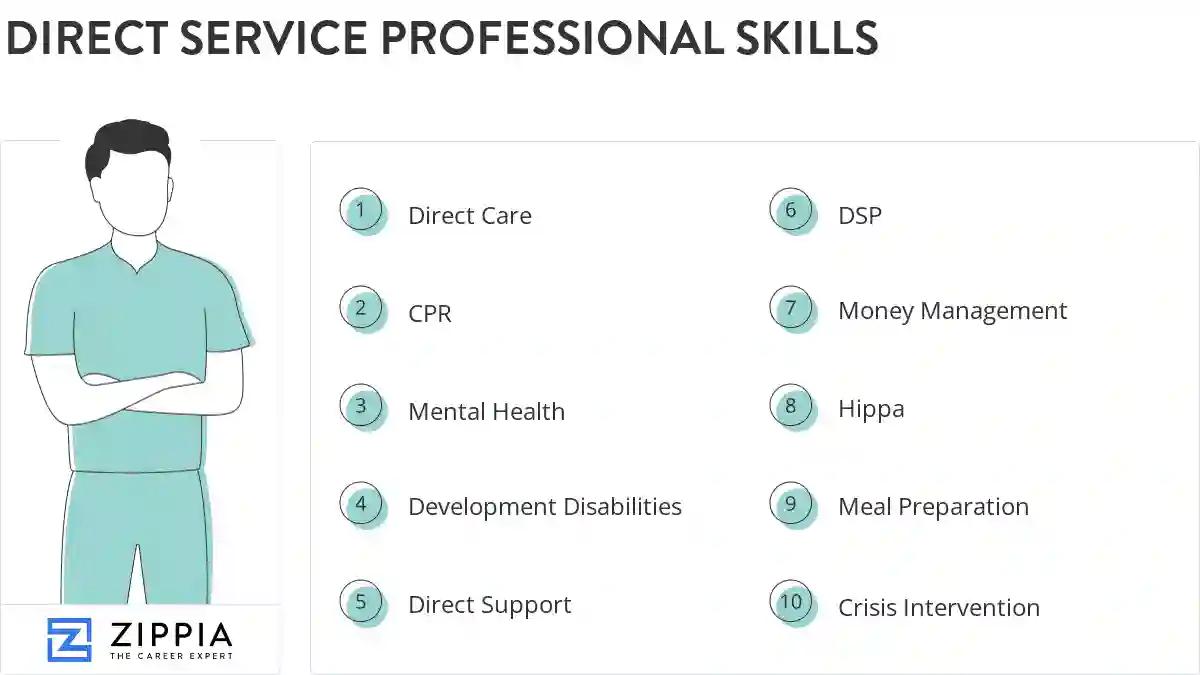
The most important skills for a direct service professional resume and required skills for a direct service professional to have include:
- Direct Care
- CPR
- Mental Health
- Development Disabilities
- Direct Support
- DSP
- Money Management
- Hippa
- Meal Preparation
- Crisis Intervention
- Role Model
- Mental Illness
- Intellectual Disabilities
- Administer Medications
- Community Integration
- Service Plan
- Independent Living
- ISP
- Community Outings
- Medical Appointments
- Physical Disabilities
- Medication Management
- ADL
- Applied Behavior Analysis
- Vital Signs
- Community Inclusion
- Patient Care
- Mental Disabilities
- HIPAA
- Behavior Management
- Community Involvement
- Food Preparation
- Quality Care
- SCIP
- Emotional Support
- Behavioral Issues
- CPI
- AMAP
- Doctor Appointments
- Social Interaction
- Support Individuals
- Social Events
- Groceries
- Learning Disabilities
Updated January 8, 2025
