
Automatically apply for jobs with Zippia
Upload your resume to get started.
Director of interiors skills for your resume and career
12 director of interiors skills for your resume and career
1. Business Development
Business development is the ideas or initiatives that work to make business work better. Selling, advertising, product development, supply chain management, and vendor management are only a few of the divisions involved with it. There is still a lot of networking, negotiating, forming alliances, and trying to save money. The goals set for business development guide and coordinate with all of these various operations and sectors.
- Experienced estimator, project manager, division leader and Business Development professional.
- Performed sales forecasting and strategic planning to ensure the sale and corporate profitability while analyzing business developments and monitoring market trends.
2. Design Development
Design development is used to refer to a number of positions and skills in a number of different industries. In the architectural world, Design Development is used to refer to an architectural plan that is already halfway or more done but needs further development, alteration, and testing. In the automotive industry, it refers to the skills necessary to create and develop new car, engine, and other designs, as well as to ensure that all designs are safe and effective.
- Interfaced with project teams on design development and presentation to clients.
- Design Development Followed through design development drawings and collaborated with the production staff for technical details and completion of construction drawings.
3. Leed
LEED is basically the acronym for Leadership in Energy and Environmental Design. It is a certification program that approves the standards of buildings that are ecology-oriented. This includes the maintenance, building, and even the working of the ecological infrastructure.
- Participated on LEED certified projects.
- Committed to maintaining client's sustainable initiatives and LEED objectives.
4. FF
FF stands for "finish-to-finish," which refers to a management process in many business. This indicates that one step a process--whether a production line or data analysis--must be finished before the next step can begin. This form of project management isn't found in many business models, however it may be necessary for certain fields such as computer programming.
- Specified FF & E and coordinated furniture installations.
5. Design Services
- Coordinated workload plans to provide interior design services to architectural
- Managed construction activities for the company by providing general contracting, construction management and design services.
6. Design Concepts
- Conducted renovation of facilities with new design concepts
- Created award-winning published designs for work that excelled in cohesive interior and exterior design and innovative design concepts.
7. Construction Administration
- Provided extensive construction administration on commercial projects.
- Developed proposal presentations, bidding procurement, site selection, construction administration, schematic design, design development and production.
8. OEM
OEM stands for Original Equipment Manufacturer and is a term for a company that produces and markets the parts of equipment for another company after having received the go-ahead to do so. The company can also produce devices from the combination of parts from different companies while in partnership with these companies. This is common in the computer hardware industry and is popular in the automobile and computer industries.
- Developed pull through strategies where End Users would ask OEM's to use our products in their tools.
- Directed technical alliance management for OEM partners (Oracle, SAP, etc.)
9. Healthcare
Healthcare is the maintenance or improvement of a person's health by the diagnosis and treatment of a person's injury, illness, or any other disease. Healthcare is a basic necessity of human life and is the responsibility of the country's government to ensure that each person gets healthcare. Providing healthcare is the job of certified health professionals that includes doctors, surgeons, nurses, and other physicians. Pharmaceutical companies, hospitals, dentistry, therapy, and health training all come under healthcare. Healthcare plays a vital role in the country's economy and its development.
- Market focuses include: Healthcare, Hospitality, Workplace, Retail and Education.
- Design Focus in Healthcare and Corporate * Participates in marketing and important milestone client presentations.
10. Interior Trim
- Manufactured interior trim components and seats for trucks, buses, and construction vehicles.
11. Space Planning
Space Planning is one of the most important elements of interior decorating. The interior designer takes the space available within a building, an apartment, a house, or another type of structure which is being renovated or otherwise altered, and then they begin to play around with the space, creating visions and revisions of the space on paper or in a specialised design program, according to the necessities of the project and clients at hand.
- Directed space planning, design, and CADD production.
- Designed space planning and assisted clients in lease negotiations.
12. Project Budget
A project budget is a tool used by project heads and project managers to estimate the total cost of a project. It can be defined as the financial and personnel disposal limits that are needed to be imposed before the execution of the project.
- Developed project budgets for furniture, finishes, and construction to meet client needs.
- Manage and prepare all decorative/project budgets.

What skills help Directors Of Interiors find jobs?
Tell us what job you are looking for, we’ll show you what skills employers want.
List of director of interiors skills to add to your resume
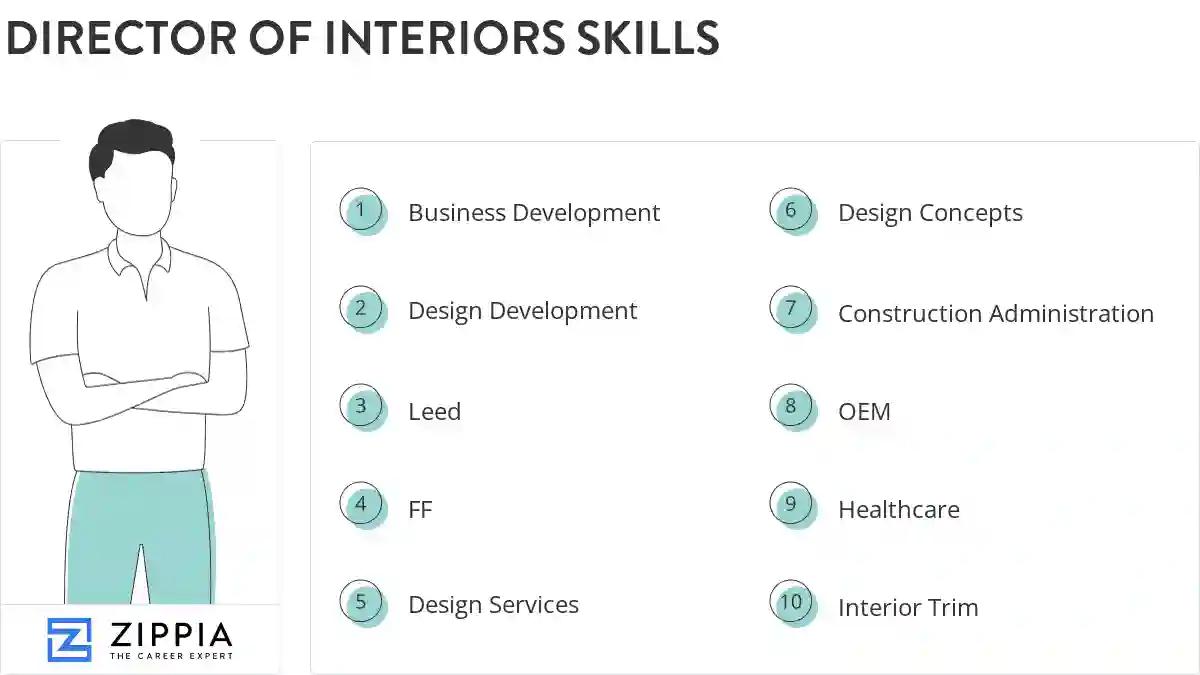
The most important skills for a director of interiors resume and required skills for a director of interiors to have include:
- Business Development
- Design Development
- Leed
- FF
- Design Services
- Design Concepts
- Construction Administration
- OEM
- Healthcare
- Interior Trim
- Space Planning
- Project Budget
Updated January 8, 2025
