
Automatically apply for jobs with Zippia
Upload your resume to get started.
Document administrator skills for your resume and career
15 document administrator skills for your resume and career
1. Booking
- Completed primary financial booking, initial loan class documentation accuracy, and initial loan funding.
- Verified booking instructions given by initiating banking group.
2. Bank Policies
- Reviewed and provided feedback for attorney prepared documentation against approval and bank policies.
- Prepared and reviewed documentation in accordance with Bank policies.
3. UCC
UCC standing for Uniform Commercial Code is a set of laws and regulations concerning commercial transactions (such as sales of goods). It's not federal law but a uniformly adopted state of law covering security interests. The UCC also aims to provide consistency and clarity across the country. And because the UCC is a universally adopted law, businesses can enter into contracts with confidence. The resulting certainty of business relationships allows the economy to thrive and business to grow.
- Reviewed UCC's, lien searches and insurance to protect company's interest in the leased equipment.
- Processed UCC searches and filings, business evaluations, appraisals.
4. PowerPoint
- Create new PowerPoint slides and upload other slides onto Adfotain for Shop floor Monitors.
- Developed training materials to support Martin Marietta University; updated PowerPoint presentations to new format/template, and rewrote content as necessary.
5. Data Entry
Data entry means entering data into a company's system with the help of a keyboard. A person responsible for entering data may also be asked to verify the authenticity of the data being entered. A person doing data entry must pay great attention to tiny details.
- Organize personal files, copy, phones, data entry, prepare for shipping and other office duties as assigned.
- Performed data entry on imaged Commercial loan documents in various work queues and systems with consistent 100% productivity levels.
6. Financial Data
- Maintain primary responsibility for accuracy of documentation and financial data, timely delivery of documents, and elimination of controllable rework.
- Classify, record, and summarize numerical and financial data to compile and keep financial records, using computers.
Choose from 10+ customizable document administrator resume templates
Build a professional document administrator resume in minutes. Our AI resume writing assistant will guide you through every step of the process, and you can choose from 10+ resume templates to create your document administrator resume.7. Real Estate
Real estate is land that has buildings on it. This kind of property consists of permanent improvements either natural or man-made, which include, houses, fences, bridges, water trees, and minerals. There are 4 types of real estate namely; residential real estate, commercial real estate, industrial real estate, and vacant land.
- Reviewed real estate and commercial loans for consistency and accuracy against internal bank policy and compliance regulations.
- Maintained a large portfolio of Real Estate, Vehicle, Equipment, CD, and Unsecured loans.
8. Credit Approval
- Reviewed outside counsel prepared documentation to ensure accuracy and compliance with credit approval.
- Reviewed credit approval documents, prepared loan agreements and supporting documents to match the approval document.
9. Due Diligence
Due diligence refers to the process of auditing, investigating, or reviewing done to confirm the authenticity of relevant facts. In addition to this, it also refers to the evaluation of a party's financial records to determine whether one should enter into a transaction with the said party or not.
- Performed entity/collateral due diligence (good standing, liens searches, etc).
- Performed due diligence on incoming special asset transfers.
10. Hard Copy
- Document Administrator Maintained all project files hard copy/electronic, updated clients specialized data bases along with our engineering data base.
- Audited hard copy files against document content management system for consistency and accuracy.
11. Commercial Loans
- Processed various loans, renewals, loan modifications, commercial loans and lines of credit.
- Assisted loan coordinators through the funding process of commercial loans.
12. MOC
- Document Administrator role maintaining the ODMS library, MOC Database, and the WebEDMS database.
- Communicate updates to personnel via MOC.
13. ISO
- Generate audit reports, customize reports and other documentation ISO regulated.
- Managed the QMS Change Management portion of ISO and created, updated, and maintained the Help File Guidelines.
14. Internal Audit
Internal audit is an evaluation process that ensures that a company's risk management, governing body, and other internal processes are running effectively. People who perform internal audits must be highly qualified, have experience, and knowledge to work accordingly with the international standards and the code of ethics.
- Executed internal audits and ensured that quality objectives aligned with business goals.
- Completed internal audits ensuring high standard safety.
15. PDF
PDF, which stands for Portable Document Format, enables one to open a document on any operating system-OS without using the app that created it while maintaining the same layout. You only need to have the PDF reader to view a PDF document.
- Converted Word documents into PDF format; entered data into Documentum WebTop System.
- Prepared user documentation for print and electronic distribution in PDF format.
5 Document Administrator resume examples
Build a professional document administrator resume in minutes. Browse through our resume examples to identify the best way to word your resume. Then choose from 5+ resume templates to create your document administrator resume.

What skills help Document Administrators find jobs?
Tell us what job you are looking for, we’ll show you what skills employers want.
What skills stand out on document administrator resumes?
Greg Kessler Ph.D.
Professor, Ohio University
What document administrator skills would you recommend for someone trying to advance their career?
Dr. Jacqueline Abernathy
Assistant Professor, Tarleton State University
Unfortunately, because of economic realities, a lot of students just take the year off to work and they work in a job where a year of experience won't necessarily count for much (if anything) when they graduate with their expected degree. This goes for both high school graduates and college graduates taking a break before their next degree. I've read the arguments about the benefits of taking a gap year, but aside from students that are on a waiting list for a prestigious program who just have time to kill, I personally find the concept of a gap year to be ill-advised as a general rule, more so between an undergraduate degree and masters or masters and doctorate. Often times the pitfalls outweigh the benefits at any stage. It just presents an opportunity for life to get in the way of something a student knows they want to do, or it delays it. Someone fresh out of high school taking a gap year to get a skill that they think will benefit them in their career after graduation might find themselves in a completely different career by the time they graduate. And university graduates who plan to further their education- taking a break or just working for a while before graduate school can put them at a disadvantage. Taking a break makes graduate school potentially harder once they have gotten used to living without that stress, the transition back to a student can be unnecessarily difficult than if they went straight through.
Those who start their career with a bachelor's degree when they know they need more than can make life choices and financial commitments that are very difficult to keep in grad school. Perhaps they financed a car or became invested in a project they don't want to abandon but would have easier with a master's degree. Or they start a family and now have to juggle caring for and providing for their family with getting the next degree they need when caring for family would have likely been easier if they had an advanced degree. My bachelor's degree was in social work and many of my classmates decided that they just wanted to work for a while before attending grad school, only to find their return to school delayed and all of the experience they gain with that license not translating into an advantage after they graduated and were looking for a job with the higher license. Essentially many of them just had to play catch-up to those that went straight through and started their career at a higher level. Starting at one level when you know that you need the next level can just be lost time, especially since starting with a bang would only put off working for two years to get the next degree.
I had classmates that intended to go back after a year or two, but by the time they intended to return, they fell in love, got married, had beautiful babies, and all of these blessings meant that they couldn't walk away from a job and health insurance to study full-time. This meant it was harder and took far longer and increased their time working for lower pay, whereas if they hadn't taken a break, they would be working full-time at a higher pay with no classes to juggle. I'm not suggesting that people put off life until school is done or delay marriage, children, or buying a home in favor of going back to school if that is their next step in life, only that they can't assume that it'll be easy to just pick up where they left off if they choose to wait.
Less fortunate things can happen as well, like health crises and caregiving, developing an illness, or having to care for aging parents. These things would have been easier if they have chosen to go straight through. These are some reasons why I think taking a gap year is risky. But if anybody wants to take a gap year, I would be conscientious not to commit to anything that would delay returning to school or not make up for that time by giving them a competitive edge. Otherwise, a year off can easily turn into a decade and it can just add up to lost time.
List of document administrator skills to add to your resume
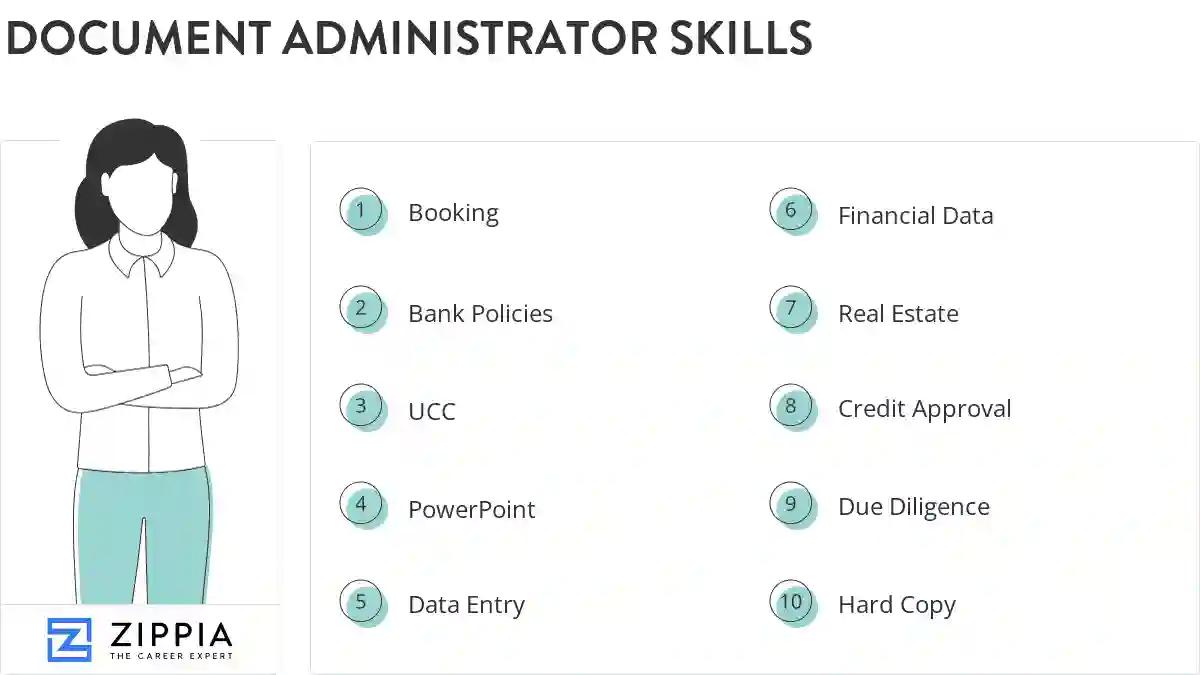
The most important skills for a document administrator resume and required skills for a document administrator to have include:
- Booking
- Bank Policies
- UCC
- PowerPoint
- Data Entry
- Financial Data
- Real Estate
- Credit Approval
- Due Diligence
- Hard Copy
- Commercial Loans
- MOC
- ISO
- Internal Audit
- Facilitate Closings
- QA
- Travel Arrangements
- FDA
- R
- Loan Closings
- Sops
- Status Updates
- SBA
- BOM
- Update Systems
- Fannie MAE
- Autocad
- Administrative Tasks
- MasterControl
- TMF
- Business Administration
- SME
- Marketplace
- Regulatory Compliance
- CAPA
- User Manuals
- DOW
Updated January 8, 2025
