
Automatically apply for jobs with Zippia
Upload your resume to get started.
Drafting engineer skills for your resume and career
15 drafting engineer skills for your resume and career
1. Production Drawings
- Read drawings, emails, and other documentation to translate these into production drawings & cost estimation drawings.
- Prepare and maintain production drawings for all areas of production.
2. Engineering Drawings
Engineering drawings are technical drawings that tell about the requirements for engineering components or equipment. Such drawings have standardized languages and symbols. There are multiple types of engineering drawings such as isometric drawing, orthographic or multiview drawing, schematic drawings, one view, and two view drawings, etc.
- Create associated engineering drawings and documentation.
- Drafted client specific engineering drawings for horizontal slurry pumps and vertical slurry pumps including changing bill of materials.
3. Auto CAD
- Utilize Auto CAD 2012 for fire detection plans, low voltage, and nurse call systems.
- Produced multiple communication based maps using the computer design program called Auto CAD.
4. As-Built Drawings
- Revised as-built drawings for Transmission and civil engineering.
- Provide AS-BUILT drawings upon completion of projects.
5. Shop Drawings
- Create detailed shop drawings from architectural documents while incorporating knowledge of shop construction techniques.
- Assist lead engineer with revisions on structural plans and shop drawings, along with any field changes made by General Contractors.
6. Architectural Drawings
- Complete architectural drawings for floor plans with layouts and framing.
- Created scaled floor plans from architectural drawings.
Choose from 10+ customizable drafting engineer resume templates
Build a professional drafting engineer resume in minutes. Our AI resume writing assistant will guide you through every step of the process, and you can choose from 10+ resume templates to create your drafting engineer resume.7. Revit
Revit, also known as Autodesk Revit, is computer software used by architects, structural engineers, and designers to perform building modeling tasks. Revit was designed to facilitate users, draw building modeling structures in a 2D and 3D format. Creating such models allows architects and engineers to pre-planning, scheduling, estimating the life of the structure and the entire cost of construction.
- Certificate of Recognition in Autodesk Revit MEP Fundamentals
- Performed drafting duties in Revit, for structural plans Archive old plans and transfer plans from AutoCAD to Revit
8. Aided Design
- Utilized third-party applications (FabCAD) to prepare shop fabrication drawings and generate computer-aided design layouts based on specific project requirements.
- Revise computer-aided designs and plans to comply with modified specifications made during actual construction.
9. BOM
BOM stands for a bill of materials in design drafting. This list outlines the raw materials, instructions, and components required to manufacture or construct a product or service.
- Issued bill of material (BOM) for assembled parts.
- Provide BOM to the Engineering Data Coordinator(s).
10. ECO
- Added ECO's revision notations.
- Maintained the engineering drawing database by incorporating ECOs when necessary.
11. Civil Engineering
Civil Engineering is a term referring to the branch of the engineering industry which deals with the design, creation, and keep up of public spaces such as roads, dams, parks, railways, pipelines, and various other infrastructures. It is one of the oldest branches of this field, having been born with the first larger cities and civilizations; thus "civil" engineering. It is an industry generally used to solve the problems of the public, such as a lack of sheltering or low cleanliness.
- Prepare technical drawings in pencil/pen and ink for cable TV systems and a variety of civil engineering construction.
- Prepared civil engineering plans and specifications for projects and performing relevant administrative duties following ASCE standards
12. CNC
CNC stands for Computer Numerical Control. It is a subtractive manufacturing technique that usually uses computerized controls and machine tools to strip layers of material from a stock piece.
- Translated drawings to KOMO CNC milling machine using NC software.
- Provide tool paths for CNC and laser machines.
13. GIS
A geographic information system (GIS) is a tool for capturing, storing, manipulating, analyzing, managing and presenting various forms of geographic data.
- Corrected existing and new drawings, collected information using GIS and as-built plans, in addition to putting construction plans together.
- Performed Quality Control and Quality Assurance on all data entered into GIS Database to ensure water data integrity.
14. Part Drawings
- Support production department by providing complete fabrication and part drawings.
- Incorporated engineering calculations into part drawings.
15. Mechanical Drawings
- Prepared drawings for central office wiring circuits, layouts, posters, maps and mechanical drawings.
- Prepared schematic/electrical/mechanical drawings in Engineering Lab.
5 Drafting Engineer resume examples
Build a professional drafting engineer resume in minutes. Browse through our resume examples to identify the best way to word your resume. Then choose from 5+ resume templates to create your drafting engineer resume.

What skills help Drafting Engineers find jobs?
Tell us what job you are looking for, we’ll show you what skills employers want.
List of drafting engineer skills to add to your resume
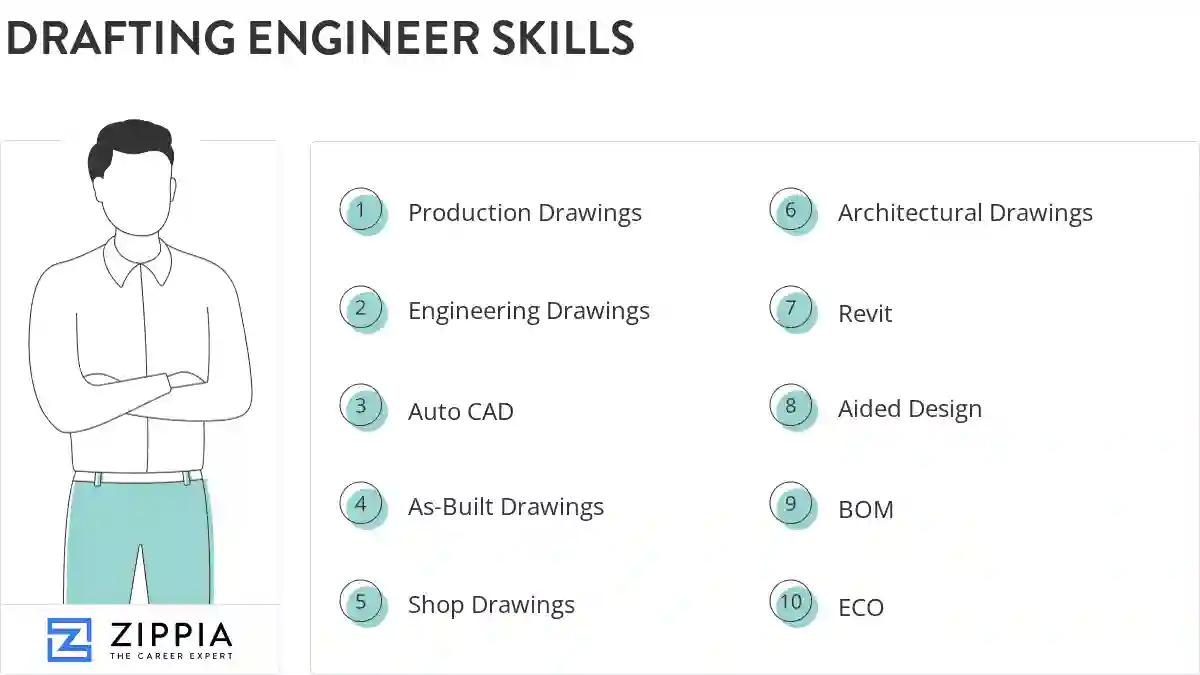
The most important skills for a drafting engineer resume and required skills for a drafting engineer to have include:
- Production Drawings
- Engineering Drawings
- Auto CAD
- As-Built Drawings
- Shop Drawings
- Architectural Drawings
- Revit
- Aided Design
- BOM
- ECO
- Civil Engineering
- CNC
- GIS
- Part Drawings
- Mechanical Drawings
- Technical Drawings
- Engineering Data
- Design Drawings
- Structural Drawings
- Assembly Drawings
- Engineering Support
- Part Numbers
- ANSI
- Electrical Drawings
- Engineering Specifications
- Sketch
- Mechanical Drafting
- Customer Drawings
- Engineering Design
- GD
- Construction Projects
- Fiber Loss
- Design Issues
- HVAC
- CATIA
- ISO
- Commercial Buildings
- ECR
- Construction Drawings
- Cost Estimates
- Outside Plant
- OSP
- Quality Standards
- PowerPoint
- V8
- Production Problems
Updated January 8, 2025
