What does an editorial manager do?
Editorial managers supervise the production operations from idea generation to the publication of contents. The managers edit contents before publication to ensure that all written materials provide the most impact or views on their audience. They also deal with planning and promoting their products through various editorial platforms. They work with the human resource department in recruiting and hiring editors. Sometimes, they conduct interviews, analyze editorial candidates based on their educational background, expertise, and experience. They should also be adept in organizational and management skills, research and accuracy, and computer operations.
Editorial manager responsibilities
Here are examples of responsibilities from real editorial manager resumes:
- Manage``FitBU"instagram and twitter accounts.
- Work closely with freelancers and in-house editor to oversee brand voice across key marketing channels; manage proofreading and editing process.
- Manage research and editorial staff for production of print and on-line database-driven publications in the commercial real estate industry.
- Work follow by NYC taxi industry, NYC government, regulators & media.
- Provide proofreading services on front-list titles, advertising and promotion copy, and more.
- Work closely with developers to integrate UI standards into the application and to build intuitive navigation and functionality.
- Edit commercial videos for venues, clothing lines, expos and DVD releases.
- Edit green screen footage and add graphics and animations into programs, authoring to DVD for duplication and distribution.
- Select appropriate communications and supplemental sales materials for each RFP.
Editorial manager skills and personality traits
We calculated that 9% of Editorial Managers are proficient in Proofreading, Digital Content, and Proofread. They’re also known for soft skills such as Good judgment, Interpersonal skills, and Detail oriented.
We break down the percentage of Editorial Managers that have these skills listed on their resume here:
- Proofreading, 9%
Performed copyediting, proofreading, and substantive editing of proposals, technical documents, marketing collateral, and Web sites.
- Digital Content, 6%
Developed prototypes for print and digital content and planned pedagogy and achieved market needs through measureable learning outcomes.
- Proofread, 6%
Reviewed and selected manuscripts for print; proofread all material printed to be published; oversaw daily operations.
- Content Marketing, 5%
Manage editorial strategy, editorial calendar, content creation and content marketing for AT&T's enterprise blog.
- Editorial Guidelines, 5%
Created all in-house editorial guidelines.
- Content Strategy, 4%
Managed stakeholder relations and global content strategy for distribution across 60+ subsidiary portals in multiple languages.
Most editorial managers use their skills in "proofreading," "digital content," and "proofread" to do their jobs. You can find more detail on essential editorial manager responsibilities here:
Good judgment. The most essential soft skill for an editorial manager to carry out their responsibilities is good judgment. This skill is important for the role because "editors decide whether certain stories are ethical and whether there is enough evidence to publish them." Additionally, an editorial manager resume shows how their duties depend on good judgment: "maintained focus on online editorial experience, and what makes content on the web sticky, conversation-starting and good for seo. "
Interpersonal skills. Another essential skill to perform editorial manager duties is interpersonal skills. Editorial managers responsibilities require that "in working with writers, editors must have tact and the ability to guide and encourage them in their work." Editorial managers also use interpersonal skills in their role according to a real resume snippet: "rendered excellent project management, account management, and interpersonal communication skills. "
Detail oriented. Another skill that relates to the job responsibilities of editorial managers is detail oriented. This skill is critical to many everyday editorial manager duties, as "editors must be meticulous to ensure that material is error free and matches the style of a publication." This example from a resume shows how this skill is used: "created and maintained detailed schedule of the editorial department, using microsoft excel and google calendar. "
Creativity. A big part of what editorial managers do relies on "creativity." You can see how essential it is to editorial manager responsibilities because "editors must be imaginative, curious, and knowledgeable in a broad range of topics." Here's an example of how this skill is used from a resume that represents typical editorial manager tasks: "established editorial creative strategy and content style guide. "
Writing skills. Another common skill required for editorial manager responsibilities is "writing skills." This skill comes up in the duties of editorial managers all the time, as "editors ensure that all written content has correct grammar, punctuation, and syntax." An excerpt from a real editorial manager resume shows how this skill is central to what an editorial manager does: "drive content production by creating landing page wireframes, writing copy briefs and sourcing editorial imagery. "
The three companies that hire the most editorial managers are:
- Corning Incorporated3 editorial managers jobs
- NBCUniversal3 editorial managers jobs
- Amazon2 editorial managers jobs
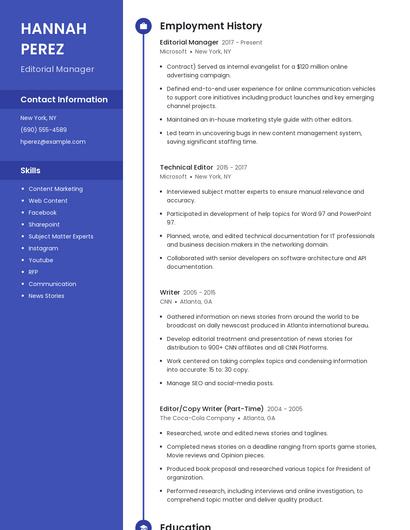
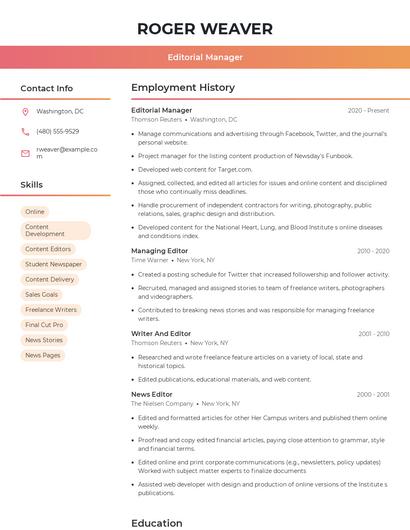
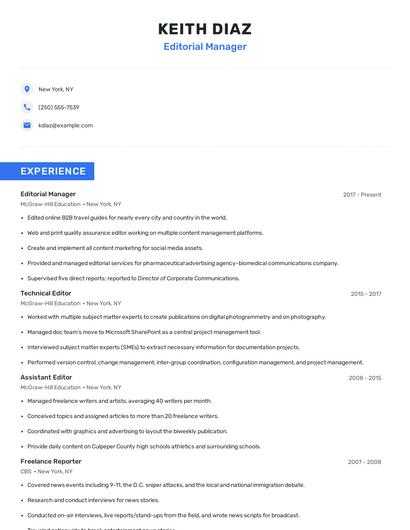
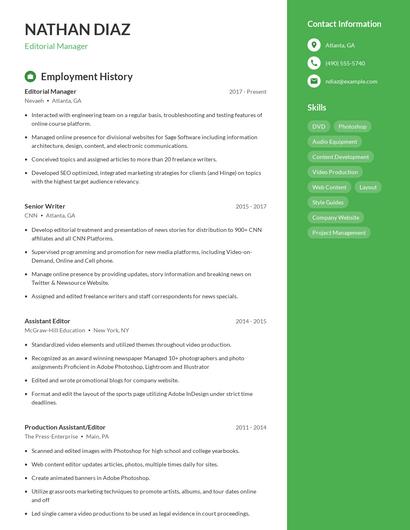
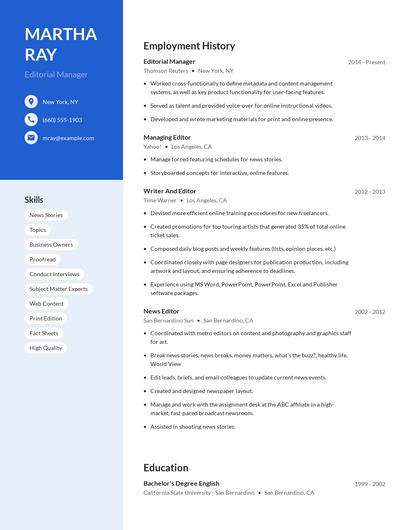
Choose from 10+ customizable editorial manager resume templates
Build a professional editorial manager resume in minutes. Our AI resume writing assistant will guide you through every step of the process, and you can choose from 10+ resume templates to create your editorial manager resume.



Compare different editorial managers
Editorial manager vs. Production assistant/editor
Production assistants/editors are individuals with skills in communication, adaptability, organization, and administration. They also possess a healthy dose of enthusiasm and perseverance and the ability to work well under pressure. This career choice calls for assisting directors of film and television in collecting and organizing elements needed to edit the film, and overseeing the various lists and instructions needed for putting the film into its final form.
While similarities exist, there are also some differences between editorial managers and production assistant/editor. For instance, editorial manager responsibilities require skills such as "proofreading," "digital content," "proofread," and "content marketing." Whereas a production assistant/editor is skilled in "adobe photoshop," "photography," "audio board," and "video production." This is part of what separates the two careers.
On average, production assistant/editors reach similar levels of education than editorial managers. Production assistant/editors are 3.0% less likely to earn a Master's Degree and 1.4% less likely to graduate with a Doctoral Degree.Editorial manager vs. Writer and editor
Writing is not an easy task, so a Writer and an Editor must work together to deliver quality content. A writer's role is to gather information to create a structured written material that would serve its purpose, whether for recreational or informational. Moreover, it is the Editor's responsibility to oversee and examine what the Writer has produced. From this, the Editor will provide feedback, corrections or suggestions, and guidelines that the Writer can follow to improve the material.
In addition to the difference in salary, there are some other key differences worth noting. For example, editorial manager responsibilities are more likely to require skills like "proofreading," "digital content," "proofread," and "editorial guidelines." Meanwhile, a writer and editor has duties that require skills in areas such as "blog posts," "writing articles," "photography," and "fiction." These differences highlight just how different the day-to-day in each role looks.
Writer and editors earn a lower average salary than editorial managers. But writer and editors earn the highest pay in the internet industry, with an average salary of $97,058. Additionally, editorial managers earn the highest salaries in the retail with average pay of $96,480 annually.In general, writer and editors achieve similar levels of education than editorial managers. They're 2.7% more likely to obtain a Master's Degree while being 1.4% less likely to earn a Doctoral Degree.Editorial manager vs. Production editor
A production editor is responsible for checking publication materials before printing and distribution to ensure error-free and accurate content. Production editors must have excellent writing communication skills to perform editing and proofreading of materials efficiently, following strict requirements of publication deadlines. They also verify the resources of content, as well as identifying highly requested feature opportunities by coordinating with writers and other industry personalities. A production editor negotiates contract offers for writers, provides feedback reviews, and facilitates brainstorming sessions.
The required skills of the two careers differ considerably. For example, editorial managers are more likely to have skills like "digital content," "proofread," "content marketing," and "editorial guidelines." But a production editor is more likely to have skills like "fiction," "adobe indesign," "typesetting," and "media management."
Production editors earn the highest salary when working in the media industry, where they receive an average salary of $61,163. Comparatively, editorial managers have the highest earning potential in the retail industry, with an average salary of $96,480.production editors typically earn similar educational levels compared to editorial managers. Specifically, they're 0.9% less likely to graduate with a Master's Degree, and 1.7% less likely to earn a Doctoral Degree.Editorial manager vs. Assistant editor
An assistant editor is an individual responsible for assisting an editor-in-chief or editor-at-large of a newspaper, magazine, radio program, or website. Assistant editors hold meetings with staff and freelance writers to discuss new, fresh and original content for projects on a daily, weekly, or monthly basis. They review assignments handed in by writers or reporters for sense, accuracy, readability, and content. Assistant editors must also utilize new media applications such as Twitter and Facebook to draw attention to an article or cause.
Updated January 8, 2025
