What does an electrical engineering project manager do?
An electrical engineering project manager spearheads and manages engineering projects, ensuring operations adhere to goals and budgets. Part of their job is to participate in identifying and meeting project requirements, set daily objectives and guidelines, manage project teams, and monitor processes, addressing and resolving issues should there be any. They may also liaise and negotiate with external parties, building positive relationships in the process. Moreover, being an electrical engineering project manager, they have the responsibility to lead and encourage the workforce to reach project goals while implementing company policies and standards.
Electrical engineering project manager responsibilities
Here are examples of responsibilities from real electrical engineering project manager resumes:
- Participate and lead capital projects, maintenance excellence and CMMS programs, and EHS objectives.
- Manage department staff of 24 full-time electrical engineers, firmware developers and technicians (employees and contractors).
- Manage projects involve from procurement to completion for geotechnical and construction materials testing and inspection projects.
- Create new opportunities and value for the company and successfully manage all geotechnical engineering matters including comprehensive report writing.
- Design analog and digital PCB's.
- Provide detail design in both analog and digital from schematic to PCB layout.
- Prepare design documentation, including plans, specifications and cost estimates in accordance with NEC, UL and customer requirements.
- Design all surface body components in cad.
- Design of power distribution to the HVAC equipment.
- Process equipment through UL, TUV and CE certifications.
- Provide AutoCad 3D model drawings for the plant layout concept and design details.
- Design wiring harnesses and control RF emissions to prevent interference with FM radios.
- Work with UL and ETL testers and inspectors to acquire and maintain product listings.
- Perform embedded system design, PCB layout, and mechanical interfacing to industrial equipment.
- Utilize AutoCAD and modern computerize tools to draft and develop plans and drawings for manufacturing upgrades.
Electrical engineering project manager skills and personality traits
We calculated that 18% of Electrical Engineering Project Managers are proficient in Electrical Engineering, Project Management, and Autocad. They’re also known for soft skills such as Concentration, Initiative, and Speaking skills.
We break down the percentage of Electrical Engineering Project Managers that have these skills listed on their resume here:
- Electrical Engineering, 18%
Managed electrical engineering projects for global manufacture of windows and doors.
- Project Management, 17%
Project Management Responsibilities include organizing project meetings, project scheduling meetings, budget tracking, billing.
- Autocad, 8%
Utilized tools such as AutoCAD 2004, Mechanical Desktop 2004, and various Microsoft Office applications to complete projects.
- Engineering Design, 5%
Coordinated multi-engineering design by interfacing with architects, subcontractors, consultants; Avoided change orders and prevented customers from unexpected expenses
- Engineering Services, 4%
Reported to the Plant Engineering Manager Provided engineering services to multiple AFL plant and office locations.
- Electrical Design, 4%
Developed Company Electrical Design specifications, Reviewed bids and purchased major Electrical equipment for power distribution and miscellaneous Electrical Company Projects.
Most electrical engineering project managers use their skills in "electrical engineering," "project management," and "autocad" to do their jobs. You can find more detail on essential electrical engineering project manager responsibilities here:
Concentration. One of the key soft skills for an electrical engineering project manager to have is concentration. You can see how this relates to what electrical engineering project managers do because "electrical and electronics engineers design and develop complex electrical systems and electronic components and products." Additionally, an electrical engineering project manager resume shows how electrical engineering project managers use concentration: "designed system monitor systems using abb plc's and including data concentration and climatecontrols. "
Initiative. Another essential skill to perform electrical engineering project manager duties is initiative. Electrical engineering project managers responsibilities require that "electrical and electronics engineers must apply their knowledge to new tasks in every project they undertake." Electrical engineering project managers also use initiative in their role according to a real resume snippet: "led companywide initiative for roles & responsibilities for all engineering disciplines in order execution and publish/rollout the same in 2013. "
Speaking skills. Another skill that relates to the job responsibilities of electrical engineering project managers is speaking skills. This skill is critical to many everyday electrical engineering project manager duties, as "electrical and electronics engineers work closely with other engineers and technicians." This example from a resume shows how this skill is used: "addressed customers questions regarding plumbing and electrical products and equipment managed special orders and receiving of merchandise provided great customer service"
Writing skills. For certain electrical engineering project manager responsibilities to be completed, the job requires competence in "writing skills." The day-to-day duties of an electrical engineering project manager rely on this skill, as "electrical and electronics engineers develop technical publications related to equipment they develop, including maintenance manuals, operation manuals, parts lists, product proposals, and design methods documents." For example, this snippet was taken directly from a resume about how this skill applies to what electrical engineering project managers do: "project management, power system design, writing specifications, construction and coordination of urban infrastructure in various voltage levels. "
Math skills. A commonly-found skill in electrical engineering project manager job descriptions, "math skills" is essential to what electrical engineering project managers do. Electrical engineering project manager responsibilities rely on this skill because "electrical and electronics engineers must use the principles of calculus and other advanced math in order to analyze, design, and troubleshoot equipment." You can also see how electrical engineering project manager duties rely on math skills in this resume example: "used various software packages for modeling: matlab simulink, mathcad, etap, and edsa. "
The three companies that hire the most electrical engineering project managers are:
- The Aerospace Corporation24 electrical engineering project managers jobs
- NANA8 electrical engineering project managers jobs
- Navistar5 electrical engineering project managers jobs
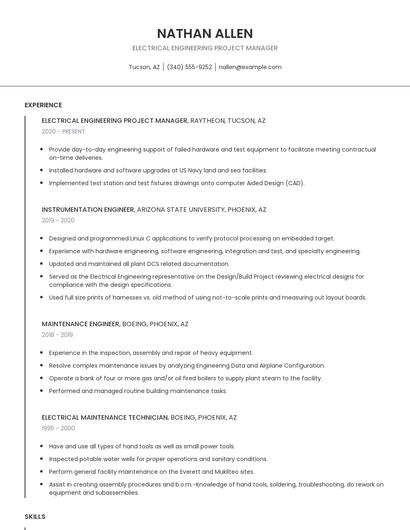
Choose from 10+ customizable electrical engineering project manager resume templates
Build a professional electrical engineering project manager resume in minutes. Our AI resume writing assistant will guide you through every step of the process, and you can choose from 10+ resume templates to create your electrical engineering project manager resume.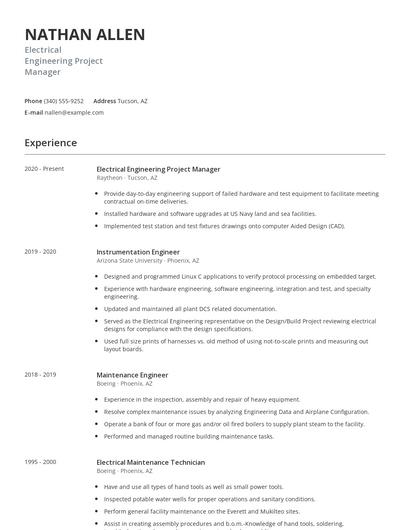


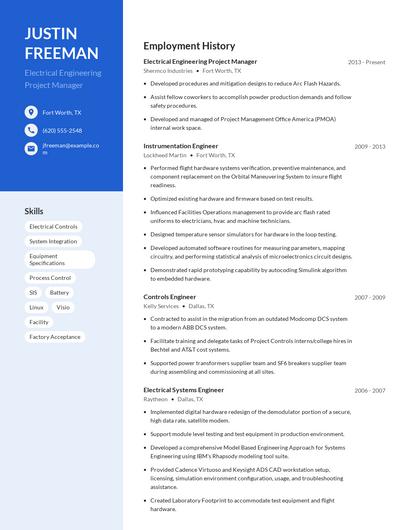
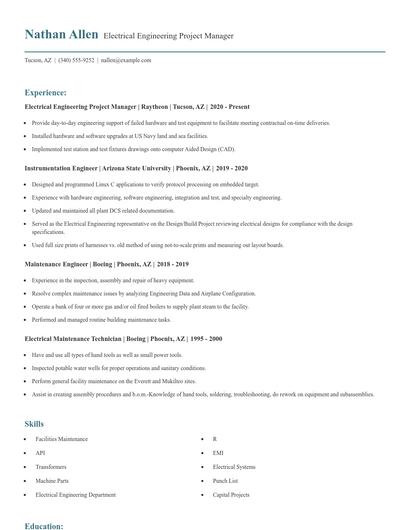

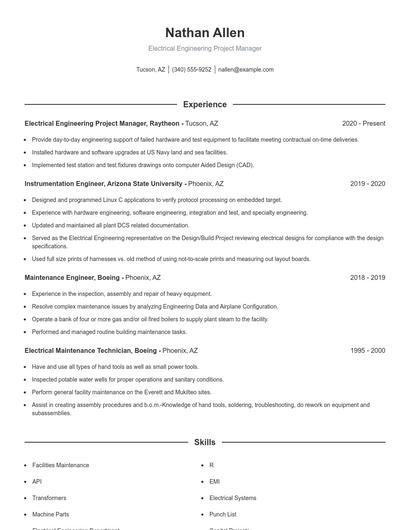

Compare different electrical engineering project managers
Electrical engineering project manager vs. Senior field engineer
A senior field engineer is in charge of overseeing and providing technical support on-site, helping operations run smoothly and efficiently. Among their responsibilities include performing installations and upgrades, performing research and analysis, managing staff, producing progress reports, and conducting inspections, ensuring compliance with state laws and regulations. They must also perform regular maintenance checks on equipment, performing corrective repairs and adjustments when necessary. Furthermore, as a senior field engineer, it is essential to lead and serve as a mentor to junior engineers while implementing the site's safety policies and regulations.
These skill sets are where the common ground ends though. The responsibilities of an electrical engineering project manager are more likely to require skills like "electrical engineering," "engineering design," "engineering services," and "electrical design." On the other hand, a job as a senior field engineer requires skills like "technical support," "excellent interpersonal," "technical problems," and "linux." As you can see, what employees do in each career varies considerably.
Senior field engineers tend to make the most money working in the energy industry, where they earn an average salary of $107,400. In contrast, electrical engineering project managers make the biggest average salary, $92,834, in the energy industry.senior field engineers tend to reach lower levels of education than electrical engineering project managers. In fact, senior field engineers are 5.5% less likely to graduate with a Master's Degree and 0.3% less likely to have a Doctoral Degree.Electrical engineering project manager vs. System design engineer
A system design engineer is an individual who participates in system design engineering and resolves manufacturing and service problems. System design engineers are required to collaborate with the system design team to research emerging technologies and develop new capabilities. They create design layouts by utilizing the use of CAD software such as AutoCad as well as supervise a group of CAD technicians. System design engineers must also provide customer service in the field and deliver individualized problem solving and system design support
In addition to the difference in salary, there are some other key differences worth noting. For example, electrical engineering project manager responsibilities are more likely to require skills like "electrical engineering," "autocad," "engineering design," and "engineering services." Meanwhile, a system design engineer has duties that require skills in areas such as "system design," "architecture," "matlab," and "c++." These differences highlight just how different the day-to-day in each role looks.
On average, system design engineers earn a higher salary than electrical engineering project managers. Some industries support higher salaries in each profession. Interestingly enough, system design engineers earn the most pay in the automotive industry with an average salary of $116,222. Whereas electrical engineering project managers have higher pay in the energy industry, with an average salary of $92,834.In general, system design engineers achieve similar levels of education than electrical engineering project managers. They're 2.6% more likely to obtain a Master's Degree while being 0.3% more likely to earn a Doctoral Degree.Electrical engineering project manager vs. Junior engineer
A Junior Engineer helps design, build, or maintain engines, machines, or public works. They work under the supervision of an engineer.
The required skills of the two careers differ considerably. For example, electrical engineering project managers are more likely to have skills like "electrical engineering," "autocad," "engineering design," and "engineering services." But a junior engineer is more likely to have skills like "control systems," "java," "c++," and "c #."
Junior engineers earn the highest salary when working in the technology industry, where they receive an average salary of $72,489. Comparatively, electrical engineering project managers have the highest earning potential in the energy industry, with an average salary of $92,834.When it comes to education, junior engineers tend to earn similar degree levels compared to electrical engineering project managers. In fact, they're 3.5% less likely to earn a Master's Degree, and 0.1% less likely to graduate with a Doctoral Degree.Electrical engineering project manager vs. Field engineer
A field engineer's role will vary on the industry or line of work involved. However, the primary responsibility will mostly revolve around handling equipment and machinery, ensuring that they function effectively and safely. It is also the task of a field engineer to oversee the workflow and workforce, giving directions and recommendations when necessary. Furthermore, a field engineer must develop strategies and plans to improve the site's efficiency, produce progress reports, and coordinate with other workers.
Types of electrical engineering project manager
Updated January 8, 2025
