
Automatically apply for jobs with Zippia
Upload your resume to get started.
Electronics test engineer skills for your resume and career
15 electronics test engineer skills for your resume and career
1. RF
- Developed Test strategies to cope with new test challenges, wrote test procedures for a wide variety of RF products.
- Respond to customer trouble calls by troubleshooting Network Interface Units, RF modems, cable plant, and some Ethernet.
2. LabVIEW
- Led the automation of vacuum-tube amplifier manufacturing processes using LabVIEW.
- Created LabView verification & validation solutions.
3. C++
C++ is a general-purpose programming language that is used to create high-performing applications. It was invented as an extension to the C language. C++ lets the programmer have a high level of domination over memory and system resources. C++ is an object-oriented language that helps you implement real-time issues based on different data functions
- Created interrupt driven C++ test software and serial/parallel communication software to control instrumentation.
- Collaborated on development of tester-to-tester program translation software with C++ programming language.
4. Test Procedures
Test procedure i defined as a tool for conducting an experiment to analyze or observe the specifications of a process or application.
- Debugged test procedures, investigated product failures and performed root cause analysis.
- Created and release test procedures and test report generation for management presentation.
5. Test Systems
- Developed software algorithms to provide alternate option of integrated programmable power supply into legacy test system hardware.
- Present data and analysis of acoustic test systems to customers, clients, vendors, engineers and management.
6. Troubleshoot
Troubleshooting is the process of analyzing and fixing any kind of problem in a system or a machine. Troubleshooting is the detailed yet quick search in the system for the main source of an issue and solving it.
- Design, implement, and troubleshoot Test equipment for new products and support existing test equipment as needed.
- Collaborate with hardware, software, and operating system teams to troubleshoot issues found in FMET.
Choose from 10+ customizable electronics test engineer resume templates
Build a professional electronics test engineer resume in minutes. Our AI resume writing assistant will guide you through every step of the process, and you can choose from 10+ resume templates to create your electronics test engineer resume.7. Power Electronics
- Validated two power electronics technologies to help system architecture team define electric drive architecture using cost effective and robust power electronics.
- Design high efficiency low to medium range power electronics interfaces in accordance with system requirements.
8. Test Reports
- Created well-organized and concise test reports and documenting test results quickly to implement corrective actions for several factories.
- Write test reports and suggest solutions to problem areas upon customer request.
9. PCB
The PCB (Printed Circuit Board) refers to the hardware part housing all of the device's electrical connections.
- Performed testing and troubleshooting of hybrid, analog and digital printed circuit boards (PCB's).
- Uncovered chip manufacturer design issues to exclude those manufacturers in future PCB production runs.
10. Test Data
- Improved the methods of testing, evaluated and analyzed the test data.
- Collected test data using scopes, multi-meters, data logers and specialized test equipment and backup.
11. Failure Analysis
Failure Analysis is a step-by-step process of determining the reason for a particular machine or equipment failure by way of checking, identification, and examination. It means conducting a test within the system and perform a maintenance check that leads you to a conclusion. A failure analysis takes place to prevent further damages.
- Support product post-release duties such as monitoring yield trends, yield enhancement, and customer return verification/failure analysis/corrective actions.
- Coordinated Failure Analysis activities for failed components to the Root Cause, facilitated corrective actions to improve reliability systems.
12. Linux
Linux is a Unix-like operating system. Just like Windows, Mac OS, and IOS, Linux is an operating system used by millions across the globe. Android itself is powered by the Linux operating system. Linux manages all the hardware resources that are associated with your computer. The software is famous because of the protection it grants from viruses, malware, and crashes. The Linux operating system is entirely free and is an open-source software meaning it can be altered by those equipped with the knowledge to code.
- Designed and implemented a Wi-Fi Display Sink reference application on an embedded Linux multimedia platform from Sigma Designs.
- Created automation for installing and testing embedded Linux systems including embedded Linux applications written in C++.
13. Test Results
- Provide reports and confer on test results and analysis with management, product engineering and customers.
- Perform a variety of testing, and evaluate the credibility and accuracy of test results.
14. Electronic Equipment
Electronic equipment is equipment in which electrons are conducted in a controlled manner, especially in a gas or vacuum, or semiconductor amplifier. These equipment are components for controlling the flow of electrical current for information and signal processing, telecommunications, and system control.
- Verified accuracy of manuals and procedures for wiring harness and electronic equipment.
- Panel and board level test fixtures that interfaced with switching matrix of electronic equipment.
15. Laser
The laser is a device that stimulates atoms to produce light and then directs it into a narrow path producing an intense beam of light.
- Provide Final QA/QC Testing of the Laser Beam system equipped for military.
- Job Requirements: Laser range finders.
5 Electronics Test Engineer resume examples
Build a professional electronics test engineer resume in minutes. Browse through our resume examples to identify the best way to word your resume. Then choose from 5+ resume templates to create your electronics test engineer resume.

What skills help Electronics Test Engineers find jobs?
Tell us what job you are looking for, we’ll show you what skills employers want.
What skills stand out on electronics test engineer resumes?
Florian Solzbacher
Department Chair, Professor, Elect & Computer Engineering, University of Utah
Supplemental skills, such as Entrepreneurial or business training, can enhance and differentiate a student's resume. This shows that an engineer is not solely focused on the core technical engineering skills but does have an understanding of the driving forces and their interaction in a real-world business setting, that are not only part of the design requirements for a product (e.g., design to cost), but also often drive the selection of technical solution paths, after all, every development and product has to make business sense. Imagine two young engineers proposing a solution to their manager for a new product: one maybe even over-exceeds the technical requirements, but the development and/or manufacturing and servicing effort and cost is significantly higher than a colleagues solution that may only just about reach the requirements, or maybe even compromise on some specifications, but that is far cheaper to develop, make and service and that may allow entering a far larger market- chances are very high that the business may decide to go for the "inferior" solution from a technical point of view, that is, however, the better product. This supplemental skill set is a significant competitive advantage to have as an engineer.
What electronics test engineer skills would you recommend for someone trying to advance their career?
Arie Nakhmani
Associate Professor of Electrical and Computer Engineering, University of Alabama at Birmingham
List of electronics test engineer skills to add to your resume
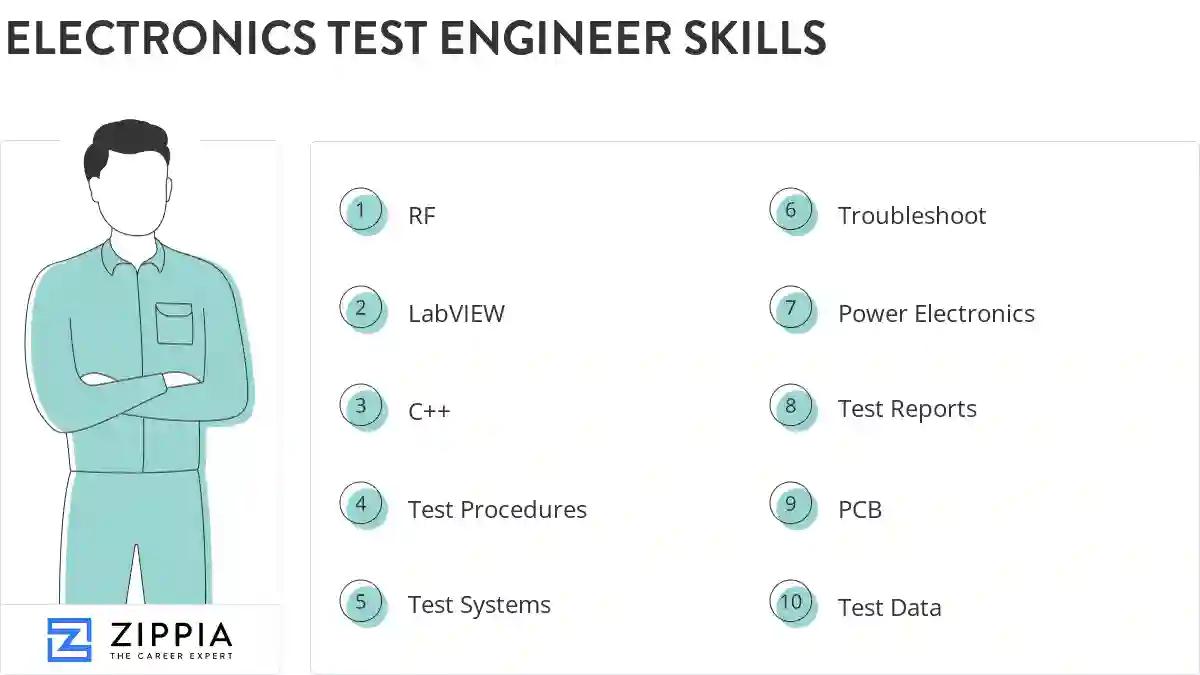
The most important skills for an electronics test engineer resume and required skills for an electronics test engineer to have include:
- RF
- LabVIEW
- C++
- Test Procedures
- Test Systems
- Troubleshoot
- Power Electronics
- Test Reports
- PCB
- Test Data
- Failure Analysis
- Linux
- Test Results
- Electronic Equipment
- Laser
- Test Software
- Product Quality
- ISO
- Software Development
- Electronic Devices
- Circuit Boards
- Technical Reports
- Test Processes
- Verification Testing
- Test Hardware
- FPGA
- R
- Debug
- Debugging
- Test Equipment
- Transmitters
- ICT
- PLC
- Electronic Components
- Ethernet
- Test Specifications
- Unix
- GPS
- System Integration
- Automatic Test
- Electronic Products
- Test Strategies
- Ac
- Dc
Updated January 8, 2025
