What does an elevator mechanic do?
An elevator mechanic specializes in installing and repairing elevators, ensuring efficiency and safety. They usually work with a team of other mechanics on an on-call basis, responding to emergencies such as malfunctions, which may involve rescuing people stuck at elevators. Their responsibilities also include understanding blueprints, replacing and assembling parts, investigating user complaints or feedback, and performing regular maintenance checks to ensure the quality of systems and safety of users. Furthermore, an elevator mechanic may also be in charge of installing and repairing escalators, dumbwaiters, chairlifts, and similar machinery.
Elevator mechanic responsibilities
Here are examples of responsibilities from real elevator mechanic resumes:
- Install safety and control devices, cables, pulleys, drive, rails, motors, and elevator cars.
- Perform routine and complex repairs to electrical systems and controls, motors, switches, relays, and hydraulics.
- Gain access to remove detective parts using hoists, ladders and hand tools while using the proper safety PPE.
- Preform installation, repairs and preventive maintenance to traction and hydraulic elevators, escalators and material lifts.
- Install emt and rigid conduit.
- Maintain log books that detail all repairs and checks perform.
- Adjust valves, ratchets, seals, brake linings and other components
- Trouble-shoot and modify dc electrical alarm systems, strobe lights etc.
- Trouble shoot solid state relay panels and run diagnostics on all software and electronic components.
- Disassemble machines for rigging and hoisting to machine rooms then reassemble machines and set in place.
- Install ceiling and venting fans, lighting fixtures, recess lighting and hard-wire general and HVAC appliances.
- Bolt and weld steel rails to the walls of shafts to guide elevators, working from scaffolding and platforms.
- Service and maintain both traction and hydraulic elevators.
- Inspect, repair, adjust and maintain freight and passenger elevators conveyors, hoisting machines and other relate machines and equipment.
- Maintain and repair HVAC systems, including boilers, air handlers, split air conditioning systems and roof top package systems.
Elevator mechanic skills and personality traits
We calculated that 17% of Elevator Mechanics are proficient in Traction, Switches, and Electric Motors. They’re also known for soft skills such as Detail oriented, Troubleshooting skills, and Mechanical skills.
We break down the percentage of Elevator Mechanics that have these skills listed on their resume here:
- Traction, 17%
Preformed installation, repairs and preventive maintenance to traction and hydraulic elevators, escalators and material lifts.
- Switches, 12%
Performed routine and complex repairs to electrical systems and controls, motors, switches, relays, and hydraulics.
- Electric Motors, 9%
Power panels with all types of electric motors and many types of frequency converters, and drive units.
- Hand Tools, 8%
Used power hand tools to install elevator cabs and safety equipment.
- Safety Regulations, 6%
Repaired and maintained elevators, escalators and dumb-waiters to meet safety regulations and building codes.
- Control Systems, 5%
Accredited four-year maintenance apprenticeship mechanic, responsible for plant electrical, instrumentation and control systems maintenance.
Most elevator mechanics use their skills in "traction," "switches," and "electric motors" to do their jobs. You can find more detail on essential elevator mechanic responsibilities here:
Detail oriented. To carry out their duties, the most important skill for an elevator mechanic to have is detail oriented. Their role and responsibilities require that "elevator and escalator installers must keep accurate records of their service schedules." Elevator mechanics often use detail oriented in their day-to-day job, as shown by this real resume: "maintained log books that detail all repairs and checks performed. "
Troubleshooting skills. Many elevator mechanic duties rely on troubleshooting skills. "elevator and escalator installers must be able to diagnose problems, especially when making repairs.," so an elevator mechanic will need this skill often in their role. This resume example is just one of many ways elevator mechanic responsibilities rely on troubleshooting skills: "conduct routine maintenance involving troubleshooting, blueprint reading and electrical wiring. "
Mechanical skills. elevator mechanics are also known for mechanical skills, which are critical to their duties. You can see how this skill relates to elevator mechanic responsibilities, because "elevator and escalator installers use a variety of power tools and handtools to install and repair lifts." An elevator mechanic resume example shows how mechanical skills is used in the workplace: "perform maintenance and repair of all solid state and electromechanical control systems. "
The three companies that hire the most elevator mechanics are:
- Department of Public Social Services3 elevator mechanics jobs
- County Of Los Angeles Public Library3 elevator mechanics jobs
- Huntington Ingalls Industries2 elevator mechanics jobs
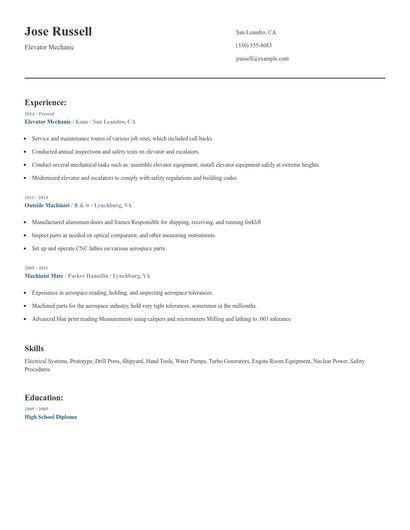
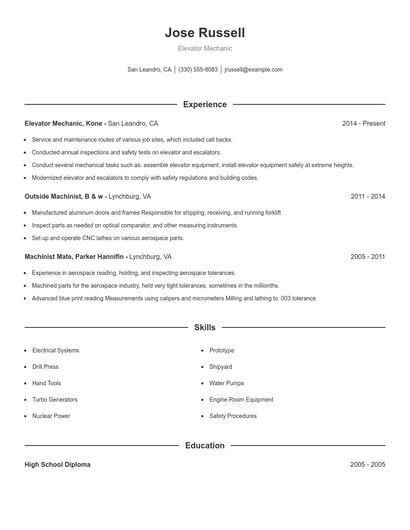
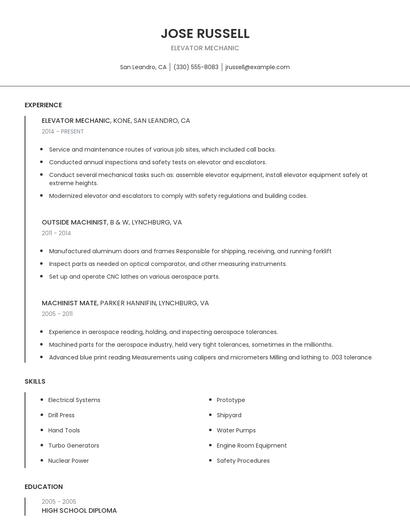
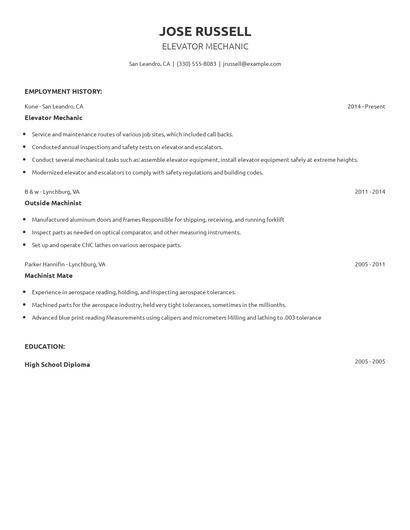
Choose from 10+ customizable elevator mechanic resume templates
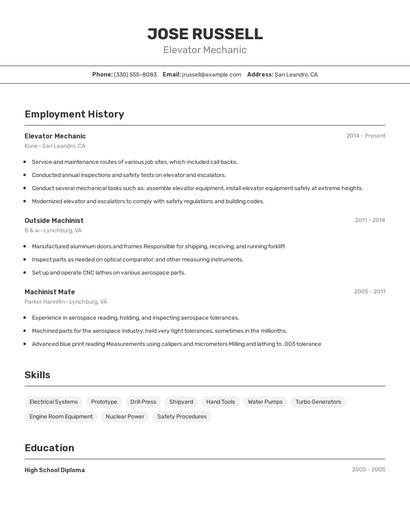
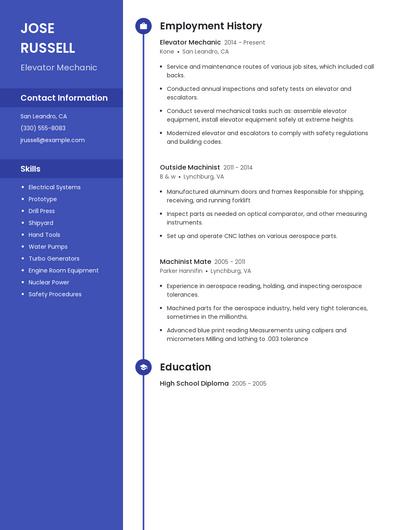
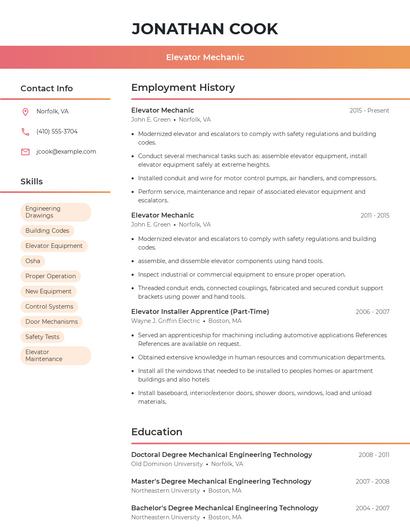
Build a professional elevator mechanic resume in minutes. Our AI resume writing assistant will guide you through every step of the process, and you can choose from 10+ resume templates to create your elevator mechanic resume.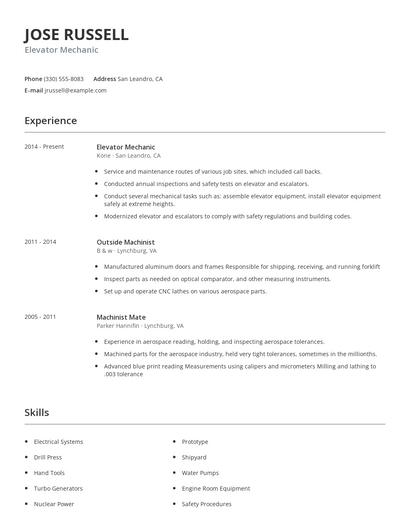
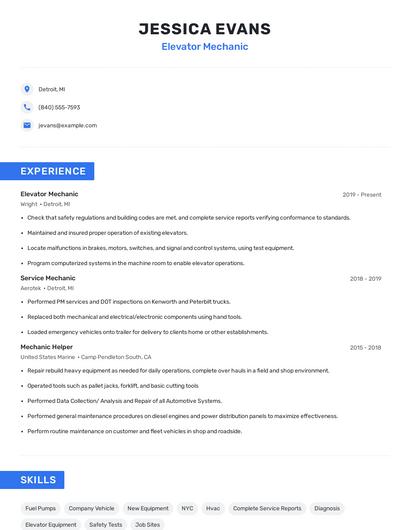
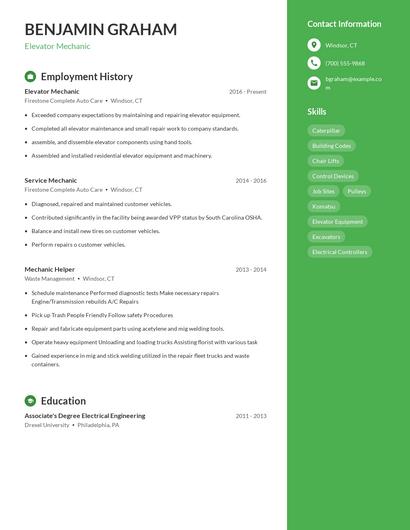
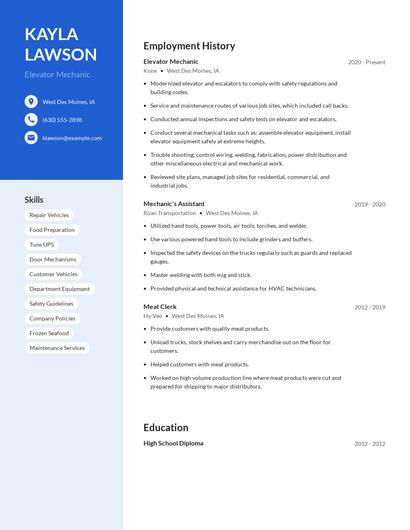
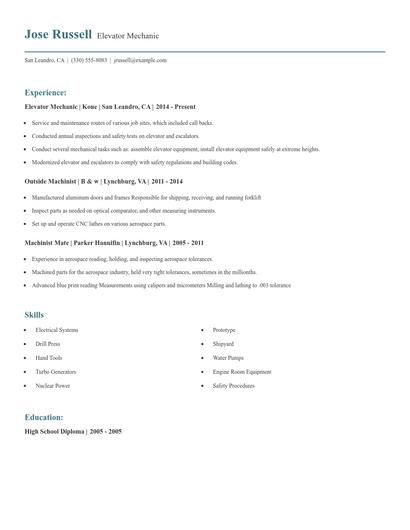
Compare different elevator mechanics
Elevator mechanic vs. Accessibility lift technician
Elevator installer apprentice evaluates hydraulic, mechanical, or electric nature problems related to wheelchair lifts operation, dumbwaiters operations, and elevator operations. They determine all these issues and make the required repairs. Besides performing yearly tests to ensure the safety devices keep working correctly, elevator installer apprentices also determine the suitability of the current elevator equipment, new equipment, and proposed modifications. These professionals inspect elevators and other devices and conduct preventive maintenance from time to time to ensure the devices keep working correctly as per OSHA requirements and safety regulations.
These skill sets are where the common ground ends though. The responsibilities of an elevator mechanic are more likely to require skills like "traction," "switches," "electric motors," and "conveyance." On the other hand, a job as an accessibility lift technician requires skills like "ndt," "nde," "scaffolding," and "ladders." As you can see, what employees do in each career varies considerably.
On average, accessibility lift technicians reach similar levels of education than elevator mechanics. Accessibility lift technicians are 0.8% more likely to earn a Master's Degree and 0.0% less likely to graduate with a Doctoral Degree.Elevator mechanic vs. Elevator installer apprentice
Mechanics are professionals responsible for assembling, maintaining, and repairing vehicles and types of machinery. They are knowledgeable of various tools and equipment, machinery, electrical systems, and other components. They can usually be seen indoors, garages in particular. Due to the advancement of technology, they are also required to be familiar with computer and software programs that can be used in auto shops and vehicles. They always work in safety precautions.
Each career also uses different skills, according to real elevator mechanic resumes. While elevator mechanic responsibilities can utilize skills like "conveyance," "ac," "preventive maintenance," and "pulleys," elevator installer apprentices use skills like "ladders," "osha," "scaffolding," and "control panels."
Elevator installer apprentices earn similar levels of education than elevator mechanics in general. They're 0.4% less likely to graduate with a Master's Degree and 0.0% more likely to earn a Doctoral Degree.Elevator mechanic vs. Elevator repairer apprentice
Some important key differences between the two careers include a few of the skills necessary to fulfill the responsibilities of each. Some examples from elevator mechanic resumes include skills like "traction," "switches," "conveyance," and "hand tools," whereas an elevator repairer apprentice is more likely to list skills in "machine repair," "mig," "troubleshoot," and "mechanical problems. "
Elevator repairer apprentices typically earn similar educational levels compared to elevator mechanics. Specifically, they're 1.7% less likely to graduate with a Master's Degree, and 0.0% less likely to earn a Doctoral Degree.Elevator mechanic vs. Mechanic
Even though a few skill sets overlap between elevator mechanics and mechanics, there are some differences that are important to note. For one, an elevator mechanic might have more use for skills like "switches," "conveyance," "safety regulations," and "control systems." Meanwhile, some responsibilities of mechanics require skills like "customer service," "customer vehicles," "diagnosis," and "ladders. "
In general, mechanics earn the most working in the manufacturing industry, with an average salary of $51,758. The highest-paying industry for an elevator mechanic is the transportation industry.The average resume of mechanics showed that they earn similar levels of education compared to elevator mechanics. So much so that theyacirc;euro;trade;re 0.3% less likely to earn a Master's Degree and more likely to earn a Doctoral Degree by 0.1%.Types of elevator mechanic
Updated January 8, 2025
