Explore jobs
Find specific jobs
Explore careers
Explore professions
Best companies
Explore companies
Job outlook for employment counselors in the United States
Are employment counselor jobs in demand?
Employment counselor job and salary trends over time
Employment counselor jobs over time
Employment counselor job growth rate over time
| Year | # of jobs | % of population |
|---|---|---|
| 2021 | 1,783 | 0.00% |
| 2020 | 1,758 | 0.00% |
| 2019 | 1,784 | 0.00% |
| 2018 | 1,717 | 0.00% |
| 2017 | 1,633 | 0.00% |
Average employment counselor salary over time
Employment counselor salary by year
| Year | Avg. salary | Hourly rate | % Change |
|---|---|---|---|
| 2026 | $43,848 | $21.08 | +1.9% |
| 2025 | $43,033 | $20.69 | +1.3% |
| 2024 | $42,482 | $20.42 | +1.6% |
| 2023 | $41,803 | $20.10 | +1.6% |
| 2022 | $41,162 | $19.79 | +1.7% |
Employment counselor jobs by state
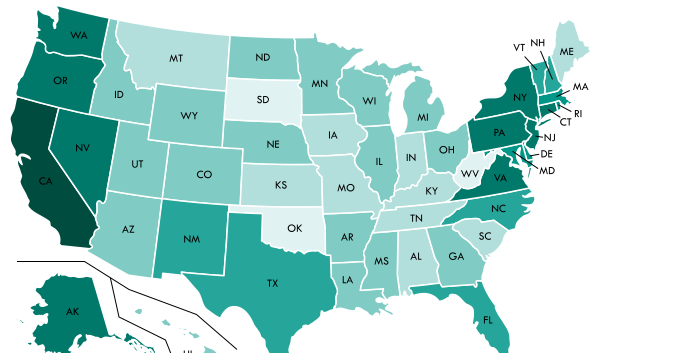
Most common states for employment counselors
| Rank | State | Population | # of jobs | Employment/ 1000ppl |
|---|---|---|---|---|
| 1 | District of Columbia | 693,972 | 97 | 14% |
| 2 | Connecticut | 3,588,184 | 237 | 7% |
| 3 | Montana | 1,050,493 | 78 | 7% |
| 4 | Delaware | 961,939 | 63 | 7% |
| 5 | Alaska | 739,795 | 43 | 6% |
| 6 | North Dakota | 755,393 | 42 | 6% |
| 7 | Wyoming | 579,315 | 32 | 6% |
| 8 | Pennsylvania | 12,805,537 | 682 | 5% |
| 9 | Massachusetts | 6,859,819 | 321 | 5% |
| 10 | Maryland | 6,052,177 | 282 | 5% |
| 11 | New Hampshire | 1,342,795 | 62 | 5% |
| 12 | Vermont | 623,657 | 29 | 5% |
| 13 | New York | 19,849,399 | 880 | 4% |
| 14 | Florida | 20,984,400 | 783 | 4% |
| 15 | Georgia | 10,429,379 | 396 | 4% |
| 16 | New Jersey | 9,005,644 | 372 | 4% |
| 17 | Washington | 7,405,743 | 326 | 4% |
| 18 | Arizona | 7,016,270 | 315 | 4% |
| 19 | Virginia | 8,470,020 | 303 | 4% |
| 20 | Oregon | 4,142,776 | 160 | 4% |
Most common cities for employment counselors
| Rank | City | # of jobs | Employment/ 1000ppl | Avg. salary |
|---|---|---|---|---|
| 1 | North Providence | 1 | 3% | $55,393 |
| 2 | Lynn | 2 | 2% | $54,203 |
| 3 | Barnstable Town | 1 | 2% | $56,703 |
| 4 | Pittsfield | 1 | 2% | $55,511 |
| 5 | Fall River | 1 | 1% | $56,926 |
| 6 | Lansing | 1 | 1% | $41,987 |
| 7 | Lawrence | 1 | 1% | $53,220 |
| 8 | Lowell | 1 | 1% | $53,768 |
| 9 | Mount Vernon | 1 | 1% | $59,354 |
| 10 | New York | 2 | 0% | $59,468 |
| 11 | Atlanta | 1 | 0% | $43,053 |
| 12 | Boston | 1 | 0% | $54,872 |
| 13 | Columbus | 1 | 0% | $41,988 |
| 14 | Montgomery | 1 | 0% | $36,396 |
| 15 | Newark | 1 | 0% | $60,837 |
| 16 | Orlando | 1 | 0% | $45,284 |
Employment Counselor job outlook: Expert opinions
Our panel of employment counselor experts

Lewis University
Louisiana State University at Shreveport

Southern Methodist University

Peak to Peak Charter School
George Fox University

Assumption University
Eastern Kentucky University
University of Illinois at Urbana-Champaign
Michigan State University

Carolina Christian College

University of Wisconsin - Madison

Montana State University – Bozeman

American University

Virginia Polytechnic Institute and State University
Lubbock Christian University

Rutgers School of Public Health
University of Arkansas
Colorado State University
What will help Employment Counselors increase their earning potential?
Dr. Jessica Lane Ph.D.: Every child deserves and needs supportive adults and student advocates, and school counselors serve in that capacity. The opportunity to help develop and support the whole student through academic, career, and social-emotional opportunities is very gratifying. A challenge of today's school counselors is the ability to have enough school counselors in schools and buildings to keep the number of students to school counselor ratio at an optimal level for student support and impact. Additionally, communicating to stakeholders how the role and training of school counselors has evolved to meet the needs of today's students is an important and necessary consideration for school counselors.
What will help Employment Counselors increase their earning potential?
Emily Yowell Ph.D.: Psychologists should be aware of what others in their field are making for similar positions. It is important to ask for what your work is worth in an initial position to assure raises are based on a solid starting salary. Newer psychologists may also consider asking for an early review that prompts an early conversation around potential raises, bonus, or other job benefits.
Lisa Brown
Assistant ProfessorLewis University
School Counseling Program
What soft skills should all Employment Counselors possess?
Lisa Brown: School counselors must be efficient. They may have large caseloads of students for which they are responsible. Being able to prioritize, manage their time, and have a strong work ethic are necessary components to success. Attitude is also key. School counselors are to be empathic, approachable, and nonjudgmental. This means school counselors need to be open to learning from others and be willing to confront any bias or prejudice they may hold.
School counselors are collaborators within the school system and may work as part of a large team that may include the student, parents, teachers, coaches, deans, social workers, psychiatrists, and so forth. School counselors must understand and demonstrate teamwork and conflict resolution.
What hard/technical skills are most important for Employment Counselors?
Lisa Brown: Because of the prevalence of social/emotional issues within K-12, especially in the last few years, school counselors need to have assessment skills. School counselors need to identify any red flags in their students that may indicate the student is struggling. This goes beyond academics and includes aspects such as interpersonal skills and self-worth.
Similar to assessment is data analysis. The gathering of data does not stop after a student is assessed but rather is just beginning. School counselors are held accountable to demonstrate the interventions they are utilizing are working. Data is also used to secure future funds. If an intervention used within the fall resulted in little change, a school district might not allocate funds to continue to use the same program. School counselors utilize data to demonstrate how effective they are and advocate for additional resources to address social/emotional issues within their student body.
As we learned during COVID-19, school counselors need to be tech-savvy. Many students are still learning remotely or are utilizing a hybrid format. While this has been quite helpful for some students, others are falling through the cracks. School counselors have had to get creative in checking in with their students and are doing so through technology.
What skills will help Employment Counselors earn the most?
Lisa Brown: Earning potential for school counselors is not likely to vary based on skillset, but rather the state or school district. Salary may vary based on the type of degree (master's versus doctorate) and level of experience. I am unsure of what skills may increase one's salary. As a counselor educator, I advise my students to remain relevant. Part of being successful in our field understands how current events shape the lives and needs of our students. Currently, there is a great need for school counselors to understand trauma, LGBTQ+ identities, and how to establish an anti-racist school.
Kacie Blalock Ph.D.
Associate Professor; Director, Master of CounselingLouisiana State University at Shreveport
Department Of Psychology
What skills stand out on Employment Counselor resumes?
Kacie Blalock Ph.D.: Skills that stand out on Counselor resumes include multilingual, critical thinking, conflict resolution, and leadership skills.
What soft skills should all Employment Counselors possess?
Kacie Blalock Ph.D.: Soft skills that are essential for counselors include emotional intelligence, empathy, multicultural competency, interpersonal abilities, and authenticity.
What hard/technical skills are most important for Employment Counselors?
Kacie Blalock Ph.D.: It is important that counselors are able to effectively take notes and summarize progress, interpret assessments, memorize and recall information, and keep clear yet concise records.
What skills will help Employment Counselors earn the most?
Kacie Blalock Ph.D.: Skills that will help you earn the most include teletherapy and trauma-informed care.
John Potter
Clinical Associate ProfessorSouthern Methodist University
Department of Dispute Resolution and Counseling
Will there be an enduring impact of the coronavirus pandemic on Employment Counselors?
John Potter: Indeed. Current students have experienced multiple ways of learning, which they would not necessarily experience otherwise. And this provides more skills and a broader understanding of the modalities to use to help others in the future.
Are there any particularly good places in the United States for Employment Counselors to find work opportunities?
John Potter: Anywhere. Let me unpack that word, though. Many of our graduates are in the workplace and study dispute resolution and conflict management to expand their opportunities with the skills they learn. So, wherever the work will be is where they will excel, or perhaps move on to another growth opportunity in another workplace elsewhere. Other students seek the degree and the skills that come with it to create a new opportunity in an environment that does not have a core dispute resolution and conflict management already in place. So, anywhere there is conflict, our graduates can excel.
How do you envision technology impacting Employment Counselors in the next 5 years?
John Potter: Faster. Disputes and conflicts will escalate more rapidly because of the speed of information. And, information can be gathered more quickly to help disputants engage more constructively and sooner. So, people who work in this field need to think faster and act quickly, and those needs will only increase with time and technology.
Macaela Holmes Fuller
Post Graduate CoordinatorPeak to Peak Charter School
College Counseling Department
What are the biggest trends we'll see in the Employment Counselor job market given the pandemic?
Macaela Holmes Fuller: Those seeking temporary employment in the service industry are going to find it more difficult to secure positions. As restaurants and retail are not operating at full tilt, I imagine those employers will prioritize their more permanent employees. I expect enrollment at community colleges will increase although I'm not sure how distance learning will impact that trend. I also expect there to be changes in employment opportunities at colleges and universities; with many institutions facing slashed budgets, there may be faculty and staff layoffs unfortunately. For many institutions, both admissions and fundraising positions will be of higher importance. I anticipate many college students to be considering options that are closer to home to be able to more easily travel home if another shutdown happens or to be able to live at home for remote learning opportunities.
What type of skills will young Employment Counselors need?
Chris Koch Ph.D.: Due to how jobs are changing, it is going to be important for graduates to be flexible and adaptable. Change will require training for new procedures. Consequently, understanding and using learning strategies will be very important. Change is based on ideas. Creativity and innovation may be valuable skills in this climate of change. One thing that can fuel change is data. Data literacy and critical thinking will help graduates use data properly.
One change from the pandemic that probably everyone has experienced is the use of Zoom or some other online conferencing tool. Although it has been extremely helpful, this type of communication is different for a variety of reasons. Having good communication skills, especially online, will be valuable. Likewise, emotional intelligence and being able to work effectively in groups will continue to be important skills.
Two other skills are time management and proactivity. If you are working from home, you do not have the typical office structure and environment, so it is important to be able to minimize distractions, monitor your time, and maintain priorities. Proactivity refers to your ability to work independently and to anticipate needs. This is especially important when working with a lesser degree of supervision, which is the case when you, your co-workers, and your boss are all working remotely.
Susan Scully-Hill Ph.D.
Associate Professor of Human Services and Rehabilitation Studies; and Director of School Counseling programAssumption University
School Counseling program in the Department of Human Services and Rehabilitation Studies
What type of skills will young Employment Counselors need?
Susan Scully-Hill Ph.D.: Our graduates must possess many gifts to support students who have experienced significant issues related to the pandemic. Our graduates will need to have technological expertise and a strong understanding of school youth and their families, needs that have intensified as a result of the pandemic. School counselors will need to have well-developed communication skills and work as a team to support students and families. As mentioned above, school counselors will need to be flexible, adaptable, creative, and innovative with school-based interventions. School counselors will encounter increased academic performance issues amongst students, and student mental health issues will be pervasive. School counselors will need to possess self-care skills. The number of students experiencing anxiety, poor academic performance, and social-emotional deficits has increased, and the school counselors' role continues to expand and intensify. Self-care will enable school counselors to continue to be effective and available for their students.
Michael A. Taylor
Associate Director for Career ServicesEastern Kentucky University
Office of Academic and Career Services
How do you envision technology impacting Employment Counselors in the next 5 years?
Michael A. Taylor: Technology is already impacting every field you can think of! However, due to COVID-19, the use of technology has become paramount for school counselors. Platforms like Zoom and Microsoft Teams will become a mainstay for school counselors as they strive to communicate with parents and other community stakeholders who may not be able to travel to the school for meetings. They are also a great way to provide virtual office hours for parents and students to advise on academic, career, and college options. Since March, all of our career counseling appointments at EKU have been conducted via Zoom, and I see this being a popular option for students in the future.
School counselors would also be remiss if they didn't take advantage of students' addiction to social media. The use of dedicated hashtags could be an easy way for students to interact with their counselors. Of course, school counselors should remember not to use their personal social media accounts for this. Additionally, apps such as Stop, Breathe & Think or Calm have seen increasing popularity among counselors as students tend to look to their phones for guidance more than people.
What type of skills will young Employment Counselors need?
Brian Ogolsky Ph.D.: Critical thinking skills are crucial in science disciplines. Graduates need to be the right consumers of research because there is a lot of false information floating around. They need to be able to understand and critique science, methods, and data. Independence and creativity are also crucial. Employees are becoming more dependent on specific guidelines, tasks, and directives, but to thrive and move up the ranks, it is critical to come up with new and exciting ideas and take risks.
How do you envision technology impacting Employment Counselors in the next 5 years?
Brian Ogolsky Ph.D.: The pandemic has taught us that we have to adapt to change, and technology has proven an essential form of adaptability. It is clear that employers now see that employees can work remotely, so I expect a lot more of this in the future. It benefits the employers financially (less overhead, etc.) and to employees (more flexibility). That said, work at home arrangements disproportionately affects women with children because they pick up more of the child care burden. This means that more needs to be done to support working parents (women, mostly) to help allow productivity and promote mental health.
What technology do you think will become more important and prevalent for Employment Counselors in the next 3-5 years?
Dr. Phil Gardner Ph.D.: Technology - Data Science - the ability to interpret trends of data tracked in livestock production and then to prescribe changes in management. This is also huge in crop production.
Automation - in animal care and food processing to lower demand for human labor because there are shortages.
What type of skills will young Employment Counselors need?
Dr. Andrew Wood: For Biblical Studies, it is vital that graduates have a genuine relationship with Jesus, that they are people of humility and integrity, desire to be lifelong learners, and have open minds to new things they learn that may challenge their original assumptions. They need to have a strong work ethic, organizational, and time management skills to work on their own productively and with integrity.
Are there any particularly good places in the United States for Employment Counselors to find work opportunities?
Dr. Andrew Wood: Many of the smaller churches across the country need part-time pastors. Our graduates could potentially find opportunities to pastor more than one rural church at the same time or to work part-time at a church as a "tentmaker," supporting themselves with a second job, as some of our missionaries and urban ministers do. Some larger churches and colleges are eager to diversify their staff, creating some unique opportunities for people of color from Carolina Christian College to minister in a way that bridges ethnic divides.
How do you envision technology impacting Employment Counselors in the next 5 years?
Dr. Andrew Wood: I believe more of our ministry and higher education will be done online. During the pandemic, many people have taken advantage of the opportunity to participate in online church, and I think not all will return to in-person church. Churches and educational institutions have an excellent opportunity to expand their impact globally. We need young people who are tech-savvy and culturally fluent while having a solid grounding in Scripture and an appreciation of the Christian tradition's positive aspects.
What technology do you think will become more important and prevalent for Employment Counselors in the next 3-5 years?
Pamela Garcia-Rivera: I think the technology that will become more important and prevalent and needs improvement is video conferencing/meetings, the ability to connect virtually, and employees being well-versed in various technologies to edit, photograph, and produce their work. The technology will need to be mobile and very user friendly.
Will there be an increase or decrease in demand for Employment Counselors in the next 5 years?
Pamela Garcia-Rivera: I surely don't think there will be a decrease in demand for graduates, but the field of journalism has been evolving and changing and will continue to do so. There is a strong need for journalists, especially journalists who represent this country and are from diverse backgrounds, who can better share the stories and report on everyone's issues.
What are the biggest trends we'll see in the Employment Counselor job market given the pandemic?
Pamela Garcia-Rivera: Some of the trends that seem to be growing are the ability to work remotely, connect with people that we may not have been able to communicate with in-person (and do so virtually), and flexibility in one's work schedule. The pandemic has led to innovative ways of performing one's job function by using various technology forms and being more self-reliant. It also provides organizations an opportunity to think of ways of saving overhead costs - and operating at a lower budget. Freelance opportunities also seem to be growing as organizations' budgets may have been reduced, and hiring employees full-time may not be feasible.
Dr. Mark Nelson
Professor and Program LeaderMontana State University – Bozeman
Department of Health and Human Development; Graduate Program – School Counseling
Are there any particularly good places in the United States for Employment Counselors to find work opportunities?
Dr. Mark Nelson: Rocky Mountain and western states seem to have many opportunities. This may be due to the westward migration in the U.S. population.
Will there be an increase or decrease in demand for Employment Counselors in the next 5 years?
Dr. Michelle Newton-Francis Ph.D.: The upheaval of the pandemic sees graduates entering the worst job market in more than a decade. Still, some forecasters say it is slowly getting better. I encourage graduates to remain flexible in their thinking and search strategies. For example, many companies will expand their remote positions, opening opportunities for jobs they may not have previously considered due to geographic location. Pandemic or not, graduates may not obtain their "dream job" right away and should also consider opportunities that build transferable skills. Pandemic or not, job searching should always be treated like a full-time job. It is just more challenging and competitive right now. Networking is vital and remains one of the most viable ways to get a job. To create networks, students should take advantage of virtual or socially distanced internships, which build contacts and skills. Students and alumni often overlook their college career centers, which offer invaluable services (and connections), including virtual career fairs and meetings with potential employers.
What type of skills will young Employment Counselors need?
Dr. Thomas Dearden Ph.D.: Indeed, the way we work is changing. The skills that young graduates will need are diverse. Transferable skills and soft skills will certainly be marketable. These include traditional crafts such as communication, but I also think the world expects more empathy from its employees. Young graduates with an understanding of racism, sexism, and environmental responsibility will become increasingly important.
Are there any particularly good places in the United States for Employment Counselors to find work opportunities?
Dr. Thomas Dearden Ph.D.: Graduates will have the opportunity to shape the future and help solve problems. Numerous organizations are attempting to solve social issues and environmental challenges. The world needs, and subsequently, employment is available for passionate graduates ready to invest their energy into solving problems.
Chris Hennington Ph.D.
School Counseling Program CoordinatorLubbock Christian University
Department of Graduate Psychology and Counseling
What type of skills will young Employment Counselors need?
Chris Hennington Ph.D.: School counselors will be tasked with the usual school counseling responsibilities while also encountering trauma that students experience outside of school and in school. Being well versed in trauma response is going to be a vital aspect of being a school counselor. Kids are experiencing more trauma, but we are getting better at recognizing and treating trauma as well.
Claire Brown
Assistant Director of Student Support Services and Head of Career ServicesRutgers School of Public Health
Will there be an enduring impact of the coronavirus pandemic on Employment Counselors?
Claire Brown: Yes, in a myriad of ways. The most significant impact we see right now is employment opportunities and work availability across the board, but even as we inch back towards economic recovery, there are going to be long-lasting impacts in our day-to-day working lives. Norms and expectations around productivity, workplace social support and connection, work-life balance, family and sick leave, and occupational health and safety have and will continue to require transformational change, and this has important implications for personal and public health.
Are there any particularly good places in the United States for Employment Counselors to find work opportunities?
Claire Brown: For graduates in any field, it's important to stay on top of which organizations and companies are hiring during the pandemic-with many employers reducing or pausing hiring altogether, the key to an efficient job search is knowing the scope of your options. It also helps to tap into your networks-former supervisors and colleagues-to see where your public health skill set might be needed now and where you can stand out. For public health specifically, the CARES Act has allocated billions in funding towards public health staffing and capacity-building for the short- and long-term across a variety of federal, state, and local agencies. While it's hard to say what specific positions will be available or when some of this longer-term funding will actualize, there's reason to hope that public health workforce opportunities will increase over the next few years in areas such as emergency/disaster management, public health informatics and data, telehealth and school-based health programs, and mental health and substance use services.
How do you envision technology impacting Employment Counselors in the next 5 years?
Claire Brown: As the COVID-19 pandemic has created a demand for innovative, effective, and secure technology-driven methods of conducting contact tracing, communicating health risks to the public, and staying in touch with each other personally and professionally, I think that we'll see a greater emphasis on how public health shapes technology and how technology shapes public health. The general public's awareness of and investment in the scope of public health has also increased, and with that, I think public health data visualization, integrity, accessibility, and transparency-all of which depend heavily on good technology-will become a professional priority for many working in the public health field.
How do you envision technology impacting Employment Counselors in the next 5 years?
Terri Dill Chadick: Zoom is here to stay. As a result, graduates are not limited by the geographic boundaries that existed pre-pandemic. Remote legal internships are becoming more common, and I expect that trend to continue. We are also seeing an increase in video interviewing, which makes it easier for graduates to pursue opportunities outside their current location. Similarly, virtual job fairs are commonplace this year, and I expect they will be in the future. The move to virtual will follow graduates as they enter practice, as judges are expected to continue virtual court proceedings in situations where it makes sense, long after the pandemic ends.
Will there be an enduring impact of the coronavirus pandemic on Employment Counselors?
Terri Dill Chadick: It's impossible to predict what the long-term impact of the pandemic will be, but I do not expect law graduates to be harder hit than other graduates.
Are there any particularly good places in the United States for Employment Counselors to find work opportunities?
Terri Dill Chadick: The need for lawyers in rural areas is real. Many older attorneys, in smaller towns, are looking for a new graduate to join the firm and eventually take over their practice. If a graduate is drawn to a larger city, they should look for areas where economic growth is strong. Law is a business, and law firm growth often mirrors the economic growth of the surrounding area. Finally, areas where the graduate has existing connections, are always a good place to be. Attracting clients is easier for graduates who already have ties to a community.
Leanna Biddle
Career Education ManagerColorado State University
Career Center and Warner College of Natural Resources
Will there be an enduring impact of the coronavirus pandemic on Employment Counselors?
Leanna Biddle: Last March, with COVID-19 and the shift to virtual business and engagement, the economy was negatively impacted, shown by high unemployment rates and business closures. Though this was unforeseen for many, jobs in this field have started to recover. As a Career Education Manager, I have seen the following: employers actively attending and engaging in virtual career fairs, job opportunities available for graduates, and the advertisement of internship opportunities for current students, offered both in-person and virtually.
In the career world, the new word I use is pivoting, looking for different ways to stand out as a candidate. It may not be as simple as applying for opportunities - there are different strategies to consider: attending networking events offered at your institution and/or in the community, making connections with faculty and staff in the field, and leaning into engagement opportunities, whether that be nationwide with an organization, like the American Fisheries Society, or volunteering in your city.
We don't know what the lasting impact will be. The landscape is still changing by the day, with hiring fluctuations and changing employer needs. I do know that graduates are not alone in this process; many institutions offer career support for recent graduates and alum.
Are there any particularly good places in the United States for Employment Counselors to find work opportunities?
Leanna Biddle: When thinking about places that may better suit our fisheries graduates, many factors come to mind: economic sector, job availability and interest, and the graduate's ability to relocate, if needed. As students prepare to graduate, many consider different economic sectors, including employment with federal, state, or local government, a nonprofit agency, or with privately-owned businesses. There are benefits of each, and job opportunities increase with the size of the organization; for example, the federal government offers a variety of jobs at various agencies, including US Fish and Wildlife Service (USFWS) and the National Oceanic and Atmospheric Administration (NOAA). Additionally, many Colorado State University (CSU) graduates find employment and gain experience in state, local, and nonprofit organizations, including the Bellvue-Watson Fish Hatchery and Trout Unlimited, a national organization.
As students prepare to graduate, I recommend the following: identifying places that interest the student while simultaneously considering the above; economic sector, job availability and interest, and ability to relocate. From there, specific search strategies can be implemented: identifying those organizations that interest the student, finding employment opportunities, and pivoting; looking for ways to connect with employers in the field, specifically in that location of interest.