
Automatically apply for jobs with Zippia
Upload your resume to get started.
Employment recruiter skills for your resume and career
15 employment recruiter skills for your resume and career
1. Human Resources
Human resources is a set of people in a business or a corporation that are designated to locate, interview, and recruit new employees into the company. They are also responsible to maintain the integrity of the employees and help them sort their problems out. They try to introduce and manage employee-benefit programs.
- Performed all functions necessary to successfully provide Human Resources consultation on issues dealing with company policies & procedures for prospective candidates.
- Developed employment opportunities for job seekers by facilitating and maintaining relationships with employers, human resources, and account managers.
2. Background Checks
- Interviewed verified references and conducted background checks.
- Perform recruitment activities for all locations by selecting, screening, interviewing and evaluating candidates, including all background checks.
3. Applicant Tracking Systems
- Moved candidates through the interview and selection process by coordinating with hiring managers and utilizing existing applicant tracking systems.
- Conducted extensive recruiting as sole recruiter accountable for filling Contract and Direct Hire opportunities and applicant tracking systems.
4. Recruitment Strategies
- Implement recruitment strategies to solidify the organization's commitment to acquire and develop a diverse workforce, including internal talent mobility.
- Developed and execute recruitment strategies by aggressively recruiting for well-qualified candidates from a variety of sources.
5. Career Fairs
- Designed innovative programs including target advertising, open houses, career fairs, and email campaigns.
- Attended college and public career fairs.
6. ATS
- Disseminated through computer information systems such as RESUMate, an internal ATS (Applicant Tracking System), and CareerBuilder.
- Provided feedback on applicants and candidates and ensures timely coordination of candidate movement through various systems including ATS and background checking/results.
7. Open Positions
Open positions may refer to a potential investment trade, where the trade has been established and recognized but has not yet closed. This is common for many investors holding a great deal of stock but have not yet sold those shares; however, there is considerable risk in holding multiple open positions given the market fluctuation.
- Specialize in seeking out, screening, and interviewing candidates for open position with multiple organizations.
- Recruited candidates for open positions with the company.
8. Ofccp
- Provide guidance to Hiring Managers and Supervisors consistent with company procedures and policies Insure compliance for OFCCP guidelines.
- Utilized familiarity with OFCCP (Office of Federal Contractor Compliance) recruiting experience while sourcing and documenting processes/results.
9. Selection Process
- Execute and manage WCM recruitment and selection process.
- Partnered extensively with hiring managers to coordinate selection process, promote local recruiting activity, and gain understanding of local market.
10. Recruitment Process
- Educate hiring managers to the recruitment process.
- Reduced the recruitment process by 30%.
11. Drug Screens
A drug screen is a drug test that consists of a collection of blood, urine, saliva, or even a hair sample. The samples are used to determine the presence of any chemical remnants which are present in the body after the intake of any drug.
- Investigated and resolved questions from the store level regarding applicants, candidates, requisitions, background checks and/or drug screens.
- Conduct Background Checks, send out for drug screens, Complete I-9 Provide facility tours to newly hired employees.
12. Business Relationships
- Streamlined business relationships with vendor staffing agencies where applicable saving thousands of dollars in overpayment and selecting the best candidates.
- Developed business relationships, directly affecting overall bottom-line profitability.
13. Interview Applicants
- Recruit and interview applicants to increase database of prospective employees.
- Interview applicants to determine qualifications, analyze responses, verifying references, comparing qualifications to job requirements and descriptions.
14. I-9
I-9 is a government verification form that indicates, whether an individual is eligible for work in the US. The form was created by the United States Department of Homeland Security division, named as the United States Citizenship and Immigration Services (USCIS) which requires that all US citizens must fill out and submit an I-9 form to start their working career in the US. An I-9 form includes a person's identification information and education credentials, that are ought to be verified by the employer.
- Conducted all paperwork and processing including: I-9 forms, 8850 Tax Credits, Quest Drug Screenings, and Confidentiality Agreements.
- Ensured I-9's accuracy, personnel, benefit records were in compliance with labor laws.
15. Employment Agencies
- Developed and maintain over 55 relationships with corporations, small businesses, city governments, and employment agencies.
- Trained Recruiters on organizational policies/procedures; negotiated contracts with Employment Agencies.

What skills help Employment Recruiters find jobs?
Tell us what job you are looking for, we’ll show you what skills employers want.
What skills stand out on employment recruiter resumes?
Tonya Courtois
Recruiting Manager, Emmaus Homes
What employment recruiter skills would you recommend for someone trying to advance their career?
Dr. Martha Martinez- Firestone Ph.D.
Associate Professor and Director of Undergraduate Program, DePaul University
What technical skills for an employment recruiter stand out to employers?
Ryan Smolko
Associate Director, Career Center, Muhlenberg College
The technical skills everyone should be continually working on are Excel/Tableau and Canva/PowerPoint. Working with large amounts of data is almost universal in today's economy regardless of industry or position. You can also have the best data in the world but if you can't present it in a dynamic way it won't be seen which is why being well versed in presentation and design tools can be a big advantage.
What soft skills should all employment recruiters possess?
Dan Wiljanen Ph.D.
Affiliate of Practice Professor, SHRM Student Chapter Adviser, Grand Valley State University
-Active Listening - Giving full attention to what other people are saying, taking time to understand the points being made, asking questions as appropriate, and not interrupting at inappropriate times.
-Critical Thinking - Using logic and reasoning to identify the strengths and weaknesses of alternative solutions, conclusions, or approaches to problems.
-Service Orientation - Actively looking for ways to help people.
-Social Perceptiveness - Being aware of others' reactions and understanding why they react as they do.
-Judgment and Decision Making - Considering the relative costs and benefits of potential actions to choose the most appropriate one.
-Complex Problem Solving - Identifying complex problems and reviewing related information to develop and evaluate options and implement solutions.
-Coordination - Adjusting actions concerning others' actions.
-Time Management - Managing one's own time and the time of others.
-Competencies - Blend of skills, abilities, and knowledge
-Integrity - Job requires being honest and ethical.
-Cooperation - Job requires being pleasant with others on the job and displaying a good-natured, cooperative attitude.
-Attention to Detail - Job requires being careful about detail and thorough in completing work tasks.
-Dependability - Job requires being reliable, responsible, and dependable, and fulfilling obligations.
-Adaptability/Flexibility - Job requires being open to change (positive or negative) and considerable variety in the workplace.
-Stress Tolerance - Job requires accepting criticism and dealing calmly and effectively with high-stress situations.
-Concern for Others - Job requires being sensitive to others' needs and feelings and understanding and helpful on the job.
-Social Orientation - Job requires preferring to work with others rather than alone and being personally connected with others on the job.
-Analytical Thinking - The job requires analyzing information and using logic to address work-related issues and problems.
Initiative - Job requires a willingness to take on responsibilities and challenges.
-Persistence - Job requires persistence in the face of obstacles.
What hard/technical skills are most important for employment recruiters?
Dan Wiljanen Ph.D.
Affiliate of Practice Professor, SHRM Student Chapter Adviser, Grand Valley State University
-Personnel and Human Resources - Knowledge of principles and procedures for personnel recruitment, selection, training, compensation and benefits, labor relations and negotiation, and personnel information systems.
-Administration and Management - Knowledge of business and management principles involved in strategic planning, resource allocation, human resources modeling, leadership technique, production methods, and coordination of people and resources.
-Law and Government - Knowledge of laws, government regulations, and executive orders.
-Education and Training - Knowledge of principles and methods for training design, implementation, and evaluation.
Technology Skills
-Enterprise resource planning ERP software
-Human resources software - Human Resource Information Systems (HRIS)
-Office suite software
-Project management software
-Web page creation and editing software
-Word processing software
List of employment recruiter skills to add to your resume
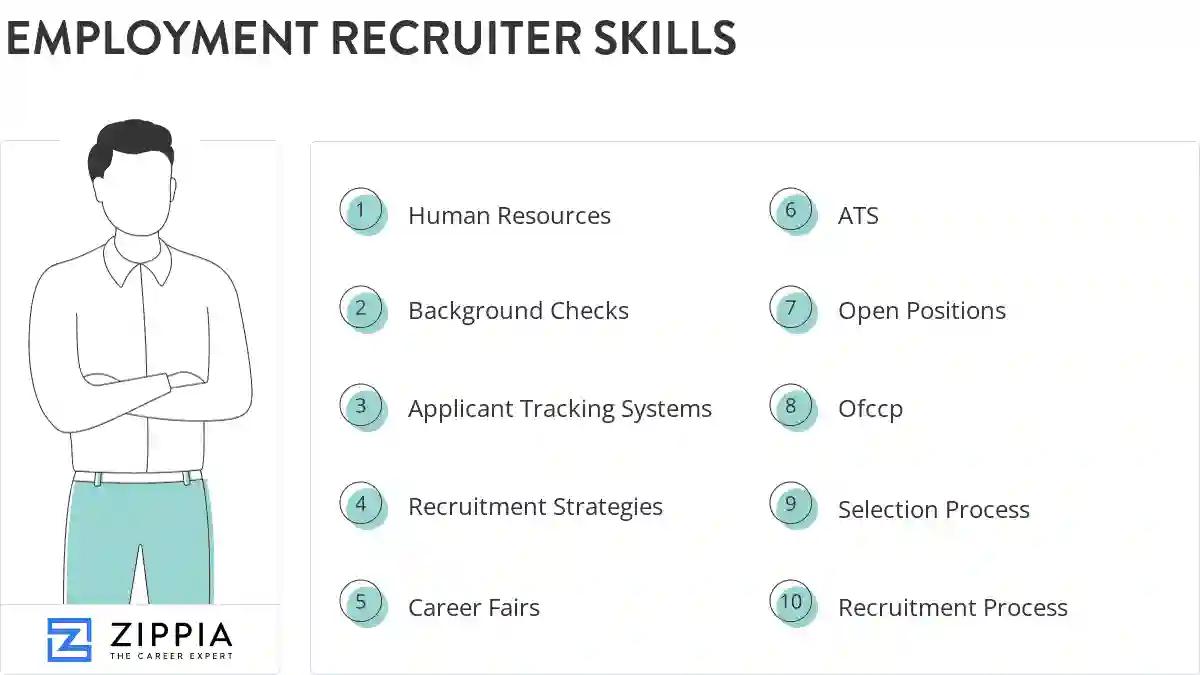
The most important skills for an employment recruiter resume and required skills for an employment recruiter to have include:
- Human Resources
- Background Checks
- Applicant Tracking Systems
- Recruitment Strategies
- Career Fairs
- ATS
- Open Positions
- Ofccp
- Selection Process
- Recruitment Process
- Drug Screens
- Business Relationships
- Interview Applicants
- I-9
- Employment Agencies
- Internal Candidates
- Reference Checks
- Drug Tests
- Cold Calls
- Exit Interviews
- EEO
- Unemployment Claims
- Phone Interviews
- Employment Process
- Computer Database
- Professional Organizations
- Scheduling Interviews
- Travel Arrangements
- PowerPoint
- Screen Applicants
Updated January 8, 2025
