Explore jobs
Find specific jobs
Explore careers
Explore professions
Best companies
Explore companies
Job outlook for employment training specialists in the United States
Employment training specialist job growth summary. After extensive research, interviews, and analysis, Zippia's data science team found that:
The projected employment training specialist job growth rate is 8% from 2018-2028.
About 28,900 new jobs for employment training specialists are projected over the next decade.
Employment training specialist salaries have increased 6% for employment training specialists in the last 5 years.
There are over 17,608 employment training specialists currently employed in the United States.
There are 38,365 active employment training specialist job openings in the US.
The average employment training specialist salary is $35,991.
Are employment training specialist jobs in demand?
Employment training specialist job and salary trends over time
Employment training specialist jobs over time
Employment training specialist job growth rate over time
| Year | # of jobs | % of population |
|---|---|---|
| 2021 | 17,608 | 0.01% |
| 2020 | 15,457 | 0.00% |
| 2019 | 15,109 | 0.00% |
| 2018 | 14,168 | 0.00% |
| 2017 | 13,238 | 0.00% |
Average employment training specialist salary over time
Employment training specialist salary by year
| Year | Avg. salary | Hourly rate | % Change |
|---|---|---|---|
| 2026 | $35,991 | $17.30 | +2.4% |
| 2025 | $35,136 | $16.89 | +0.6% |
| 2024 | $34,941 | $16.80 | +0.8% |
| 2023 | $34,648 | $16.66 | +2.3% |
| 2022 | $33,879 | $16.29 | +1.4% |
Employment training specialist jobs by state
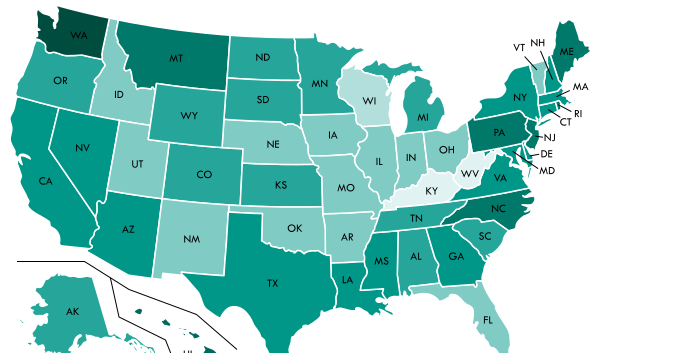
Most common states for employment training specialists
| Rank | State | Population | # of jobs | Employment/ 1000ppl |
|---|---|---|---|---|
| 1 | District of Columbia | 693,972 | 228 | 33% |
| 2 | Delaware | 961,939 | 162 | 17% |
| 3 | North Dakota | 755,393 | 127 | 17% |
| 4 | Wyoming | 579,315 | 100 | 17% |
| 5 | Iowa | 3,145,711 | 500 | 16% |
| 6 | New Hampshire | 1,342,795 | 216 | 16% |
| 7 | Nebraska | 1,920,076 | 295 | 15% |
| 8 | Maine | 1,335,907 | 200 | 15% |
| 9 | Montana | 1,050,493 | 160 | 15% |
| 10 | Massachusetts | 6,859,819 | 983 | 14% |
| 11 | Vermont | 623,657 | 85 | 14% |
| 12 | Minnesota | 5,576,606 | 731 | 13% |
| 13 | Alabama | 4,874,747 | 616 | 13% |
| 14 | Arkansas | 3,004,279 | 402 | 13% |
| 15 | Alaska | 739,795 | 97 | 13% |
| 16 | Virginia | 8,470,020 | 1,048 | 12% |
| 17 | Mississippi | 2,984,100 | 372 | 12% |
| 18 | Utah | 3,101,833 | 363 | 12% |
| 19 | Kansas | 2,913,123 | 347 | 12% |
| 20 | North Carolina | 10,273,419 | 1,103 | 11% |
Most common cities for employment training specialists
| Rank | City | # of jobs | Employment/ 1000ppl | Avg. salary |
|---|---|---|---|---|
| 1 | Salem | 3 | 7% | $37,896 |
| 2 | Medford | 1 | 2% | $38,004 |
| 3 | Worcester | 1 | 1% | $38,235 |
| 4 | Boston | 1 | 0% | $38,064 |
| 5 | Pittsburgh | 1 | 0% | $39,065 |
| 6 | Seattle | 1 | 0% | $48,671 |
Employment Training Specialist job outlook: Expert opinions
Our panel of employment training specialist experts
New Mexico State University
Texas A&M University - Central Texas
Saint Xavier University
University of Alaska Fairbanks
University of Memphis

Indiana University of Pennsylvania (IUP)

Virginia Wesleyan University
University of Utah

Rowan University

Michigan State University

American University

The Ohio State University at Lima

University of the Ozarks
North Carolina Central University
ETSTech-Ops

American Public University System

Forsyth County, Georgia
What general advice would you give to an Employment Training Specialist?
Carol Flinchbaugh Ph.D.: I always remind students entering today’s workforce they will have anywhere from 6-8 careers. Not jobs, careers. That is the age we are living in with such fast technological advances. They need to have an understanding as to how and when their careers will change based on generative AI. That said, there are many industries – especially in customer service-related jobs – where job roles won’t change so quickly.
Allen Redmon Ph.D.
Dean, College of Arts and SciencesTexas A&M University - Central Texas
Multi/Interdisciplinary Studies
What general advice would you give to an Employment Training Specialist?
Allen Redmon Ph.D.: Those who want to maximize their earning potential should consider a company’s culture as much as the job they are taking. Every company has its own culture. Those who find the right culture for them and grow into that culture will fare better than those who just accept a job without considering the culture of a company. Those who take a job without considering the culture will almost always experience a mismatch at some point, which will require them to look for a new job sooner than expected.
What Employment Training Specialist skills would you recommend for someone trying to advance their career?
Allen Redmon Ph.D.: One essential job trait that doesn’t get discussed enough is empathy, the ability to develop processes, statements, and objectives with the client, customer, or user in mind. Those employees or companies who start from a place of empathy will always outpace those who do not.
David Parker LL.M. Human Rights Law, LL.M. National Security Law, JD, MBA, CFE
Associate ProfessorSaint Xavier University
Business, Management, Marketing, And Related Support Services
What general advice would you give to an Employment Training Specialist?
David Parker LL.M. Human Rights Law, LL.M. National Security Law, JD, MBA, CFE: Critical thinking and problem-solving, Technological literacy / digital literacy, Resiliency, stress tolerance and flexibility, Creativity, originality and ideation, Emotional intelligence & interpersonal skills, and Curiosity and active/continuous learning.
What general advice would you give to an Employment Training Specialist?
Jaunelle Celaire: Never stop learning! This may consist of going back to school, earning new certifications in your field of study, attending conferences and seminars, and making sure that your time management is always at its finest level of excellence.
What Employment Training Specialist skills would you recommend for someone trying to advance their career?
Jaunelle Celaire: Leadership - the world needs more of these; the ability to lead, craft and grow. Digital literacy - this world is definitely turning digital and virtual is the new trend. Emotional intelligence - there is a vast number of personalities in our world today; individuals grow and it is our job to stay emotionally connected, so we can operate more effectively.
What will help Employment Training Specialists increase their earning potential?
Jaunelle Celaire: Learn from everything. Remember every moment is a learning opportunity from everyone around you, no matter their title. Pay attention when things go well and clue in and pay extra attention when they do not; watch how people react to it. Build relationships and network with the people who face problems by being their solution.
Ali Fatemi
Ring Companies Professor and Chair of Mechanical EngineeringUniversity of Memphis
Mechanical Engineering
What Employment Training Specialist skills would you recommend for someone trying to advance their career?
Ali Fatemi: Research the company you will be working for and see how your skillsets and strengths, both academic and personal, match the needs of the company. Try to differentiate yourself from others with the same degree with unique qualifications, such as strong communication, teamworking, organizational, and leadership skills.
Dr. Tammy Manko Ed.D.
DirectorIndiana University of Pennsylvania (IUP)
Career and Professional Development Center, Academic Affairs
What Employment Training Specialist skills would you recommend for someone trying to advance their career?
Dr. Tammy Manko Ed.D.: I recommend all graduates and professionals become adept at virtual communication in all its forms, so they can be effective communicators in all settings and are prepared to work with various technological platforms and tools. I also recommend all graduates and professionals review the NACE Competencies naceweb and ensure they have and continue to hone the outlined career-ready skill sets as well as these additional career and life skills (or power/soft skills): adaptability, prioritization, positivity, emotional intelligence, and nonverbal communication (i.e., body language).
Will there be an enduring impact of the coronavirus pandemic on Employment Training Specialists?
Jessica Harrington: Realistically, new graduates should expect some impact. New graduates, depending on their field, may struggle to find full-time employment directly after graduation, which could have effects on lifetime earnings and, as a result, major financial decisions.
What type of skills will young Employment Training Specialists need?
Jessica Harrington: Competitive new graduates will need a variety of soft skills, some of which they have likely already developed, such as adaptability and advanced written and oral communication skills. Strong technical skills and certifications will benefit new graduates as they enter what is often a virtual work setting.
Will there be an enduring impact of the coronavirus pandemic on Employment Training Specialists?
Sarah Kovalesky: I think the pandemic's impact on graduates is still a little bit unknown as we see changes and different waves in different parts of the country. I believe and hope that most of the impact will be in the short-term.
After a period of little hiring, we are seeing companies and organizations hiring again. We know it is an employer's market right now, meaning postings have more applicants, and employers have their pick of qualified candidates. I think it is fair to say that it might take longer for graduates to find jobs, and networking is more critical now than ever!
The last thing I have been reminding a lot of Psychology students these last several months is that their degree offers a lot of versatility in the world of work. The ability to identify your skills and recognize the transferability of them is critical!
Dr. Kate Seltzer Ph.D.
Assistant ProfessorRowan University
Department of Language, Literacy and Sociocultural education
How would you rate the starting salaries for Employment Training Specialists, as well as the prospects for salary advancement?
Dr. Kate Seltzer Ph.D.: Educators are not paid nearly enough. However, working in a state with strong teachers' unions helps to ensure a starting salary that recent graduates can live off of and growth opportunities, albeit modest, over their careers.
What technology do you think will become more important and prevalent for Employment Training Specialists in the next 3-5 years?
Dr. Phil Gardner Ph.D.: Technology - Data Science - the ability to interpret trends of data tracked in livestock production and then to prescribe changes in management. This is also huge in crop production.
Automation - in animal care and food processing to lower demand for human labor because there are shortages.
Will there be an increase or decrease in demand for Employment Training Specialists in the next 5 years?
Dr. Phil Gardner Ph.D.: During the quarantine, we had strong demand for both interns and graduates - there were many programs at MSU that had many internships canceled due to covid. Americans now realize the importance of our food industry and supply chain as we all saw shortages in the stores - food production is essential. Areas such as poultry, swine, dairy and meat industry are winning the student recruitment battle because of competitive salaries. The demand for talent in production ag has been strong. We also have a few contract research organizations recruiting for study technicians. I predict that the trend of more animal science jobs than interested students will continue in the future.
Employers are offering jobs if students are doing a great job in their internship. MSU also had two-year programs offered through our Institute of Ag Technology, last fall. We had a first-year student get offered an internship in the fall with Kalmbach in Ohio, halfway through his summer internship, and he was offered a job. Because his courses are now online this semester, he is staying in Ohio, starting his new job, and finishing up his classes online.
What general advice would you give to an Employment Training Specialist?
Raina Gandhi: First impressions matter and will stay with you, so remember to bring your most professional self to work, maintain a positive attitude, and put in the hours. When you make mistakes, learn from them.
Also, take the time to get to know your colleagues and workplace norms, make sure you understand how performance is measured, and don't be afraid to ask for feedback. As you get comfortable with your role, look for ways to take on additional responsibilities to expand your skillset and build your reputation within the company.
You may not land your dream job right away, but this first job is critical for building your experience and gaining transferrable skills. Stay current in your field by reading articles, subscribing to email newsletters, and following relevant people and companies on LinkedIn
Are there any particularly good places in the United States for Employment Training Specialists to find work opportunities?
Leah Herner-Patnode: Usually, urban areas of bigger cities and southern states, such as North Carolina, have many openings. Maine, Florida, California, Hawaii, Washington, and Texas are the most open positions.
Are there any particularly good places in the United States for Employment Training Specialists to find work opportunities?
Ruth Walton: There are tons of employment opportunities across this country. During the past few months, there have been more and more remote jobs too! Yet, there must be a realization that the job market is very different for each geographic region. According to Bloomberg.com, in August 2020, there was an increase in the Performing Arts, Motion Pictures, and Electronics, and a decline in Facilities Support Services, Lodging, and Travel. According to the Bureau of Labor, if we research the fastest-growing occupations, we find 57% of the growth is in Healthcare, split pretty much in half by jobs requiring less than a bachelor's degree, and half requiring at least a master's degree.
Salary.com lists the seven best careers for the future as:
Healthcare
Information Technology
Alternative Energy
International Law
Marketing
Financial Analyst
Content Creator
If we narrow down our top growth sectors and jobs per Texas, Arkansas, and Oklahoma, we can see other industries.
Each of these three states shares top growth in Healthcare and Professional & Business Services. In Texas, we add Education and Engineering, and in Oklahoma, we add Education.
It is not to say that there are not Education jobs in Arkansas; it means that Texas and Oklahoma will have much more growth. Arkansas will still need teachers.
bloomberg
Bls
Salary
Elisha Blankson
Program Director NCCU, Assistant ProfessorNorth Carolina Central University
Communication Disorders Department
What type of skills will young Employment Training Specialists need?
Elisha Blankson: Graduates will need a skill set about the field in which they received training and additional skills useful to the job market. For example, with the changing demographics in the United States, extra skills in information technology and foreign languages will be a plus when entering the job market.
Are there any particularly good places in the United States for Employment Training Specialists to find work opportunities?
Nola Pearce: Depending on your chosen career scope, there are opportunities across the United States - urban, suburban, rural. If you have a wide range of interests and career experience, geographic possibilities are endless. If you are very specific within an industry, material, or application, there are pockets of locations that might be better than another. I recommend that you reach out to professionals within the industry or profession that you have interest in.
Dr. Elizabeth Keavney Ph.D.
Associate ProfessorAmerican Public University System
Public Administration Department
How do you envision technology impacting Employment Training Specialists in the next 5 years?
Dr. Elizabeth Keavney Ph.D.: COVID-19 has increased the number of people who are working at home. This means a solid basic knowledge of telecommuting, and the ability to work unsupervised will be necessary. The ability to use remote security protocols, the cloud, and various software platforms will be required.
Are there any particularly good places in the United States for Employment Training Specialists to find work opportunities?
Donna Kukarola: This one, not so sure of, the southeast continues to see options as well as mid-western states.