What does an environmental engineer/scientist do?
An environmental engineer/scientist specializes in devising strategies and solutions against environmental issues. Their responsibilities revolve around observing subjects, gathering samples and data, performing experiments and thorough analyses, studying human effects and influences on the environment, and producing reports based on research findings. Moreover, as an environmental engineer/scientist, it is essential to coordinate with other scientists, review findings, and participate in environmental projects and causes. One may also contribute studies on research papers and other publications and even raise public awareness of environmental issues.
Environmental engineer/scientist responsibilities
Here are examples of responsibilities from real environmental engineer/scientist resumes:
- Manage Jenkins security by providing specific access to authorize developers/testers using project base matrix authorization strategy.
- Perform safety and health monitoring and oversight on all projects.
- Present audit results to site level director and EHS senior managers.
- Conduct personnel oversight and supervision.
- Initiate a thorough EHS auditing and corrective action program and establish a comprehensive industrial hygiene monitoring program at each facility.
- Assist in development of work plans and provide assistance to EPA for subsequent remediation of contaminate sites and abandon industrial facilities.
- Demonstrate the significance of regulations implement by EPA through creation of presentations and informational booklets to be distribute at regional meetings.
- Expedite and simplify the quotation process for solar water heating systems by accurately representing solar water heating system performance through MATLAB models
- Evaluate facilities in regard to RCRA compliance, general facility safety, and best management practices.
- Perform environmental and geotechnical exploratory boring field logging and reporting.
Environmental engineer/scientist skills and personality traits
We calculated that 11% of Environmental Engineers/Scientist are proficient in OSHA, Environmental Engineering, and Oversight. They’re also known for soft skills such as Imagination, Reading skills, and Writing skills.
We break down the percentage of Environmental Engineers/Scientist that have these skills listed on their resume here:
- OSHA, 11%
Developed and implemented a configuration management program for company documents required by both OSHA and EPA risk assessment regulations.
- Environmental Engineering, 10%
Moved to environmental engineering and managed air emissions work with contractors as well as performing individual contributor work.
- Oversight, 9%
Conducted personnel oversight and supervision.
- EPA, 8%
Developed desk reference for EPA s National Exposure Research Laboratory to help researchers communicate environmental research to the public more effectively.
- Groundwater, 6%
Performed environmental sampling for analysis and regulatory requirements including groundwater, soil, sediment, air and hazardous waste.
- Air Quality, 5%
Obtained air quality construction and operating permits from state and local regulating agencies by forging and maintaining relationships with agency representatives.
"osha," "environmental engineering," and "oversight" are among the most common skills that environmental engineers/scientist use at work. You can find even more environmental engineer/scientist responsibilities below, including:
Imagination. The most essential soft skill for an environmental engineer/scientist to carry out their responsibilities is imagination. This skill is important for the role because "environmental engineers sometimes have to design systems that will be part of larger ones." Additionally, an environmental engineer/scientist resume shows how their duties depend on imagination: "verified full system emulator with android opengl basemark es taiji, imagination isp benchmarks. "
Reading skills. Another essential skill to perform environmental engineer/scientist duties is reading skills. Environmental engineers/scientist responsibilities require that "environmental engineers often work with businesspeople, lawyers, and other professionals outside their field." Environmental engineers/scientist also use reading skills in their role according to a real resume snippet: "performed elevation readings and recorded with gps unit. "
Writing skills. Another skill that relates to the job responsibilities of environmental engineers/scientist is writing skills. This skill is critical to many everyday environmental engineer/scientist duties, as "environmental engineers must write clearly so that others without their specific training can understand their documents, including plans, proposals, specifications, and findings, among others." This example from a resume shows how this skill is used: "assist in the analysis of lab results, and writing report for semiannual groundwater and surface water sampling. "
Problem-solving skills. A big part of what environmental engineers/scientist do relies on "problem-solving skills." You can see how essential it is to environmental engineer/scientist responsibilities because "when designing facilities and processes, environmental engineers strive to solve several issues at once, from workers’ safety to environmental protection." Here's an example of how this skill is used from a resume that represents typical environmental engineer/scientist tasks: "project manager for resolution trust corporation (rtc) environmental site assessments. "
The three companies that hire the most environmental engineer/scientists are:
- AECOM10 environmental engineers/scientist jobs
- Barr Engineering Co.9 environmental engineers/scientist jobs
- Langan9 environmental engineers/scientist jobs
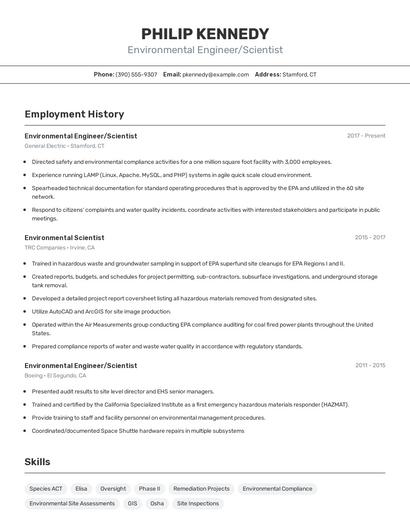
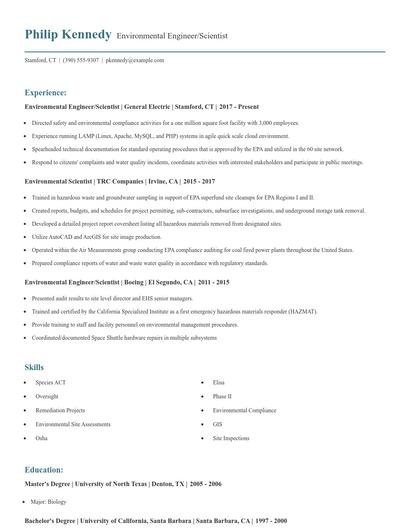
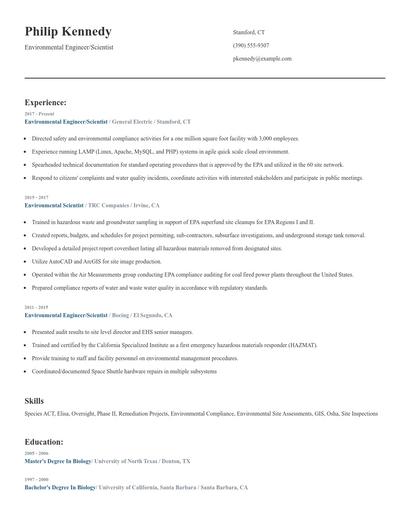
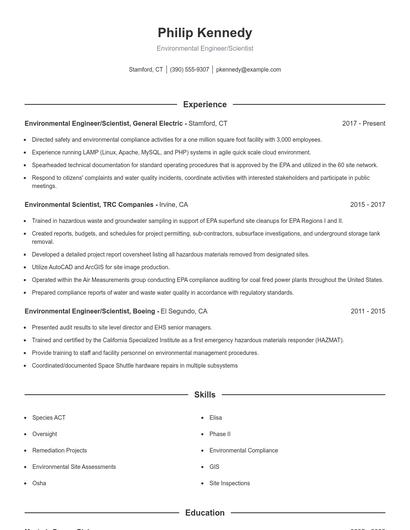
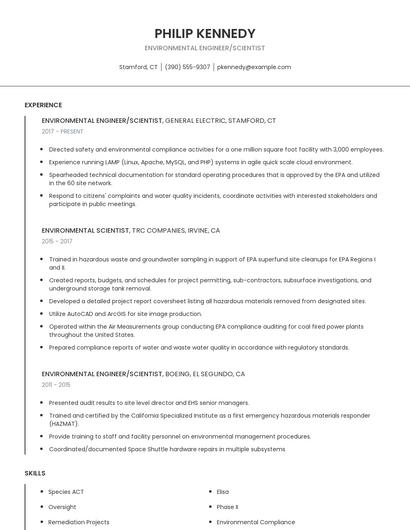
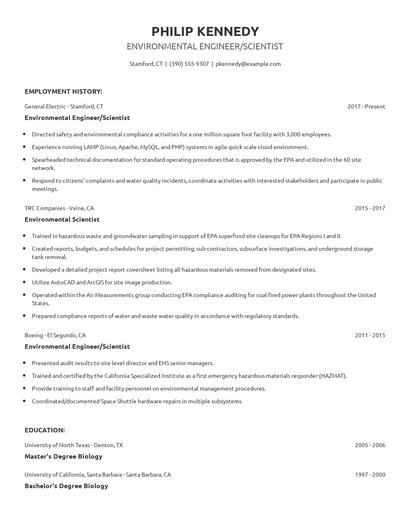
Choose from 10+ customizable environmental engineer/scientist resume templates
Build a professional environmental engineer/scientist resume in minutes. Our AI resume writing assistant will guide you through every step of the process, and you can choose from 10+ resume templates to create your environmental engineer/scientist resume.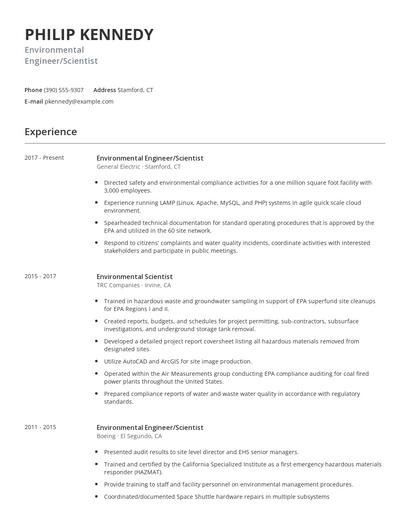


Compare different environmental engineers/scientist
Environmental engineer/scientist vs. Waste management specialist
A waste management specialist designs and manages waste reduction and reclamation projects. They work with government officials to ensure that waste management goes smoothly. They ensure the implementation of waste management and evaluate a waste management program's success. This position requires a university degree or a recognized training certificate.
While similarities exist, there are also some differences between environmental engineers/scientist and waste management specialist. For instance, environmental engineer/scientist responsibilities require skills such as "environmental engineering," "oversight," "groundwater," and "air quality." Whereas a waste management specialist is skilled in "hazardous waste management," "waste disposal," "environmental compliance," and "waste streams." This is part of what separates the two careers.
Waste management specialists really shine in the energy industry with an average salary of $79,835. Comparatively, environmental engineers/scientist tend to make the most money in the technology industry with an average salary of $86,387.The education levels that waste management specialists earn slightly differ from environmental engineers/scientist. In particular, waste management specialists are 8.6% less likely to graduate with a Master's Degree than an environmental engineer/scientist. Additionally, they're 3.0% less likely to earn a Doctoral Degree.Environmental engineer/scientist vs. Engineering project coordinator
An engineering project coordinator works with project managers and specialists to ensure that all aspects of the project are carried out and cared for. They make sure that work is done according to schedule, the staff is doing their job per timeframe, the budget is allocated for, and expenditures are accounted for. They must also have good communication skills to report to stakeholders and heads proficiently. They are also involved in project meetings and propose improvements.
In addition to the difference in salary, there are some other key differences worth noting. For example, environmental engineer/scientist responsibilities are more likely to require skills like "osha," "environmental engineering," "oversight," and "epa." Meanwhile, an engineering project coordinator has duties that require skills in areas such as "project management," "shop drawings," "powerpoint," and "project documentation." These differences highlight just how different the day-to-day in each role looks.
Engineering project coordinators earn a lower average salary than environmental engineers/scientist. But engineering project coordinators earn the highest pay in the technology industry, with an average salary of $100,848. Additionally, environmental engineers/scientist earn the highest salaries in the technology with average pay of $86,387 annually.In general, engineering project coordinators achieve lower levels of education than environmental engineers/scientist. They're 5.6% less likely to obtain a Master's Degree while being 3.0% less likely to earn a Doctoral Degree.What technology do you think will become more important and prevalent for environmental engineer/scientists in the next 3-5 years?
Andrea Welker Ph.D.
Associate Dean for Academic Affairs, College of Engineering Professor, Civil and Environmental Engineering, Villanova University
Environmental engineer/scientist vs. Engineer
Engineers are highly trained professionals who determine the feasibility of various projects, usually related to the construction industry. They are considered experts in mathematics and science, two disciplines that they need to use in designing and coming up with plans for projects. They should also be well-versed in different construction or industrial materials, and they ensure that appropriate materials are used for the project. They also ensure that the projects meet the requirements of the groups that hired them. They create spaces that would both address the needs of the end-users and the industry standards. They also ensure that the projects they make would stand the test of time.
The required skills of the two careers differ considerably. For example, environmental engineers/scientist are more likely to have skills like "osha," "environmental engineering," "oversight," and "epa." But a engineer is more likely to have skills like "python," "cloud," "c++," and "c #."
Engineers make a very good living in the automotive industry with an average annual salary of $97,672. On the other hand, environmental engineers/scientist are paid the highest salary in the technology industry, with average annual pay of $86,387.When it comes to education, engineers tend to earn similar degree levels compared to environmental engineers/scientist. In fact, they're 2.3% less likely to earn a Master's Degree, and 2.4% less likely to graduate with a Doctoral Degree.Environmental engineer/scientist vs. Engineering coordinator
An engineering coordinator organizes and oversees engineering projects. They typically perform administrative support tasks such as conducting extensive research and analysis, arranging schedules with clients, handling calls and correspondence, liaising with internal and external parties, reviewing contracts and other documentation, and managing the flow of documents and information across different teams. They may also participate in the planning, designing, and developing stages of projects. Moreover, as an engineering coordinator, it is essential to maintain an active communication line with different departments while implementing the company's policies and regulations.
Types of environmental engineer/scientist
Updated January 8, 2025
