
Automatically apply for jobs with Zippia
Upload your resume to get started.
Executive relations specialist skills for your resume and career
15 executive relations specialist skills for your resume and career
1. Government Officials
- Coordinate nationwide industry leading corporate events which host elite market leaders and government officials.
- Developed new business opportunities for the company through effective working relationships with clients, government officials, and media representatives.
2. Customer Complaints
- Handle customer complaints by researching and negotiating verbal and written complaints addressed to Verizon Wireless Executive Leadership.
- Worked closely with corporate headquarters and government agencies to register and resolve customer complaints.
3. Infectious Disease
Infectious disease refers to an illness or disorder caused by a small organism. These organisms may be bacteria, fungi, parasites, or viruses and can cause a variety of symptoms in the exposed person. Some of these organisms can jump from one person to another, which spreads the infectious disease between individuals.
- Called on Pediatricians, Neonatologist, Pulmonologist and Infectious Disease Specialists in high volume private practices, clinics and hospitals.
- Focused customers: Intensivists, Pulmonologists, Infectious Disease, Surgeons, Cardiologists, and Pharmacists.
4. Sales Procedures
- Assess client needs by processing a thorough knowledge of optional products and sales procedures.
5. Business Bureau
- Gathered account data for sensitive client escalations, including legal and Better Business Bureau situations.
- Completed intake forms for government agency complaints from the FCC, Attorney General, Better Business Bureau and Public Utilities commission.
6. OCC
- Upload reports to CFPB, OCC, and BBB portals.
Choose from 10+ customizable executive relations specialist resume templates
Build a professional executive relations specialist resume in minutes. Our AI resume writing assistant will guide you through every step of the process, and you can choose from 10+ resume templates to create your executive relations specialist resume.7. Internal Medicine
- Developed new business and managed existing accounts in pediatrics, family medicine, and internal medicine as well as hospitals.
- Promoted the sales of blood glucose meters and strips to endocrinologists, internal medicine specialists and primary care physicians.
8. Regulatory Agencies
A regulatory agency is a Public Benefit Corporation (PBC) that is responsible for supervising certain human activities and controlling them to some extent. They are set up in some areas such as hospitals, law firms, and governmental setup to regulate safety standards. They prevent undue and unjust abuse of power in these setups.
- Developed positive relations with representatives at state regulatory agencies via personal contact as well as written.
- Coordinate with the regulatory agencies and law enforcement body as and when required.
9. FCC
The Federal Communications Commission (FCC) is an autonomous agency of the US government that regulates all communication by television, radio, satellite, wire, and cable throughout the United States. The FCC holds jurisdiction over the fields of broadband access, homeland security, radio frequency use, fair competition, media responsibility, and public safety.
- Resolved high level disputes including FCC complaints, BBB feedback and those directed to high ranking executives.
- Partnered with Legal to provide correspondences to the BBB, FCC, and Attorney General Agencies.
10. HR
HR stands for human resources and is used to describe the set of people who work for a company or an organization. HR responsibilities revolve around updating employee records and carrying out management processes like planning, recruitment, evaluation, and selection processes. HR is a key contributor to any company or organization's growth as they are in charge of hiring the right employees, processing payrolls, conducting disciplinary actions, etc.
- Computed monthly and quarterly employee grievance reports for over 50 employees and discussed the same at team meetings with HR Director.
- Act as custodian of HR compensation & benefit budget, including year to year projection and optimization.
11. Sales Training
- Completed sales training and mastered product knowledge.
- Direct sales training for new hires.
12. Inbound Calls
- Received inbound calls from health care professionals requesting to initiate prior authorizations for specific medications.
- Answer inbound calls from medical facilities nationwide, inquiring about patient laboratory results.
13. Customer Issues
- Charged with the effective resolution of escalated customer issues involving regulatory, discriminatory, and complex customer concerns to reduce risk.
- Performed detailed research and resolution of customer complaint issues and managed headquarters and customer service escalated customer issues.
14. Expense Reports
- Process expense reports of varying currencies, compliance reporting, internal audit reports and monthly/quarterly reporting due to Board of Directors.
- Maintained Outlook calendar, travel advances, expense reports and special projects for the Sr. VP of International Development Program.
15. Government Agencies
- Handled calls from government agencies, public utilities commissions, AT&T executive offices and senior management and attorneys.
- Respond to Government agencies Addressing customers concerns about telephony, Cable, and CHSI billing.
5 Executive Relations Specialist resume examples
Build a professional executive relations specialist resume in minutes. Browse through our resume examples to identify the best way to word your resume. Then choose from 5+ resume templates to create your executive relations specialist resume.

What skills help Executive Relations Specialists find jobs?
Tell us what job you are looking for, we’ll show you what skills employers want.
What skills stand out on executive relations specialist resumes?
Dr. Mike Dillon
Associate Professor/Internship Director, Duquesne University
What executive relations specialist skills would you recommend for someone trying to advance their career?
Brooke Witherow
Assistant Professor of Communication Arts, Hood College
What soft skills should all executive relations specialists possess?
Gregg Feistman
Assistant Chair for Public Relations, Associate Professor of Practice, Temple University
What hard/technical skills are most important for executive relations specialists?
Jennifer Lee Magas
Vice President of Magas Media Consultants, LLC and a Clinical Associate Professor of Public Relations, Pace University
-Intelligence
-The ability to recognize a good story when you see one
-Media savvy - knowing different kinds of media and how they function, deadlines, formats
-Contacts - who do you know in the news business
-Good business sense - how to make money, capitalize on an idea
-Broad communications experience
-Specialized experience - watch these emerging trends: more jobs in corporate communications, crisis management, health care, consumer goods, financial services, technology, cannabis PR, collaborating with influencers
List of executive relations specialist skills to add to your resume
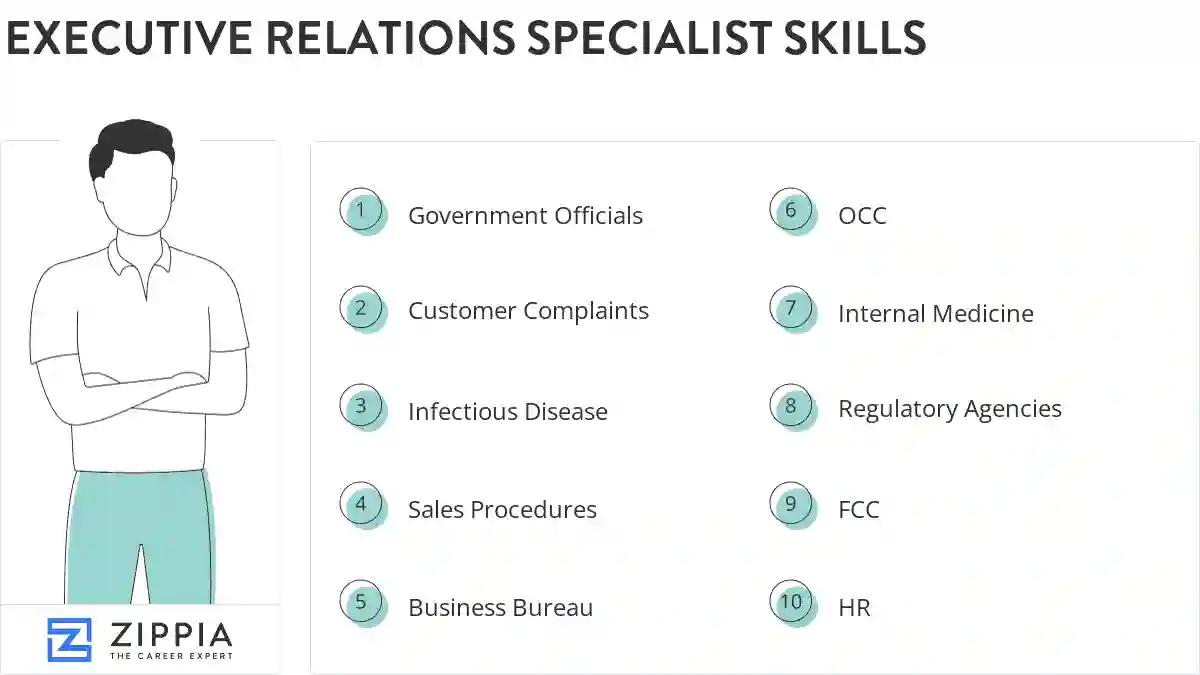
The most important skills for an executive relations specialist resume and required skills for an executive relations specialist to have include:
- Government Officials
- Customer Complaints
- Infectious Disease
- Sales Procedures
- Business Bureau
- OCC
- Internal Medicine
- Regulatory Agencies
- FCC
- HR
- Sales Training
- Inbound Calls
- Customer Issues
- Expense Reports
- Government Agencies
- Conference Calls
- PowerPoint
- Customer Inquiries
- Advisory Boards
- Psychiatry
- Business Development
- ADHD
- Customer Relationships
- Educational Programs
- Apple
- Process Improvement
Updated January 8, 2025
