What does a features editor do?
A features editor's duty is to oversee and delegate the articles in the feature section of newspapers, magazines, and other digital publications to writers. Their job also includes pitching suitable articles from freelancers and making sure that the articles made for their publication are informative, on topic, and well-written. Also, the features editor must be detail-oriented and meticulous to ensure that every article is error-free and creative since they are the ones who supervise and decide whether the stories are ethical and factual enough before publishing.
Features editor responsibilities
Here are examples of responsibilities from real features editor resumes:
- Manage SEO and Adwords, and social media content.
- Film and edit all video content as well as managing the YouTube channel and social media feeds.
- Manage weekly flash fiction competition.
- Manage communication between editorial, photo, video and production departments.
- Market via facebook, twitter and blog.
- Report to editor-in-chief and oversee feature reporting staff.
- Assign, copy edit and schedule posts on WordPress.
- Assign, write and edit stories for daily metro newspaper.
- Work with the news editor and editor-in-chief to determine what stories should be cover.
- Experience with HTML coding, Java applets and PageMill and SiteMill HTML editing programs.
- Recruit and train unpaid bloggers in SEO and teach them to post on hot topics and trends.
- Recruit to be main contributor of Caribbean entertainment base articles for new blog for and by Caribbean women.
- Maintain social media accounts: add daily posts to the company s blog, facebook, and twitter pages.
- Appoint photography editor in 2001and specialize in sports photography.
- Produce photography as needed for articles and accumulate additional images in repository.
Features editor skills and personality traits
We calculated that 12% of Features Editors are proficient in Editorial Content, Layout Design, and SEO. They’re also known for soft skills such as Creativity, Detail oriented, and Good judgment.
We break down the percentage of Features Editors that have these skills listed on their resume here:
- Editorial Content, 12%
Collaborated with expert authors and editorial staff to develop targeted and timely editorial content.
- Layout Design, 9%
Provided the original concept, as well as the photo-editing, writing and layout design of the publication.
- SEO, 8%
Recruited and trained unpaid bloggers in SEO and taught them to post on hot topics and trends.
- Adobe Indesign, 7%
Created, designed and edited published pages for publication in the Features section using Adobe InDesign.
- Lifestyle, 7%
Managed content planning and editing for seven weekly lifestyles and entertainment sections.
- Feature Stories, 6%
Coordinated photographers for feature stories.
Most features editors use their skills in "editorial content," "layout design," and "seo" to do their jobs. You can find more detail on essential features editor responsibilities here:
Creativity. One of the key soft skills for a features editor to have is creativity. You can see how this relates to what features editors do because "editors must be imaginative, curious, and knowledgeable in a broad range of topics." Additionally, a features editor resume shows how features editors use creativity: "key accomplishments: wrote consistently compelling persuasive copy that spoke directly to the audience and provided editorial, creative direction. "
Detail oriented. Many features editor duties rely on detail oriented. "editors must be meticulous to ensure that material is error free and matches the style of a publication.," so a features editor will need this skill often in their role. This resume example is just one of many ways features editor responsibilities rely on detail oriented: "worked in an extremely time-sensitive deadline oriented environment to create feature stories for both publications. "
Good judgment. Another skill that relates to the job responsibilities of features editors is good judgment. This skill is critical to many everyday features editor duties, as "editors decide whether certain stories are ethical and whether there is enough evidence to publish them." This example from a resume shows how this skill is used: "exercised sound editorial judgment, typically with minimal supervision, in a highly competitive and deadline-driven environment. "
Interpersonal skills. For certain features editor responsibilities to be completed, the job requires competence in "interpersonal skills." The day-to-day duties of a features editor rely on this skill, as "in working with writers, editors must have tact and the ability to guide and encourage them in their work." For example, this snippet was taken directly from a resume about how this skill applies to what features editors do: "coordinated interpersonal relations between editorial staff, artists, writers and judges. "
Writing skills. Another crucial skill for a features editor to carry out their responsibilities is "writing skills." A big part of what features editors relies on this skill, since "editors ensure that all written content has correct grammar, punctuation, and syntax." How this skill relates to features editor duties can be seen in an example from a features editor resume snippet: "maintained correspondence with 8 features writers on staff about article topics and their writing progression. "
The three companies that hire the most features editors are:
- Screen Rant6 features editors jobs
- BuzzFeed
2 features editors jobs
- NBCUniversal2 features editors jobs
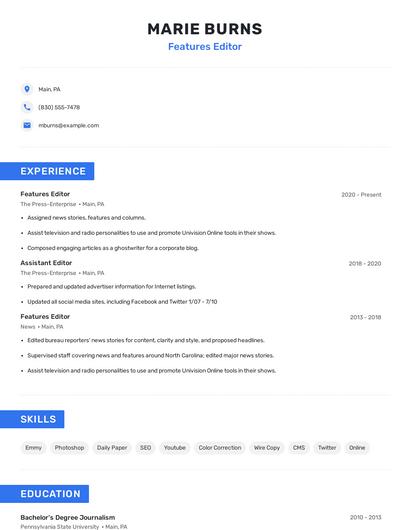
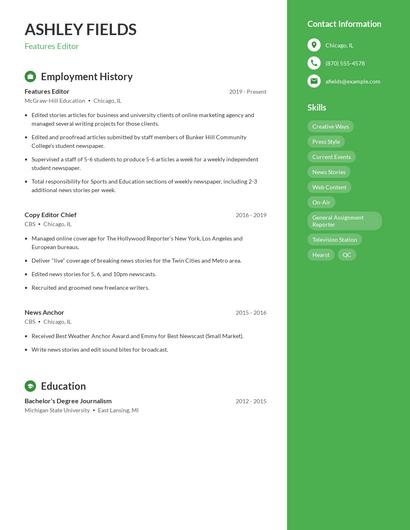
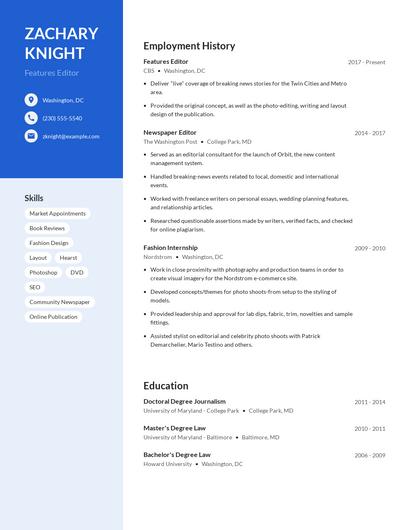
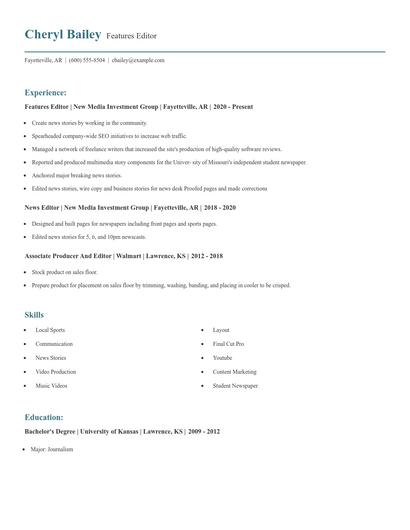
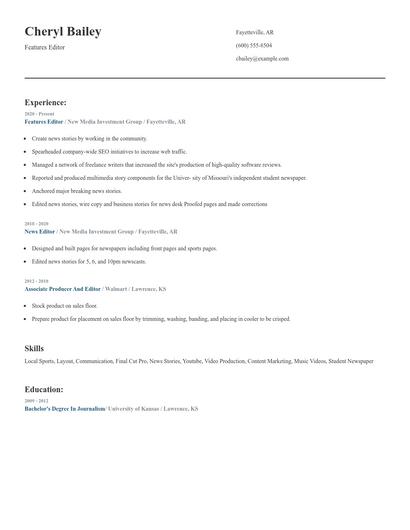
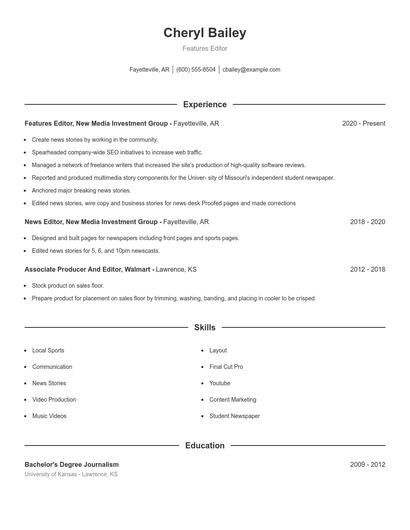
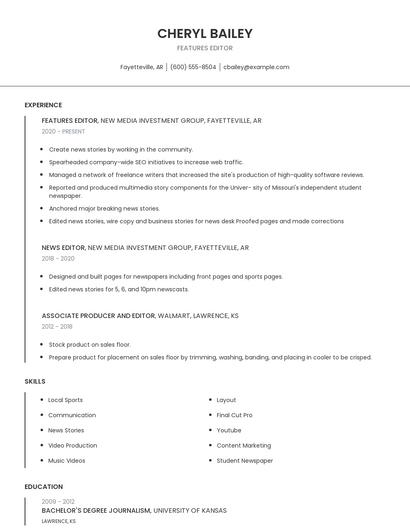
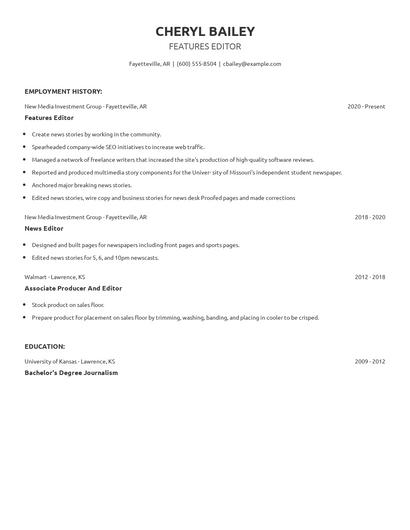
Choose from 10+ customizable features editor resume templates
Build a professional features editor resume in minutes. Our AI resume writing assistant will guide you through every step of the process, and you can choose from 10+ resume templates to create your features editor resume.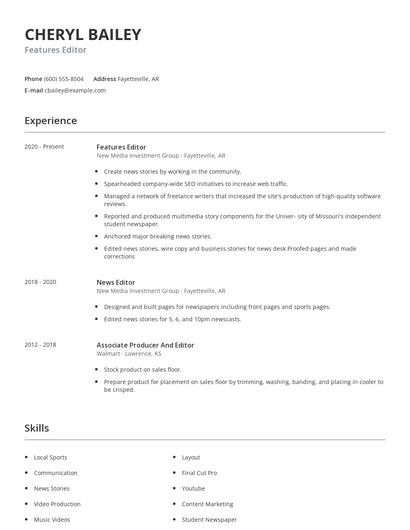
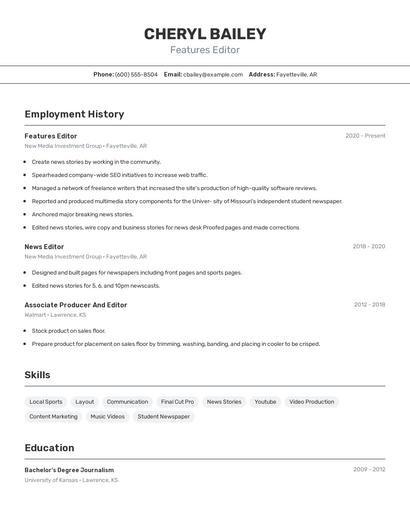
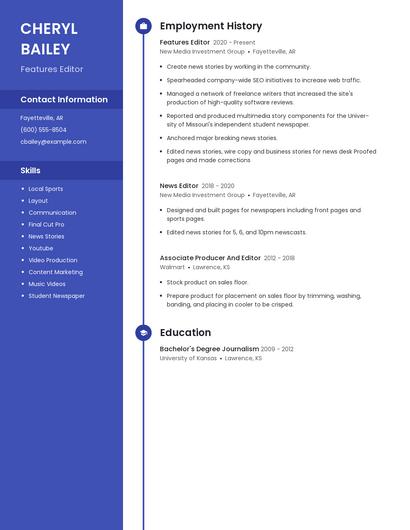
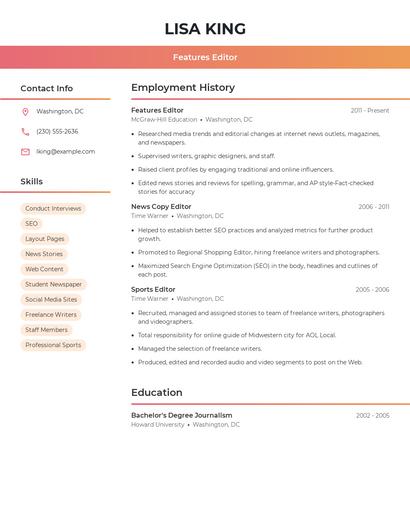
Compare different features editors
Features editor vs. Editing internship
An editorial intern is responsible for assisting the editorial department of an organization with publishing various media and digital content. Editorial interns shadow tenured editorial staff on researching stories, validating information, writing captivating articles, interviewing target audiences, and screening submitted manuscripts. They also assist in planning promotional strategies and marketing campaigns, such as monitoring press releases, posting on social media platforms, and developing marketing materials. An editorial intern must have excellent organizational skills, most importantly, a fast-learner to understand complex tasks and perform assigned duties under minimal supervision.
These skill sets are where the common ground ends though. The responsibilities of a features editor are more likely to require skills like "editorial content," "layout design," "seo," and "lifestyle." On the other hand, a job as an editing internship requires skills like "video footage," "photography," "youtube," and "adobe premiere pro." As you can see, what employees do in each career varies considerably.
On average, editing interns reach similar levels of education than features editors. Editing interns are 1.7% less likely to earn a Master's Degree and 0.4% less likely to graduate with a Doctoral Degree.Features editor vs. Editorial internship
An editorial intern is responsible for assisting the editorial team in publishing digital and media content, writing articles, and managing readers' reviews. Editorial interns must have excellent knowledge of the industry they work for, suggesting the latest trends and featured topics, taking notes of the tenured employees' advice and observations, and actively joining brainstorming sessions. An editorial intern must be detail-oriented and take constructive feedback as an opportunity to learn. It is also crucial to have outstanding communication and proofreading skills and keep all the materials confidential until release.
In addition to the difference in salary, there are some other key differences worth noting. For example, features editor responsibilities are more likely to require skills like "layout design," "lifestyle," "comics," and "editorial calendar." Meanwhile, an editorial internship has duties that require skills in areas such as "fact-check," "editorial intern," "instagram," and "administrative tasks." These differences highlight just how different the day-to-day in each role looks.
Editorial interns earn a lower average salary than features editors. But editorial interns earn the highest pay in the media industry, with an average salary of $33,508. Additionally, features editors earn the highest salaries in the non profits with average pay of $55,202 annually.editorial interns earn similar levels of education than features editors in general. They're 1.4% less likely to graduate with a Master's Degree and 0.4% less likely to earn a Doctoral Degree.What technology do you think will become more important and prevalent for features editors in the next 3-5 years?
Bradley Shreve
Editor, Tribal College Journal
Features editor vs. Editor, freelance
An Editor, Freelance is responsible for reading content and correcting for errors in spelling, grammar, and punctuation. They work with writers to help their ideas and stories succeed.
The required skills of the two careers differ considerably. For example, features editors are more likely to have skills like "editorial content," "layout design," "adobe indesign," and "lifestyle." But a editor, freelance is more likely to have skills like "music videos," "fiction," "track changes," and "promotional videos."
Most editors, freelance achieve a higher degree level compared to features editors. For example, they're 5.8% more likely to graduate with a Master's Degree, and 1.8% more likely to earn a Doctoral Degree.Features editor vs. Production assistant/editor
Production assistants/editors are individuals with skills in communication, adaptability, organization, and administration. They also possess a healthy dose of enthusiasm and perseverance and the ability to work well under pressure. This career choice calls for assisting directors of film and television in collecting and organizing elements needed to edit the film, and overseeing the various lists and instructions needed for putting the film into its final form.
Even though a few skill sets overlap between features editors and production assistant/editors, there are some differences that are important to note. For one, a features editor might have more use for skills like "editorial content," "layout design," "seo," and "lifestyle." Meanwhile, some responsibilities of production assistant/editors require skills like "photography," "audio board," "video production," and "teleprompter. "
In general, production assistant/editors hold similar degree levels compared to features editors. Production assistant/editors are 1.0% less likely to earn their Master's Degree and 0.2% more likely to graduate with a Doctoral Degree.Types of features editor
Updated January 8, 2025
