What does a feed mill operator do?
Feed mill operator responsibilities
Here are examples of responsibilities from real feed mill operator resumes:
- Experience following procedures and managing GMP documentation.
- Operate tube mill, and Mig and Tig welding.
- Check and start equipment such as agitators, pumps, and filters.
- Coordinate with material engineers and chemists to troubleshoot areas of improvement.
- Prepare rough cut wood for assembly by ripping, jointing, planing, and cutting various exotic woods.
Feed mill operator skills and personality traits
We calculated that 45% of Feed Mill Operators are proficient in CDL, FDA, and Grinders. They’re also known for soft skills such as Communication skills, Coordination, and Mechanical skills.
We break down the percentage of Feed Mill Operators that have these skills listed on their resume here:
- CDL, 45%
Have CDL would drive swab unit to job and rig up and swab well in then turn it over to production
- FDA, 28%
Maintain records as required by Food and Drug Administration (FDA).
- Grinders, 6%
Maintain and operate all feed-making equipment Load and unload, haul and deliver feed Operating corn grinders Understand ingredients and feed formula
- Mill Equipment, 4%
Maintain and repair various components of mill equipment.
- Rail Cars, 4%
Loaded in trucks,rail cars and 18 wheelers.
- Load Trucks, 3%
Load and unload trucks as well as weigh them in and out of facility.
Most feed mill operators use their skills in "cdl," "fda," and "grinders" to do their jobs. You can find more detail on essential feed mill operator responsibilities here:
Communication skills. One of the key soft skills for a feed mill operator to have is communication skills. You can see how this relates to what feed mill operators do because "material moving machine operators signal and direct workers to load and unload material." Additionally, a feed mill operator resume shows how feed mill operators use communication skills: "entered customer information into computer system monitored all of the communications within a specific geographic area. "
Coordination. Another soft skill that's essential for fulfilling feed mill operator duties is coordination. The role rewards competence in this skill because "material moving machine operators must have steady hands and feet to guide and control heavy machinery precisely." According to a feed mill operator resume, here's how feed mill operators can utilize coordination in their job responsibilities: "meet productivity goals & quality standards- communicate in english, both verbal and written- good hand-eye coordination- attention to detail"
Mechanical skills. This is an important skill for feed mill operators to perform their duties. For an example of how feed mill operator responsibilities depend on this skill, consider that "material moving machine operators make minor adjustments to their machines and perform basic maintenance on them." This excerpt from a resume also shows how vital it is to everyday roles and responsibilities of a feed mill operator: "operated front end loader and bulldozer drove rock truck and tractor unloaded and loaded trucks mechanical maintenance and repair".
Visual ability. For certain feed mill operator responsibilities to be completed, the job requires competence in "visual ability." The day-to-day duties of a feed mill operator rely on this skill, as "material moving machine operators must be able to see clearly where they are driving or what they are moving." For example, this snippet was taken directly from a resume about how this skill applies to what feed mill operators do: "perform visual quality checks and quality tests using testing equipment. "
The three companies that hire the most feed mill operators are:
- Livestock Nutrition Center Llc
17 feed mill operators jobs
- Christensen Farms5 feed mill operators jobs
- CHS5 feed mill operators jobs
Choose from 10+ customizable feed mill operator resume templates
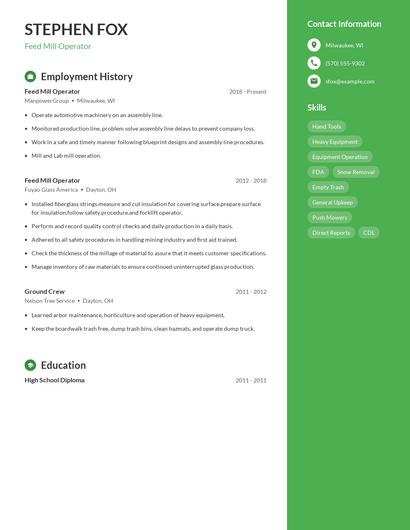
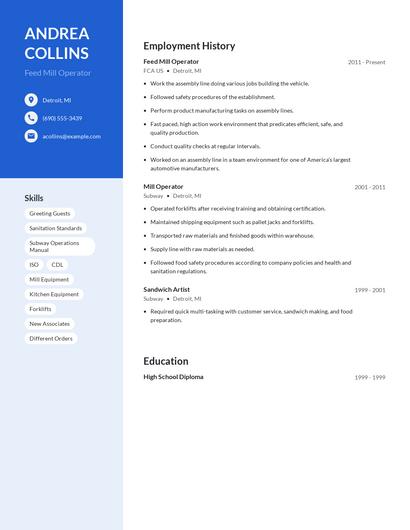
Build a professional feed mill operator resume in minutes. Our AI resume writing assistant will guide you through every step of the process, and you can choose from 10+ resume templates to create your feed mill operator resume.




Compare different feed mill operators
Feed mill operator vs. Production employee
In a manufacturing setting, a production employee is in charge of assembling and processing products, ensuring efficiency and timelines. Their responsibilities include adhering to guidelines and blueprints, monitoring the products for any defects or inconsistencies, operating machines and equipment, keeping an eye on the assembly line, and maintaining the cleanliness of work areas. Furthermore, as a production employee, it is essential to maintain an active communication line with co-workers, coordinating every step of the way, and alerting managers should there be any problems.
These skill sets are where the common ground ends though. The responsibilities of a feed mill operator are more likely to require skills like "cdl," "fda," "strong work ethic," and "propane." On the other hand, a job as a production employee requires skills like "production floor," "quality standards," "safety standards," and "work ethic." As you can see, what employees do in each career varies considerably.
Production employees tend to make the most money working in the automotive industry, where they earn an average salary of $35,336. In contrast, feed mill operators make the biggest average salary, $38,760, in the manufacturing industry.On average, production employees reach similar levels of education than feed mill operators. Production employees are 1.0% less likely to earn a Master's Degree and 0.2% more likely to graduate with a Doctoral Degree.Feed mill operator vs. Ammunition assembly labour
A shop worker may work in a wholesale or retail shop to provide customer service. They welcome guests, maintain their store's cleanliness, and ensure stock levels are maintained. They may also be responsible for ringing customers up.
In addition to the difference in salary, there are some other key differences worth noting. For example, feed mill operator responsibilities are more likely to require skills like "cdl," "fda," "strong work ethic," and "propane." Meanwhile, an ammunition assembly labour has duties that require skills in areas such as "hand tools," "assembly line," "blueprint specifications," and "work ethic." These differences highlight just how different the day-to-day in each role looks.
Ammunition assembly labours may earn a lower salary than feed mill operators, but ammunition assembly labours earn the most pay in the automotive industry with an average salary of $35,211. On the other hand, feed mill operators receive higher pay in the manufacturing industry, where they earn an average salary of $38,760.Average education levels between the two professions vary. Ammunition assembly labours tend to reach similar levels of education than feed mill operators. In fact, they're 1.7% less likely to graduate with a Master's Degree and 0.2% less likely to earn a Doctoral Degree.Feed mill operator vs. Shop worker
Production workers are employees who are usually seen in an assembly line in a company's factory. They are responsible for a specific part of the production of goods for the company. They ensure that production processes are being followed. Production workers are required to be efficient, detail-oriented, and organized. They should be able to uphold the quality standards set by the company and should be able to conduct quality control checks. Should they be working alongside machines, and they must know how to operate the machine as well as maintain it. Production workers should also be familiar with occupational safety and health guidelines and must be able to follow policies and procedures in place.
Some important key differences between the two careers include a few of the skills necessary to fulfill the responsibilities of each. Some examples from feed mill operator resumes include skills like "cdl," "fda," "strong work ethic," and "propane," whereas a shop worker is more likely to list skills in "tape measure," "safety procedures," "in-shop," and "delivery orders. "
Shop workers earn the best pay in the manufacturing industry, where they command an average salary of $35,066. Feed mill operators earn the highest pay from the manufacturing industry, with an average salary of $38,760.When it comes to education, shop workers tend to earn similar degree levels compared to feed mill operators. In fact, they're 1.8% less likely to earn a Master's Degree, and 0.3% less likely to graduate with a Doctoral Degree.Feed mill operator vs. Production worker
Types of feed mill operator
Updated January 8, 2025
