
Automatically apply for jobs with Zippia
Upload your resume to get started.
Field applications scientist skills for your resume and career
15 field applications scientist skills for your resume and career
1. Post Sales
- Provided Post Sales support for product training, installation, and commissioning.
- Supported customer base on in a post sales role.
2. Next-Generation Sequencing
- Established a Next-generation sequencing platform and developed assays for high-throughput genetic analysis using Ion Torrent Personal Genome Machine (PGM).
- Led execution of research evaluation study to prepare Small-RNA sequencing libraries from clinical samples for Next-Generation sequencing.
3. Pre Sales
- Served as a post and pre sales technical liaison.
- Implemented Applications pre sales initiative, resulting in growth of new client base.
4. Chemistry
Chemistry is the branch of science that tells us about the composition, properties, and structure of elements and compounds. The processes these elements undergo and how they undergo change all come under the branch of chemistry.
- Managed software development projects, including the creation of a chemical inventory management system to integrate with the Discovery Chemistry ELN.
- Served as the in-house discovery chemistry consultant for the Discovery Chemistry Electronic Laboratory Notebook (ELN) software development team.
5. Technical Support
Technical support or tech support are the services provided by any hardware or software company to users. They help in solving the technical difficulties the customers face with their products or services. Moreover, the tech support employees maintain, manage, and repair the IT faults. They are also responsible for resolving the network problems, installing and configuring hardware and software.
- Provided technical support for sales teams by facilitating product presentations and demonstrations of analyzers and sorters to close new business deals.
- Carried on technical support to customers through field visit, phone calls and emails.
6. Customer Support
- Promote quality-driven, on-site customer support to align both products and optimal performance for customers to achieve continued success.
- Contributed for the designing and execution of AOAC style validation, verification and feasibility studies to develop customer support recommendations.
Choose from 10+ customizable field applications scientist resume templates
Build a professional field applications scientist resume in minutes. Our AI resume writing assistant will guide you through every step of the process, and you can choose from 10+ resume templates to create your field applications scientist resume.7. Customer Service
Customer service is the process of offering assistance to all the current and potential customers -- answering questions, fixing problems, and providing excellent service. The main goal of customer service is to build a strong relationship with the customers so that they keep coming back for more business.
- Traveled to 5 different countries to accomplish customer services.
- Managed client accounts, including training, equipment installations and repairs, presales presentations and demonstrations, customer service.
8. Customer Satisfaction
- Enhance customer satisfaction and increase competitive advantage while building trust and relationships with customers.
- Collaborated with sales account managers to increase sales and customer satisfaction.
9. Product Demonstrations
Product demonstrations mean displaying products or services offered by an organization to potential customers. It assists in capturing prospective clients or investors interested in the product. It also helps in addressing more comprehensively the concerns of a specific product.
- Traveled to hundreds of customer sites throughout the US to conducted product demonstrations, training sessions and product presentation seminars.
- Analyzed customer requirements and workflow processes in developing product demonstrations.
10. Molecular Biology
- Support other molecular biology related instruments mainly Qiagility, Qiaxcel and Pyrosequencing.
- Planned and completed experiments utilizing molecular biology, cell biology and biochemistry techniques to discover and develop novel neurological disease targets.
11. Troubleshoot
Troubleshooting is the process of analyzing and fixing any kind of problem in a system or a machine. Troubleshooting is the detailed yet quick search in the system for the main source of an issue and solving it.
- Install, integrate, troubleshoot and perform preventive maintenance of telecommunication and networking hardware/software.
- Consult, repair and troubleshoot electrical/electronic control circuits.
12. Trade Shows
- Represent Qiagen s detection product line at trade shows
- Presented at numerous trade shows and taught several seminars to paying customers on multiple radio frequency identification-related topics.
13. Applications Support
- Key Achievements Rapidly assumed applications support for half of North American customers.
- Field applications support for CLIPR(TM) and FLIPR(TM) imaging instruments for small molecule drug discovery applications.
14. Customer Training
Customer training is the training aimed at providing customers with the information, content, and other materials they need to efficiently and effectively use a product or service to derive value from it. It is an excellent way to reduce customer support interaction and to improve customer retention.
- Coordinate new installation, validation and customer training.
- Provide installation, customer training and field service support.
15. Sample Preparation
Sample preparation stands for the processes through which a sample is extracted from a bigger amount and prepared for analysis. The objective of sample preparation is to better analytical results without compromising the actual material's integrity.
- Trained as sample preparation and instrumentation specialist.
- Perform a variety of complex sample preparation and analysis procedures to quantitatively measure pharmaceutical compounds in a variety of biological matrices.
5 Field Applications Scientist resume examples
Build a professional field applications scientist resume in minutes. Browse through our resume examples to identify the best way to word your resume. Then choose from 5+ resume templates to create your field applications scientist resume.

What skills help Field Applications Scientists find jobs?
Tell us what job you are looking for, we’ll show you what skills employers want.
What field applications scientist skills would you recommend for someone trying to advance their career?
Lisa Cuchara Ph.D.
Professor of Biomedical Sciences, Quinnipiac University
Also being a good steward towards science and being willing and able to communicate not just with peers as we are trained, but also with the public, the politicians, the board members. John Holdren*, stated that Scientists should be tithing at least 10 percent of their time to public service ... including activism. In the ever growing science denialism that is happening in our country being able to communicate science with the public is important. As Peter Hotaz states, "Anti-science propaganda is "killing Americans in unprecedented numbers,""
*Holdren is an American scientist who served as the senior advisor to President Barack Obama on science and technology issues through his roles as assistant to the president for science and technology, director of the White House Office of Science and Technology Policy, and co-chair of the President's Council of Advisors on Science and Technology and a Research Professor in Harvard University's Kennedy School of Government
What type of skills will young field applications scientists need?
Dennis Doverspike Ph.D.
Chief People Scientist, Doverspike Consulting/HR LItehouse
List of field applications scientist skills to add to your resume
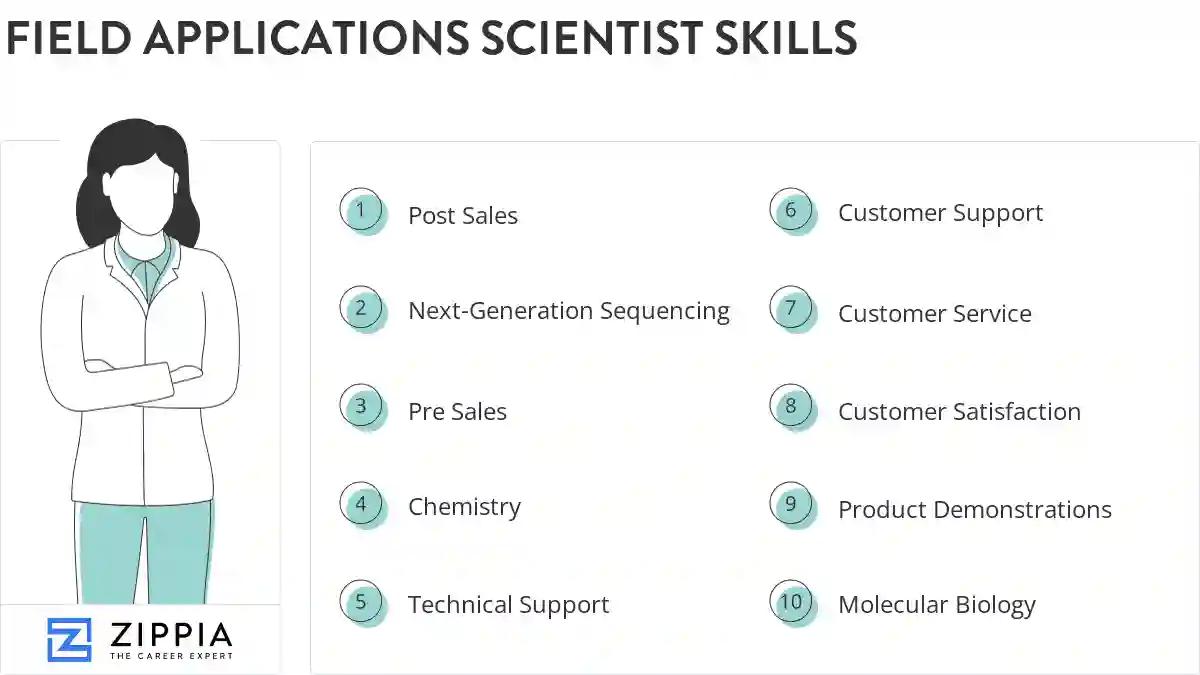
The most important skills for a field applications scientist resume and required skills for a field applications scientist to have include:
- Post Sales
- Next-Generation Sequencing
- Pre Sales
- Chemistry
- Technical Support
- Customer Support
- Customer Service
- Customer Satisfaction
- Product Demonstrations
- Molecular Biology
- Troubleshoot
- Trade Shows
- Applications Support
- Customer Training
- Sample Preparation
- Data Analysis
- Product Training
- NGS
- Customer Sites
- CRM
- Assay Development
- Customer Feedback
- GMP
- Technical Presentations
- FAS
- RNA
- PCR
- Cell-Based Assays
- DNA
- Technical Expertise
- Marketing Collateral
- Image Analysis
- Biosystems
- R
- Software Products
- Elisa
- Assay Design
- Building Relationships
- Electrophoresis
- HTS
- User Training
- Lead Generation
- QC
Updated January 8, 2025
