What does a field engineer associate do?
Field engineer associate responsibilities
Here are examples of responsibilities from real field engineer associate resumes:
- Manage Terraform and refactore from monolithic to application specific components.
- Key support and assistance for problems on network and individual PCs.
- Image PCs, resolve printer and connectivity issues, and install software as necessary.
- Analyze malfunctions and equipment failures of various network operating systems such as servers, gateways and routers used in radio communications systems
- Develop procedural documentation for plan and corrective maintenance of high power radar transmitters.
Field engineer associate skills and personality traits
We calculated that 17% of Field Engineers Associate are proficient in Control Systems, Troubleshoot, and Technical Assistance. They’re also known for soft skills such as Concentration, Initiative, and Speaking skills.
We break down the percentage of Field Engineers Associate that have these skills listed on their resume here:
- Control Systems, 17%
Performed debug and repair of simulator electronic control systems.
- Troubleshoot, 16%
Network and System administration background provided a strong problem solving skills and ability to troubleshoot network application and environment issues.
- Technical Assistance, 13%
Provided technical assistance and training to Navy personnel.
- Customer Satisfaction, 12%
Provided quality service to customer base to include remedial and preventative maintenance, perform corrective actions and ensure total customer satisfaction.
- Customer Sites, 8%
Travel to customer sites to perform walk downs, maintenance, installation, site acceptance testing and commissioning.
- Technical Support, 7%
Provide routine, on-site technical support for customer/company network systems.
Common skills that a field engineer associate uses to do their job include "control systems," "troubleshoot," and "technical assistance." You can find details on the most important field engineer associate responsibilities below.
Concentration. To carry out their duties, the most important skill for a field engineer associate to have is concentration. Their role and responsibilities require that "electrical and electronics engineers design and develop complex electrical systems and electronic components and products." Field engineers associate often use concentration in their day-to-day job, as shown by this real resume: "provided engineering support for department of energy construction activities with concentration on civil installations. "
Initiative. Another essential skill to perform field engineer associate duties is initiative. Field engineers associate responsibilities require that "electrical and electronics engineers must apply their knowledge to new tasks in every project they undertake." Field engineers associate also use initiative in their role according to a real resume snippet: "led initiative to standardize css, themes and javascript for cross browser and cross platform support. "
Speaking skills. Another skill that relates to the job responsibilities of field engineers associate is speaking skills. This skill is critical to many everyday field engineer associate duties, as "electrical and electronics engineers work closely with other engineers and technicians." This example from a resume shows how this skill is used: "identified, addressed, and resolved technical issues with electronic equipment. "
Writing skills. field engineer associate responsibilities often require "writing skills." The duties that rely on this skill are shown by the fact that "electrical and electronics engineers develop technical publications related to equipment they develop, including maintenance manuals, operation manuals, parts lists, product proposals, and design methods documents." This resume example shows what field engineers associate do with writing skills on a typical day: "experience writing automation scripts in ruby and bash. "
Interpersonal skills. Another common skill required for field engineer associate responsibilities is "interpersonal skills." This skill comes up in the duties of field engineers associate all the time, as "electrical and electronics engineers must work with others during the manufacturing process to ensure that their plans are implemented correctly." An excerpt from a real field engineer associate resume shows how this skill is central to what a field engineer associate does: "demonstrated strong customer management and excellent interpersonal communication skills. "
Math skills. Another skill commonly found on field engineer associate job descriptions is "math skills." It can come up quite often in field engineer associate duties, since "electrical and electronics engineers must use the principles of calculus and other advanced math in order to analyze, design, and troubleshoot equipment." Here's an example from a resume of how this skill fits into day-to-day field engineer associate responsibilities: "developed taught various everyday math, literacy (including fundations), social studies, and anti-bullying lessons. "
The three companies that hire the most field engineer associates are:
- ERM8 field engineers associate jobs
- Emerson4 field engineers associate jobs
- Technology Service Professionals3 field engineers associate jobs
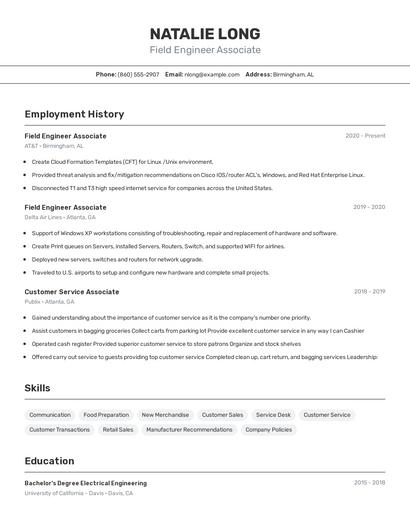
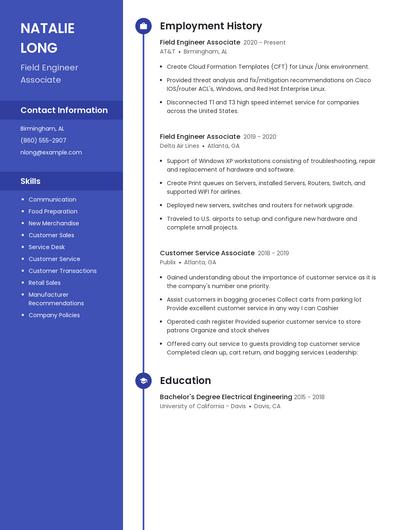
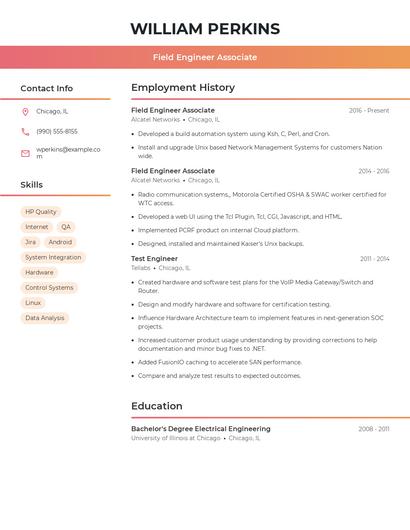
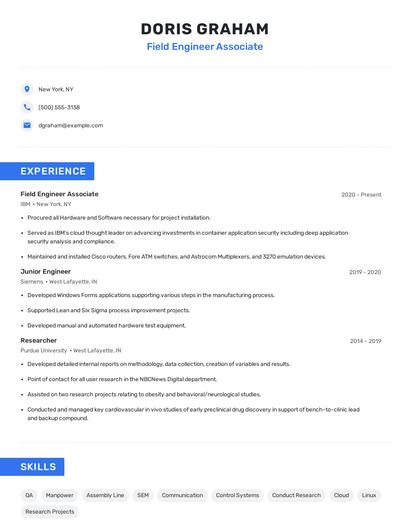
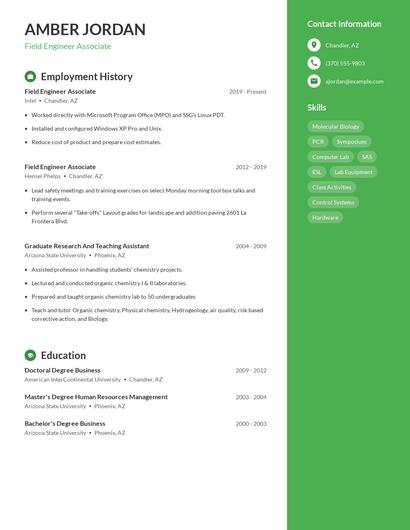
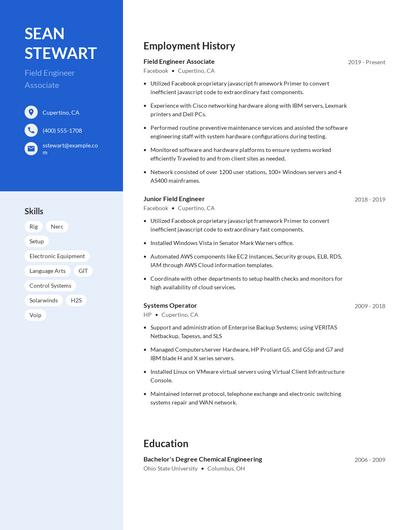
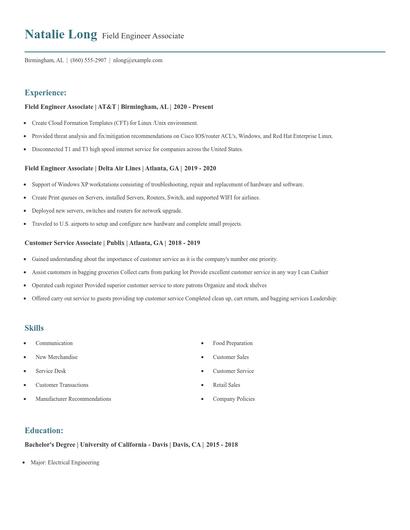
Choose from 10+ customizable field engineer associate resume templates
Build a professional field engineer associate resume in minutes. Our AI resume writing assistant will guide you through every step of the process, and you can choose from 10+ resume templates to create your field engineer associate resume.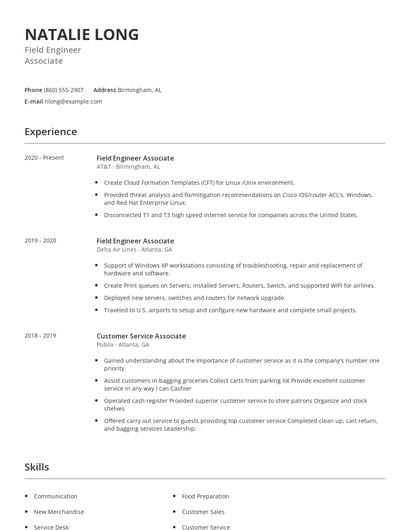
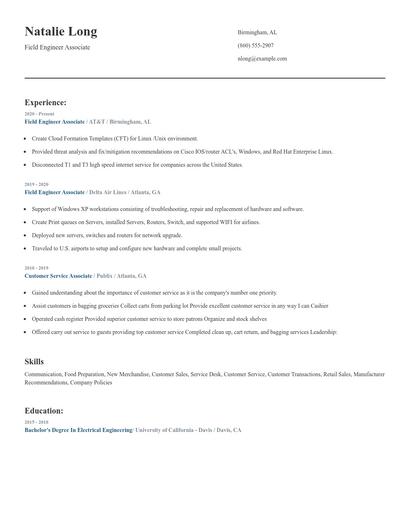
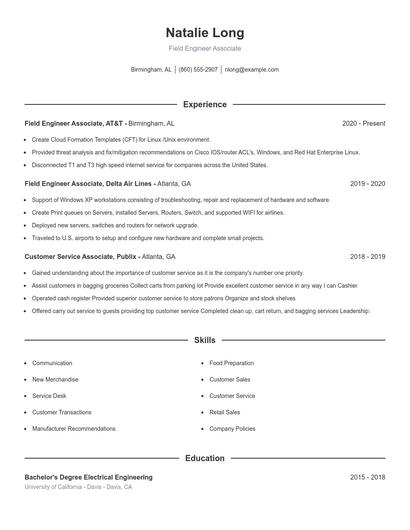
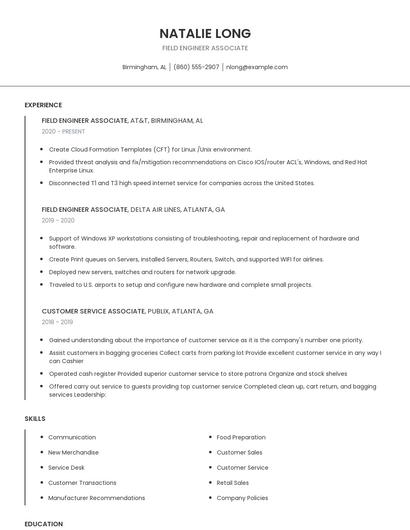
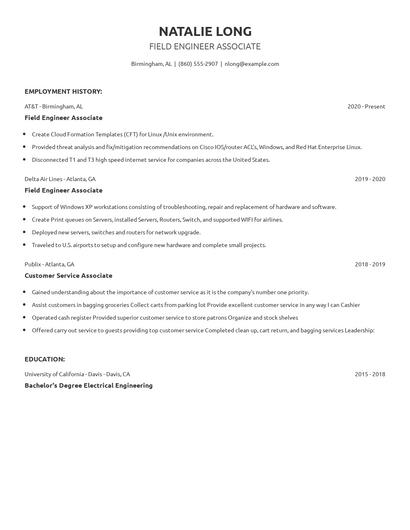
Compare different field engineers associate
Field engineer associate vs. Electrical & instrumentation designer
An electrical instrumentation designer's main job is to design instruments that can be used in various areas such as laboratories, power plants, or research institutes. They work together with a team or individually to design instruments, create a prototype, and test its functions. They can even install these instruments in different establishments and locations. They are tasked with repair and training engineers. At other times, they are assigned to record expenses and other documentation.
These skill sets are where the common ground ends though. The responsibilities of a field engineer associate are more likely to require skills like "fire protection," "troubleshoot," "process management," and "technical assistance." On the other hand, a job as an electrical & instrumentation designer requires skills like "plc," "instrumentation design," "p id," and "i/o." As you can see, what employees do in each career varies considerably.
The education levels that electrical & instrumentation designers earn slightly differ from field engineers associate. In particular, electrical & instrumentation designers are 4.3% less likely to graduate with a Master's Degree than a field engineer associate. Additionally, they're 0.0% less likely to earn a Doctoral Degree.Field engineer associate vs. Electrical designer
An electrical designer designs and develops electrical circuit and system layouts for electric power distribution. The responsibilities of an electrical designer include assembling electrical panels and leading a team of document control personnel in-charged to identify and organize facility maintenance drawings. The position requires good initiative, writing, speaking, and mathematical skills to accomplish such responsibilities. The job's education requirements include possessing a college degree in electrical engineering, design, or a related field.
While some skills are similar in these professions, other skills aren't so similar. For example, resumes show us that field engineer associate responsibilities requires skills like "fire protection," "troubleshoot," "process management," and "technical assistance." But an electrical designer might use other skills in their typical duties, such as, "revit," "electrical design," "autocad electrical," and "ul."
Electrical designers earn a lower average salary than field engineers associate. But electrical designers earn the highest pay in the manufacturing industry, with an average salary of $72,768. Additionally, field engineers associate earn the highest salaries in the energy with average pay of $87,432 annually.Average education levels between the two professions vary. Electrical designers tend to reach similar levels of education than field engineers associate. In fact, they're 1.5% less likely to graduate with a Master's Degree and 0.0% more likely to earn a Doctoral Degree.Field engineer associate vs. Senior electrical designer
A Senior Electrical Designer is in charge of creating electrical schematics, layouts, and other grid plans for their organization, as well as providing the best solution for improvements. They supervise the material, construction, labor costs, and project timescales.
Some important key differences between the two careers include a few of the skills necessary to fulfill the responsibilities of each. Some examples from field engineer associate resumes include skills like "fire protection," "troubleshoot," "process management," and "technical assistance," whereas a senior electrical designer is more likely to list skills in "electrical design," "revit," "electrical equipment," and "electrical systems. "
Senior electrical designers earn the best pay in the manufacturing industry, where they command an average salary of $90,234. Field engineers associate earn the highest pay from the energy industry, with an average salary of $87,432.Most senior electrical designers achieve a similar degree level compared to field engineers associate. For example, they're 1.1% less likely to graduate with a Master's Degree, and 0.0% less likely to earn a Doctoral Degree.Field engineer associate vs. Instrumentation & control engineer
An instrumentation and control engineer is responsible for installing and designing technical components for engineering systems that would support production and manufacturing processes. Instrumentation and control engineers inspect control systems, modify features and infrastructure, configure controllers, and run multiple quality checks to ensure stability and optimal performance. They must have excellent communication and technical skills, especially in developing system codes and analyzing programming languages to serve control functions and development. An instrumentation and control engineer also resolves system issues and write resolution reports for reference.
Types of field engineer associate
Updated January 8, 2025
