
Automatically apply for jobs with Zippia
Upload your resume to get started.
Finisher operator skills for your resume and career
15 finisher operator skills for your resume and career
1. Hand Tools
- Add or mix chemicals and ingredients for processing, using hand tools or other devices.
- Operated various power tool and hand tools.
2. Math
- Produced and maintained accurate documentation for production reports using math and computer skills.
- Job required a variety of skills including general math and communication with management.
3. Quality Checks
Quality checks are a component of quality control aimed at ensuring that quality requirements are met. Internally, quality checks provide assurance to managers, and externally, it provides assurance to clients, federal departments, authorities, and certifiers.
- Perform quality checks and documentations.
- Prepared the machines for cutting labels to company specifications while performing product quality checks.
4. Safety Procedures
Safety procedures are a set of standardized procedures, that ensures minimal to no risk to people, resources, and the work environment. A company follows the step-by-step safety procedures as it they not only keep the customers and the employees safe, but also help in avoiding legal claims.
- Followed all safety procedures and policies per GMP regulations
- Followed all safety procedures and kept a clean and safe environment for all employees.
5. Quality Standards
Quality standards are a specific level of standards of products that are set by the companies for the customers that have to be met and maintained throughout the process until the time of delivery. Quality standards are information that includes the customer's requirements, guidelines, and characteristics for the needed final product or service.
- Developed training documentation and quality standards and implemented to the team.
- Ensured all quality standards are met and procedures are followed.
6. Product Quality
Product quality is the basic element of a business. It means to add features in a product or service in such a way that it meets the needs and wants of the customers. Enhancing the product quality also means improve the goods from any existing defects to ensure customer satisfaction.
- Performed product quality inspections, demonstrating a commitment to continuous improvement, in preparation for air bag distribution and shipping.
- Maintained communication with technicians, supervisors, and operators to ensure product quality and to rectify problems.
Choose from 10+ customizable finisher operator resume templates
Build a professional finisher operator resume in minutes. Our AI resume writing assistant will guide you through every step of the process, and you can choose from 10+ resume templates to create your finisher operator resume.7. Machine Operation
- Attend safety meetings to ensure machine operation safety.
- Complete maintenance review prior to machine operation of the labeling and cartooning machines and printing machines, etc.
8. Customer Specifications
A Customer Specification is a document that describes the general requirement of an expected service from a contractor. It outlines the key requirements of the customer. Customer specifications should be written in simple and general language so that the contractor clearly understands the expectations of the customer. It is also known as a User Specification.
- Inspected and packaged silicon material to customer specifications in a clean room environment.
- Follow blueprint/traveler documents to produce and move products according to customer specifications.
9. Routine Maintenance
- Performed routine maintenance on assigned equipment.
- Performed routine maintenance, setups, changeovers, and troubleshooting of packaging equipment when necessary.
10. Data Entry
Data entry means entering data into a company's system with the help of a keyboard. A person responsible for entering data may also be asked to verify the authenticity of the data being entered. A person doing data entry must pay great attention to tiny details.
- Perform data entry and generate reports in SQL LIMS database.
- Sectioned out wire products to appropriate lengths Operated machinery to produce spools of cable Data entry of quantities and finished product
11. Safety Rules
Principles or regulations that ensure the protection of people, objects, or the environment are called safety rules. These rules can be governing actions, devices, or procedures that help in minimizing the risks of loss, injury, or damage.
- Performed job duties in accordance with all federal, state, local, and company safety rules.
- Follow safety rules of the plant as well as help train new employees.
12. Lean Manufacturing
- Practiced LEAN manufacturing Occasionally stepped up as Finishing Supervisor.
- Lean manufacturing., Manufacturing process cross training., Machine operations., Manufacturing assembly standards and procedures.
13. ISO
- Recorded statistics on ISO documentation, and coordinated with machine technicians and electrical technicians to keep machines operating at maximum efficiency.
- Helped plant to achieve ISO 9000 Certification by following product specifications and performing in-process inspections.
14. GMP
GMP stands for Good Manufacturing Practice. It is a system that ensures that all products like food, beverages, and medicinal drugs that are produced comply with the quality standards. It helps in minimizing the risks and hazards that cannot be eliminated after the testing of final products.
- Followed standardized company general manufacturing procedures (GMP) throughout shift.
- Complete all necessary documentation and perform GMP procedures regularly.
15. Quality Issues
- Identify quality issues relating to trimming, injection molding, and order fulfillment.
- Communicated with engineers and supervisors to report quality issues.
5 Finisher Operator resume examples
Build a professional finisher operator resume in minutes. Browse through our resume examples to identify the best way to word your resume. Then choose from 5+ resume templates to create your finisher operator resume.

What skills help Finisher Operators find jobs?
Tell us what job you are looking for, we’ll show you what skills employers want.
List of finisher operator skills to add to your resume
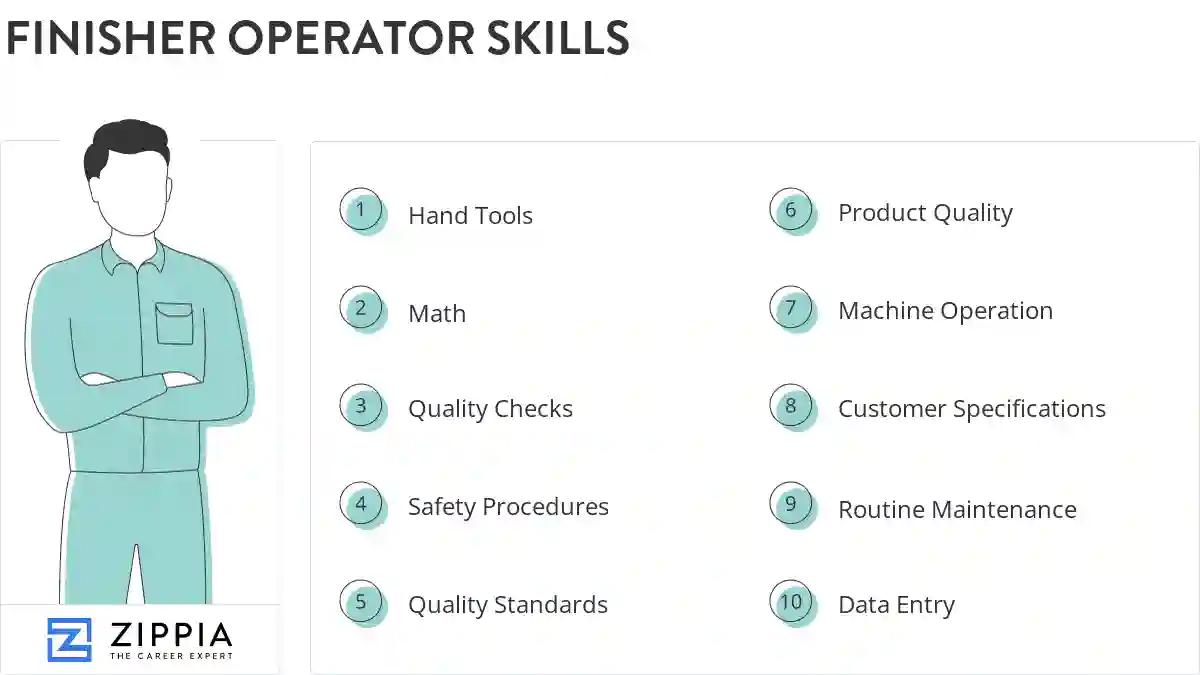
The most important skills for a finisher operator resume and required skills for a finisher operator to have include:
- Hand Tools
- Math
- Quality Checks
- Safety Procedures
- Quality Standards
- Product Quality
- Machine Operation
- Customer Specifications
- Routine Maintenance
- Data Entry
- Safety Rules
- Lean Manufacturing
- ISO
- GMP
- Quality Issues
- Safety Policies
- Glue Pots
- Production Equipment
- Product Specifications
- QA
- Hoists
- Collating
- Production Reports
- Detect Defects
- Sops
- Fork Trucks
- Production Schedules
- Stitching
- CNC
- PPE
- Safety Regulations
- Assembly Line
- Medical Devices
- Stackers
- Computer System
- GPS
- Sigma
- Clean Room Environment
- Extrusion
- FDA
- Visual Inspections
- Machine Problems
- Etching
- Equipment Problems
Updated January 8, 2025
