What does a framing carpenter do?
Framing carpenter responsibilities
Here are examples of responsibilities from real framing carpenter resumes:
- Wall repair specialist with advance knowledge of spackling and caulking.
- Work involve footing, framing, sheetrock, siding, roofing and trim.
- Install doors, cabinet, window, baseboards, & vinyl floor Sheetrock with precision.
- Perform applied carpentry including installation of structures, blueprint interpretation, and limit scaffolding.
- Install windows and dooers, tile flooring, concrete pads for HVAC.
- Reconfigure residential electrical systems, water systems, and HVAC.
Framing carpenter skills and personality traits
We calculated that 17% of Framing Carpenters are proficient in Hand Tools, OSHA, and Safety Rules. They’re also known for soft skills such as Business skills, Detail oriented, and Dexterity.
We break down the percentage of Framing Carpenters that have these skills listed on their resume here:
- Hand Tools, 17%
Used powered hand tools following company safety guidelines to frame walls and floors in a factory environment.
- OSHA, 11%
Experienced with an assortment of power and air tools OSHA safety standards.
- Safety Rules, 9%
Follow established safety rules and regulations.
- Install Windows, 9%
Frame, sheet and roof houses, trim out interior of houses, install windows and doors.
- Ladders, 8%
Build temporary ladders for construction sites.
- Scaffolding, 7%
Coordinated with crane operators and heavy equipment operators for structural assembly/ material / scaffolding location.
Common skills that a framing carpenter uses to do their job include "hand tools," "osha," and "safety rules." You can find details on the most important framing carpenter responsibilities below.
Business skills. The most essential soft skill for a framing carpenter to carry out their responsibilities is business skills. This skill is important for the role because "self-employed carpenters must conduct activities such as bidding on new jobs, tracking inventory, and directing workers." Additionally, a framing carpenter resume shows how their duties depend on business skills: "work framing and general construction for a small business. "
Detail oriented. Many framing carpenter duties rely on detail oriented. "carpenters must be able to precisely cut, measure, and modify the materials they work with.," so a framing carpenter will need this skill often in their role. This resume example is just one of many ways framing carpenter responsibilities rely on detail oriented: "poured concrete for various places along the job site projects, and helped finishers detail concrete. "
Dexterity. This is an important skill for framing carpenters to perform their duties. For an example of how framing carpenter responsibilities depend on this skill, consider that "carpenters use many tools and need hand-eye coordination to avoid injuring themselves or damaging materials." This excerpt from a resume also shows how vital it is to everyday roles and responsibilities of a framing carpenter: "general construction, final clean up, operate construction lifts and equipment. ".
Math skills. For certain framing carpenter responsibilities to be completed, the job requires competence in "math skills." The day-to-day duties of a framing carpenter rely on this skill, as "carpenters frequently use math skills, including basic trigonometry, to calculate the area, size, and amount of material needed for the job. ." For example, this snippet was taken directly from a resume about how this skill applies to what framing carpenters do: "learned to square up foundation lines and walls using mathematics. "
Physical strength. A commonly-found skill in framing carpenter job descriptions, "physical strength" is essential to what framing carpenters do. Framing carpenter responsibilities rely on this skill because "carpenters use heavy tools and materials that weigh up to 100 pounds." You can also see how framing carpenter duties rely on physical strength in this resume example: "conferred with clients to strengthen customer relations during potential bids refinished and remodeled hardwood floors"
Problem-solving skills. Lastly, "problem-solving skills" is an important element of what a framing carpenter does. Framing carpenter responsibilities require this skill because "carpenters may work independently with little guidance." This resume example highlights how framing carpenter duties rely on this skill: "provided excellent customer service by helping customers find items and helped with returns helped customers to find solutions to crafting problems"
The three companies that hire the most framing carpenters are:
- PeopleReady5 framing carpenters jobs
- PulteGroup3 framing carpenters jobs
- US LBM2 framing carpenters jobs
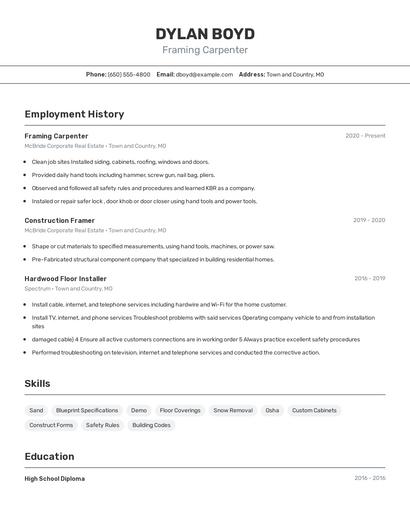
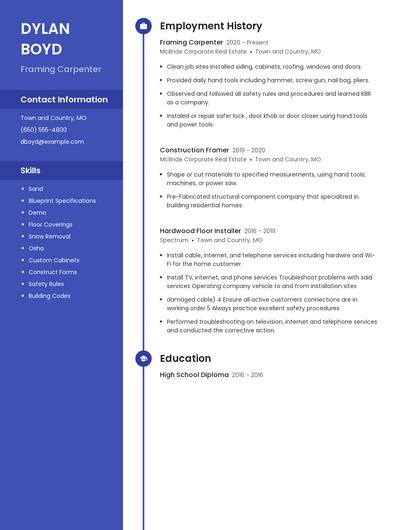
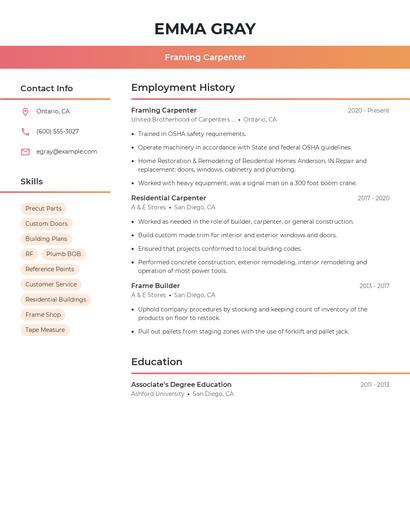
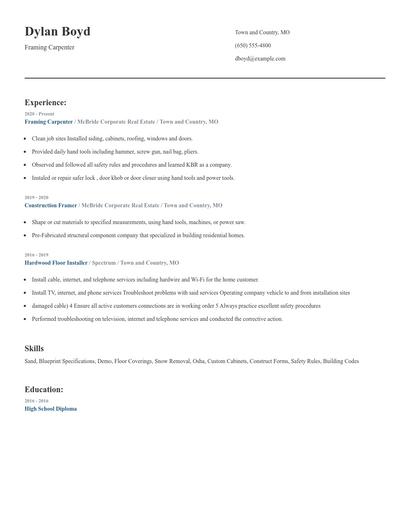
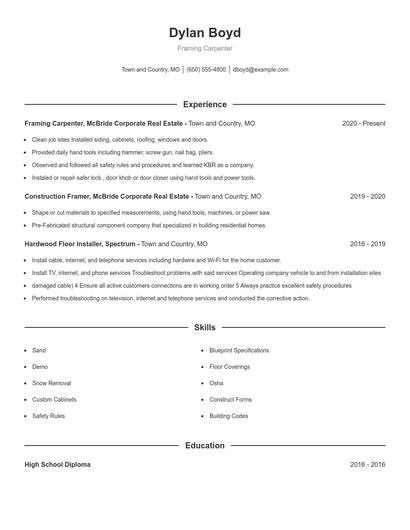
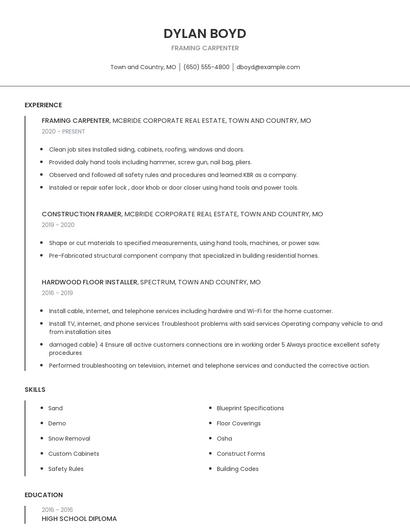
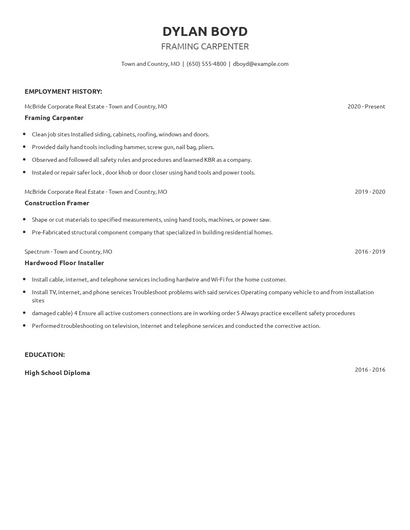
Choose from 10+ customizable framing carpenter resume templates
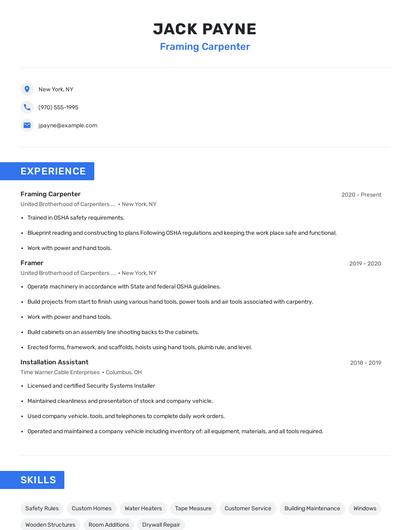
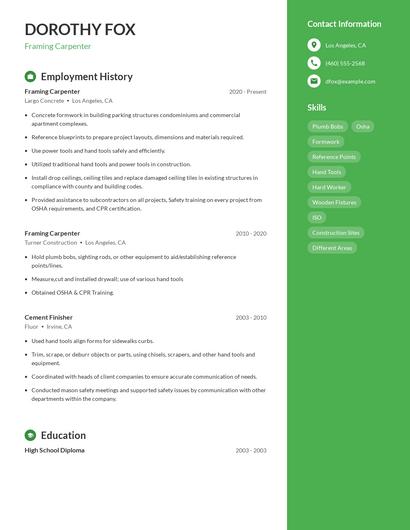
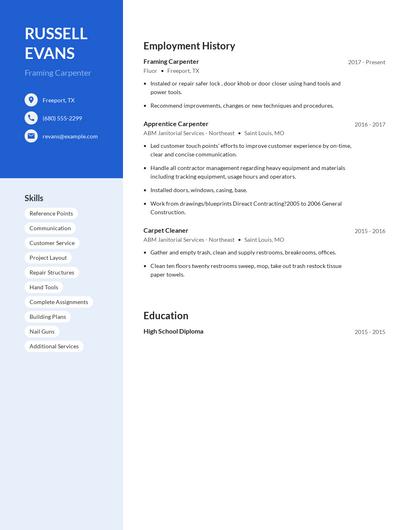
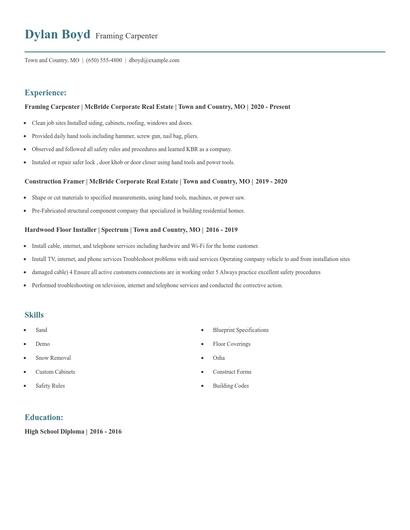
Build a professional framing carpenter resume in minutes. Our AI resume writing assistant will guide you through every step of the process, and you can choose from 10+ resume templates to create your framing carpenter resume.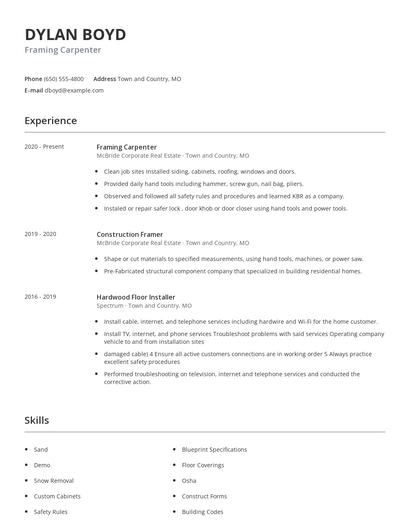
Compare different framing carpenters
Framing carpenter vs. Installer
Installers are assigned to assemble equipment or fixtures in the client's work or home area. They should have extensive knowledge of the product they will install to ensure it works as intended. They should also be familiar with handling different tools, especially those that would help them build the product. Installers should be able to walk the client through how to use the product. They should also be able to answer any inquiries that the client may have. Installers should have quick decision-making skills, interpersonal skills, and creativity.
These skill sets are where the common ground ends though. The responsibilities of a framing carpenter are more likely to require skills like "hand tools," "osha," "safety rules," and "install windows." On the other hand, a job as an installer requires skills like "customer service," "windows," "plumbing," and "work ethic." As you can see, what employees do in each career varies considerably.
Installers tend to make the most money working in the technology industry, where they earn an average salary of $40,956. In contrast, framing carpenters make the biggest average salary, $44,290, in the media industry.The education levels that installers earn slightly differ from framing carpenters. In particular, installers are 1.3% less likely to graduate with a Master's Degree than a framing carpenter. Additionally, they're 0.1% less likely to earn a Doctoral Degree.Framing carpenter vs. Builder
Builders are responsible for managing, coordinating, and working on the construction. They are also responsible for repairing and maintaining commercial and residential buildings. They oversee a project by either making arrangements with subcontractors to finish specific jobs or doing the work themselves. Builders need to ensure that the construction projects meet their client's requirements as well as the government and industry regulations. They often perform their work in an industrial setting. Their day-to-day activity depends on their specialization and level of experience.
Each career also uses different skills, according to real framing carpenter resumes. While framing carpenter responsibilities can utilize skills like "hand tools," "osha," "install windows," and "ladders," builders use skills like "work ethic," "construction sites," "c #," and "windows."
On average, builders earn a lower salary than framing carpenters. Some industries support higher salaries in each profession. Interestingly enough, builders earn the most pay in the finance industry with an average salary of $42,512. Whereas framing carpenters have higher pay in the media industry, with an average salary of $44,290.Average education levels between the two professions vary. Builders tend to reach similar levels of education than framing carpenters. In fact, they're 1.6% more likely to graduate with a Master's Degree and 0.1% less likely to earn a Doctoral Degree.Framing carpenter vs. Pallet builder
Lead installers are individuals who execute residential construction activities. The installers review the organization's blueprints with its sales, supervise the loading and unloading procedure, and manage the crew during the installation process. They set up and maintain the workstations, maintain the VoIP phone systems, and construct the cubicles for modular offices. The necessary skills for this job include customer service, knowledge of the installation process, and attention to detail. They are also expected to develop skills in communication, diligence, and the ability to follow instructions.
Some important key differences between the two careers include a few of the skills necessary to fulfill the responsibilities of each. Some examples from framing carpenter resumes include skills like "hand tools," "osha," "install windows," and "ladders," whereas a pallet builder is more likely to list skills in "pallets," "electric pallet jack," "build pallets," and "safety standards. "
Pallet builders make a very good living in the hospitality industry with an average annual salary of $40,282. On the other hand, framing carpenters are paid the highest salary in the media industry, with average annual pay of $44,290.When it comes to education, pallet builders tend to earn similar degree levels compared to framing carpenters. In fact, they're 1.8% less likely to earn a Master's Degree, and 0.2% less likely to graduate with a Doctoral Degree.Framing carpenter vs. Lead installer
Even though a few skill sets overlap between framing carpenters and lead installers, there are some differences that are important to note. For one, a framing carpenter might have more use for skills like "osha," "safety rules," "install windows," and "ladders." Meanwhile, some responsibilities of lead installers require skills like "hvac," "customer service," "customer satisfaction," and "windows. "
Lead installers enjoy the best pay in the energy industry, with an average salary of $86,951. For comparison, framing carpenters earn the highest salary in the media industry.lead installers reach similar levels of education compared to framing carpenters, in general. The difference is that they're 0.5% more likely to earn a Master's Degree, and 0.2% less likely to graduate with a Doctoral Degree.Types of framing carpenter
Updated January 8, 2025
