
Automatically apply for jobs with Zippia
Upload your resume to get started.
Graduate research and teaching assistant skills for your resume and career
15 graduate research and teaching assistant skills for your resume and career
1. Lab Reports
- Created lab and homework assignments, graded lab reports, worked with students of all ages and varying ethnic backgrounds.
- Instructed undergraduate students General Chemistry & Organic Laboratory Techniques, Set exams & quizzes and graded their lab reports.
2. Laboratory Equipment
- Managed and taught all manufacturing, fabrication, and mechanical testing laboratory equipment.
- Handled and archived records for laboratory equipment.
3. Research Projects
- Participated in research activities throughout the College of Health Sciences, including statistical analysis and literature reviews for different research projects.
- Established strong interpersonal working relationship with Professor Kill in order to accomplish research projects and preparation of course material.
4. General Chemistry
- Instructed Undergraduate students to perform General Chemistry lab experiments to understand basic Chemistry knowledge.
- Well experienced in mentoring undergraduate students in instrumental analysis lab and general chemistry lab.
5. Undergraduate Courses
Undergraduate courses usually refer to the first studies undertaken at university.
- Assist setting up laboratory experiments for undergraduate courses in immunology.
- Developed curricula for undergraduate coursework in English Second Language courses.
6. Graduate Research
Graduate research is work and studying done by someone pursuing a masters or doctorate degree.
- Graduate research assistant responsible for carrying out mechanical testing of pulmonary arteries and right ventricular tissue.
- Mentored undergraduate research students to ensure proper understanding of concepts and completion of assigned roles.
Choose from 10+ customizable graduate research and teaching assistant resume templates
Build a professional graduate research and teaching assistant resume in minutes. Our AI resume writing assistant will guide you through every step of the process, and you can choose from 10+ resume templates to create your graduate research and teaching assistant resume.7. R
R is a free software environment and a language used by programmers for statistical computing. The R programming language is famously used for data analysis by data scientists.
- Helped students to improve programming R and SAS skills, and understanding statistical and mathematical contents.
- Used various statistical software programs including Microsoft Excel and R to analyze data.
8. Molecular Biology
- Conducted molecular biology laboratory techniques.
- Completed interdisciplinary courses and attended seminars covering all aspects of pharmaceutical sciences before transitioning into the Molecular Biology and Biochemistry department.
9. Data Analysis
- Provide assistance to principal investigators through primary quantitative and qualitative data collection and analysis, and secondary data analysis.
- Applied Statistical Model (Probability Density Function) to facilitate data analysis, decision-making and optimization using MATLAB.
10. TA
TA stands for Teaching Assistant. A TA helps a teacher with certain education and instructive responsibilities. Generally, a TA is chosen from different levels of academic students such as recent graduations, postgraduates, and undergraduates. A teacher's assistant generally helps the teacher with course management, question preparation, marking, and other similar activities.
- Coordinated labs with other TA s, course director, and lab coordinator to ensure weekly labs went as planned.
- Graded labs, and submitted grades I was a TA for Exercise & Wellness Cert Prep
11. Data Collection
Data collection means to analyze and collect all the necessary information. It helps in carrying out research and in storing important and necessary information. The most important goal of data collection is to gather the information that is rich and accurate for statistical analysis.
- Coordinated with Chief Medical Officers and Risk Managers to facilitate implementation, data collection and dissemination.
- Designed and performed a simulation project involving 72 human participants for data collection and analysis.
12. Synthesis
Synthesis refers to the process of combining a number of things to become something new. Depending on the field of work, this may mean combining ideas, products, and new influences into a new service or product. Overall, the process is focused on reviewing and analyzing different data points to make something new.
- Developed a new computational synthesis methodology to optimize the decision-making during the product design life circle.
- Performed metal-mediated organic synthesis under air and moisture free conditions.
13. Statistical Analysis
- Instructed Undergraduate Psychological Research Methods lab and facilitated workshops on study design, peer review, writing and statistical analysis.
- Assisted in designing instructional materials and methods for undergraduate classes in statistical analysis, research design, and introductory psychology.
14. C++
C++ is a general-purpose programming language that is used to create high-performing applications. It was invented as an extension to the C language. C++ lets the programmer have a high level of domination over memory and system resources. C++ is an object-oriented language that helps you implement real-time issues based on different data functions
- Developed a fully functional Super Scalar Simulator designed for investigating the effect of different architecture parameters on the processor in C++.
- Created programs in Arc Macro Language (AML), C++ and VB for investigation of basement-involved folds.
15. Literature Reviews
- Analyzed quantitative data, performed literature reviews, and collaborated with transnational research group.
- Organized literature reviews, wrote scholarly papers, conducted interviews, collected and analyzed data
5 Graduate Research And Teaching Assistant resume examples
Build a professional graduate research and teaching assistant resume in minutes. Browse through our resume examples to identify the best way to word your resume. Then choose from 5+ resume templates to create your graduate research and teaching assistant resume.

What skills help Graduate Research And Teaching Assistants find jobs?
Tell us what job you are looking for, we’ll show you what skills employers want.
What technical skills for a graduate research and teaching assistant stand out to employers?
Sya Kedzior Ph.D.
Associate Professor, Towson University
What soft skills should all graduate research and teaching assistants possess?
David Brown
Professor of History, Elizabethtown College
What hard/technical skills are most important for graduate research and teaching assistants?
Harriet Phinney Ph.D.
Associate Professor, Seattle University
List of graduate research and teaching assistant skills to add to your resume
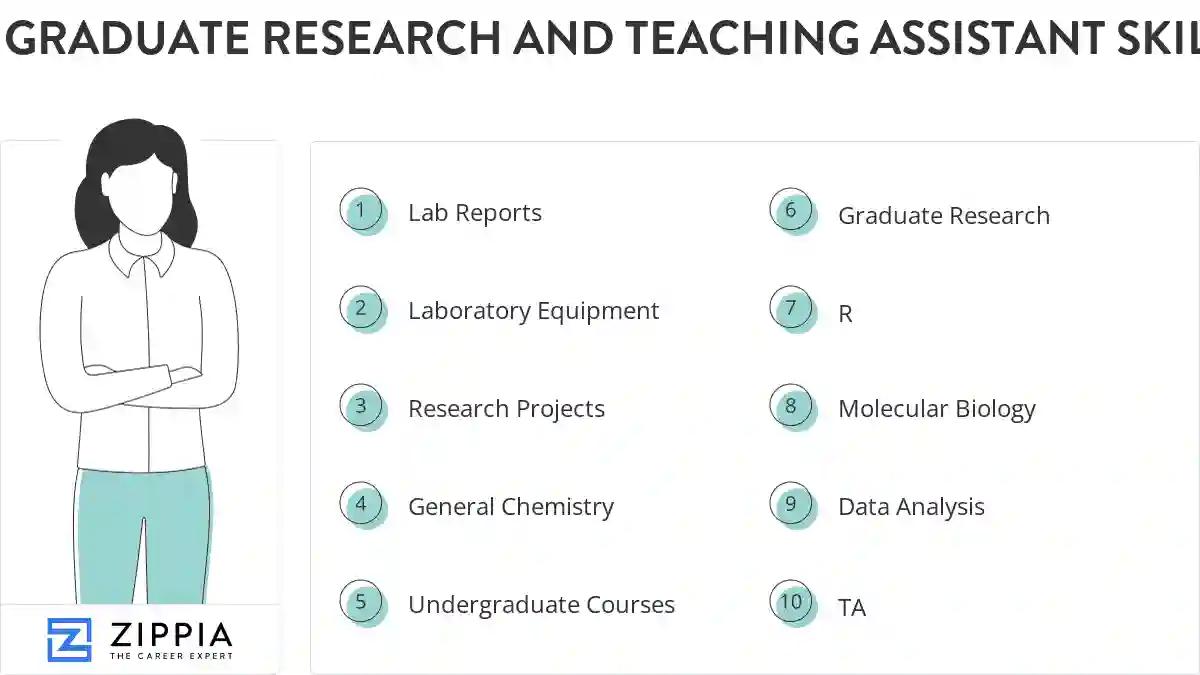
The most important skills for a graduate research and teaching assistant resume and required skills for a graduate research and teaching assistant to have include:
- Lab Reports
- Laboratory Equipment
- Research Projects
- General Chemistry
- Undergraduate Courses
- Graduate Research
- R
- Molecular Biology
- Data Analysis
- TA
- Data Collection
- Synthesis
- Statistical Analysis
- C++
- Literature Reviews
- Physiology
- Organic Chemistry
- Course Materials
- SPSS
- PCR
- Python
- HPLC
- NMR
- SAS
- SEM
- Research Paper
- PowerPoint
- GIS
- Lab Sessions
- UV-Vis
- Economics
- IR
- DNA
- Nanoparticles
- Research Data
- Blackboard
- Syllabus
- Mass Spectrometry
- ArcGIS
- Research Findings
- Laboratory Experiments
- Analyze Data
- Solidworks
- GC-MS
- Sociology
- FTIR
- CAD
- Review Sessions
- LabVIEW
- DSC
Updated January 8, 2025
