What does a grinding machine operator do?
Grinding machine operator responsibilities
Here are examples of responsibilities from real grinding machine operator resumes:
- Verify conformance to specifications, using gauges, calipers, templates.
- Control face, side, and outside diameter CNC grinding machines in day-to-day assignments involving industrial see sharpening.
- Operate machines to place grinding parts on size using calipers.
- Operate CNC lathes as well as various shop machinery, also do inspection.
- Follow standardized company general manufacturing procedures (GMP) throughout shift.
- Participate in technical support and assist validation and QA department during equipment validation.
Grinding machine operator skills and personality traits
We calculated that 14% of Grinding Machine Operators are proficient in Grinders, Grinding Wheels, and Micrometers. They’re also known for soft skills such as Computer skills, Dexterity, and Physical strength.
We break down the percentage of Grinding Machine Operators that have these skills listed on their resume here:
- Grinders, 14%
Maintained and operated several crankshaft main grinders.
- Grinding Wheels, 12%
Set secondary finish grinding wheels to final diameter.
- Micrometers, 10%
Inspect product to blue print specification utilizing micrometers, Vernier calipers as well as other gauging tools.
- CNC, 10%
Insured product quality standard based on customer specifications through five piece inspections on production samples from CNC Screw Machines.
- Calipers, 8%
Checked quality of work usingmicrometers, dial & slide calipers and electronic indicators.
- Grinding Machines, 7%
Set shoes inside of grinding machines with indicator dials.
Common skills that a grinding machine operator uses to do their job include "grinders," "grinding wheels," and "micrometers." You can find details on the most important grinding machine operator responsibilities below.
Computer skills. The most essential soft skill for a grinding machine operator to carry out their responsibilities is computer skills. This skill is important for the role because "metal and plastic machine workers often must be able to use programmable devices, computers, and robots on the factory floor." Additionally, a grinding machine operator resume shows how their duties depend on computer skills: "use hand tools and computer touch screens. "
Dexterity. Many grinding machine operator duties rely on dexterity. "metal and plastic machine workers who work in metal and plastic machined goods manufacturing use precise hand movements to make the necessary shapes, cuts, and edges that designs require.," so a grinding machine operator will need this skill often in their role. This resume example is just one of many ways grinding machine operator responsibilities rely on dexterity: "fork lift, operated machines, ran grinder"
Physical strength. grinding machine operators are also known for physical strength, which are critical to their duties. You can see how this skill relates to grinding machine operator responsibilities, because "metal and plastic machine workers must be strong enough to guide and load heavy and bulky parts and materials into machines." A grinding machine operator resume example shows how physical strength is used in the workplace: "evaluated raw materials and/or finished products throughout the production process for acceptable physical appearance and ensure products met specifications. "
Mechanical skills. For certain grinding machine operator responsibilities to be completed, the job requires competence in "mechanical skills." The day-to-day duties of a grinding machine operator rely on this skill, as "metal and plastic machine workers set up and operate machinery." For example, this snippet was taken directly from a resume about how this skill applies to what grinding machine operators do: "performed preventative maintenance, replaced motors, belts and mechanical maintenance changed over machinery according to production needs. "
The three companies that hire the most grinding machine operators are:
- Kelly Services4 grinding machine operators jobs
- Smithfield Foods3 grinding machine operators jobs
- Stanley Black & Decker2 grinding machine operators jobs
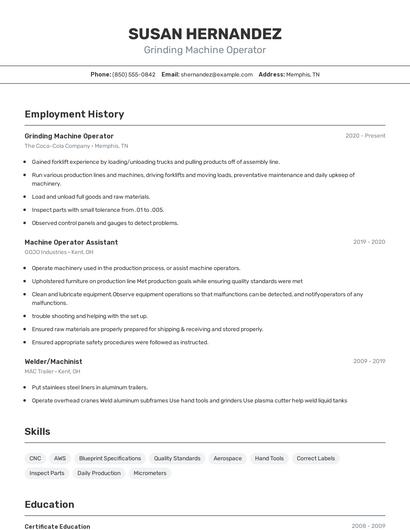
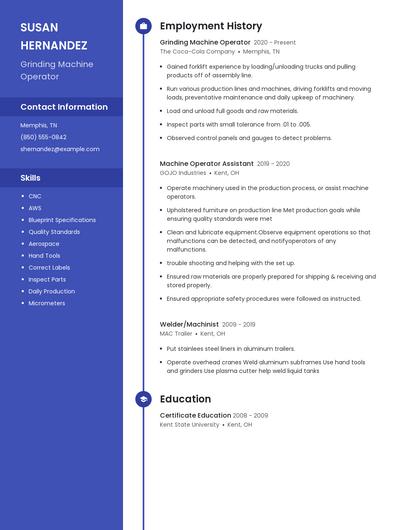
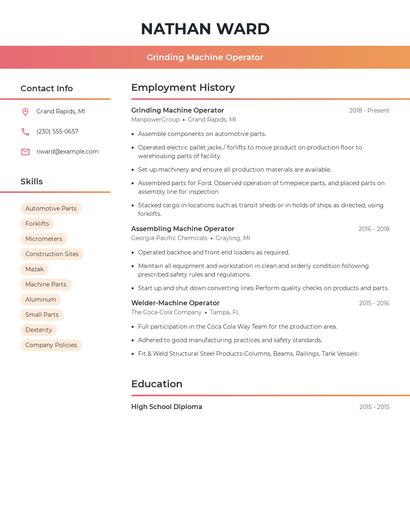
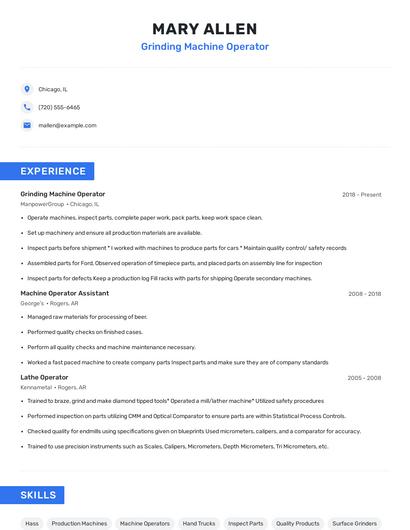
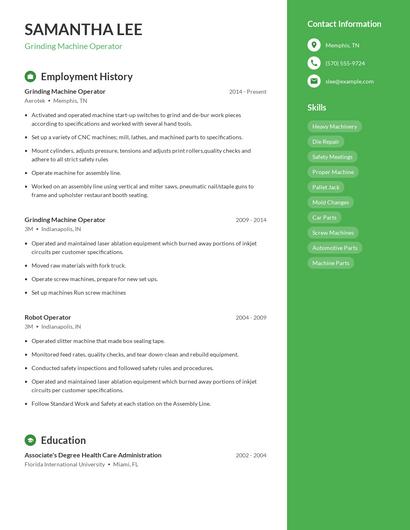
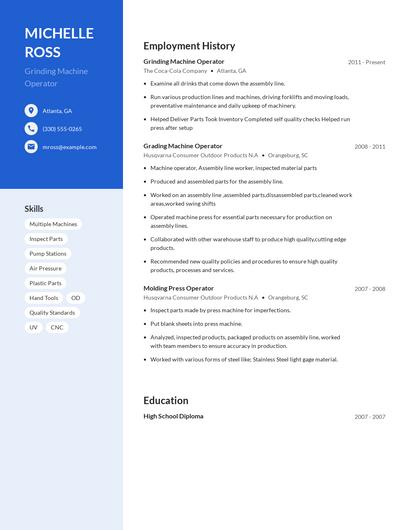
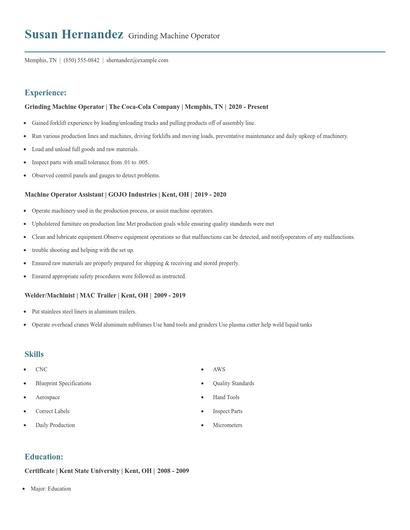
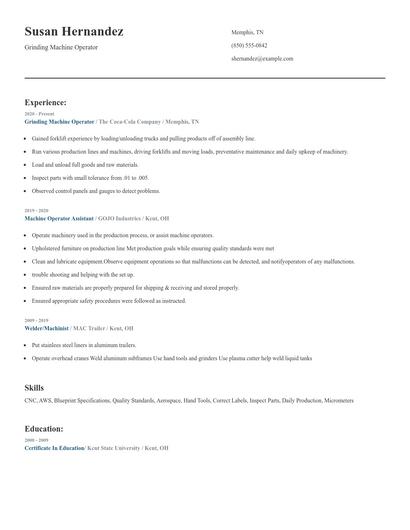
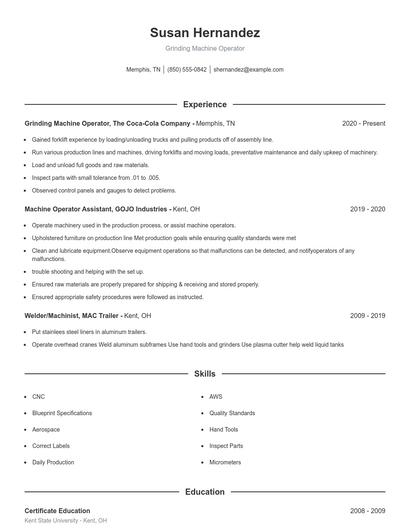
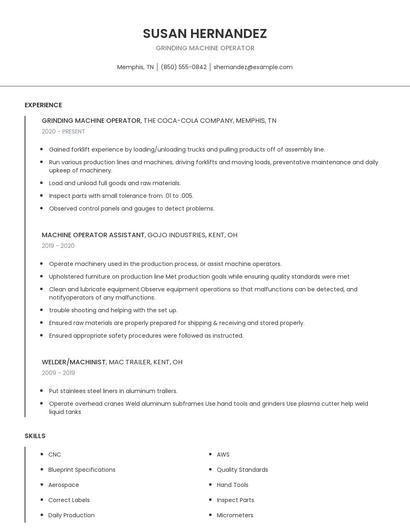
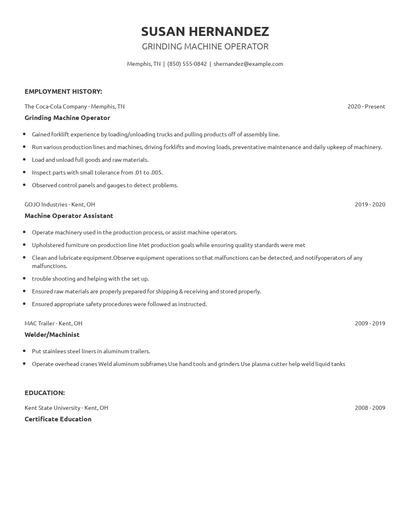
Choose from 10+ customizable grinding machine operator resume templates
Build a professional grinding machine operator resume in minutes. Our AI resume writing assistant will guide you through every step of the process, and you can choose from 10+ resume templates to create your grinding machine operator resume.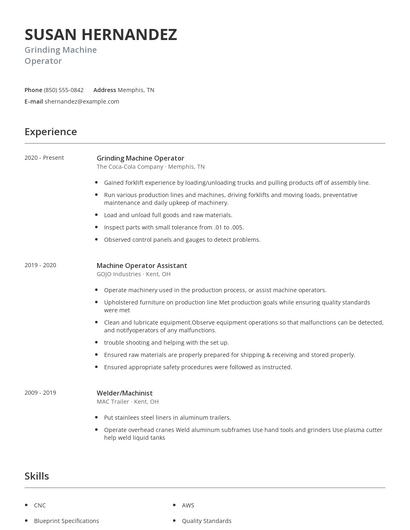
Compare different grinding machine operators
Grinding machine operator vs. Set-up operator
A machine set-up operator operates machinery such as grinders, bores, and mills. They prepare machines to be used by organizing tools, setting valve directions, sharpening tools as needed, positioning tools, and conducting regular maintenance.
While similarities exist, there are also some differences between grinding machine operators and set-up operator. For instance, grinding machine operator responsibilities require skills such as "grinders," "cnc," "gauges," and "ran." Whereas a set-up operator is skilled in "cnc machines," "math," "preventative maintenance," and "safety procedures." This is part of what separates the two careers.
Set-up operators tend to make the most money working in the automotive industry, where they earn an average salary of $44,628. In contrast, grinding machine operators make the biggest average salary, $40,910, in the technology industry.On average, set-up operators reach similar levels of education than grinding machine operators. Set-up operators are 0.2% more likely to earn a Master's Degree and 0.0% less likely to graduate with a Doctoral Degree.Grinding machine operator vs. Molder operator
A molder operator sets up for the production of millwork, which is a crucial and major output of precision wood products. This position requires experience with all machinery associated with the woodworking industry. The responsibilities of a molder operator include setting up and operating the molder, inspecting the stock being cut, and verifying the dimensions of cut material to ensure they match specifications.
While some skills are similar in these professions, other skills aren't so similar. For example, resumes show us that grinding machine operator responsibilities requires skills like "grinders," "grinding wheels," "micrometers," and "calipers." But a molder operator might use other skills in their typical duties, such as, "gmp," "dexterity," "quality inspection," and "production schedules."
Molder operators may earn a lower salary than grinding machine operators, but molder operators earn the most pay in the manufacturing industry with an average salary of $33,149. On the other hand, grinding machine operators receive higher pay in the technology industry, where they earn an average salary of $40,910.Average education levels between the two professions vary. Molder operators tend to reach similar levels of education than grinding machine operators. In fact, they're 0.1% less likely to graduate with a Master's Degree and 0.0% less likely to earn a Doctoral Degree.Grinding machine operator vs. Laser operator
A Laser Operator is responsible for operating the machine and devices used for laser purposes. They do the engraving and cutting of the metal or plastic parts of the laser device. They set up and adjust the machine lens to meet the correct specification. They also ensure that there will be no issues before and after operating the laser device by routinely checking the equipment. They also need to monitor and do an inventory of instruments and tools required if there are operations or whenever they are required.
There are many key differences between these two careers, including some of the skills required to perform responsibilities within each role. For example, a grinding machine operator is likely to be skilled in "grinders," "grinding wheels," "micrometers," and "cnc," while a typical laser operator is skilled in "laser cutting," "laser machine," "math," and "cnc laser."
Laser operators make a very good living in the technology industry with an average annual salary of $36,571. On the other hand, grinding machine operators are paid the highest salary in the technology industry, with average annual pay of $40,910.When it comes to education, laser operators tend to earn similar degree levels compared to grinding machine operators. In fact, they're 0.0% more likely to earn a Master's Degree, and 0.1% more likely to graduate with a Doctoral Degree.Grinding machine operator vs. Cell operator
A Cell Operator is someone who handles a production cell in a company or factory. This position ensures that a cell unit of the production functions properly and efficiently. The position also does other miscellaneous tasks related to production, such as inspection, sorting, and other assembly operations, depending on the type of company, business, or manufactured product. This person generally has strong organizational and problem-solving skills and has a knack for troubleshooting.
Types of grinding machine operator
Updated January 8, 2025
