
Automatically apply for jobs with Zippia
Upload your resume to get started.
Hearing aide technician skills for your resume and career
15 hearing aide technician skills for your resume and career
1. Medical History
- Checked in patients, confirmed appointments, medical history and pre-testing of all patients.
- Reviewed patient medical charts/medical history/transfusion records/etc.
2. Audiology
- Maintained appropriate supplies within the Audiology department, notifying supervisors when refill orders must be placed.
- Greet patient/collect relevant data - Conduct basic audiometric testing, including pure tone/speech - Enter CPT and ICD coding for audiology
3. Test Results
- Provide infant hearing screens in a variety of different clinical settings Communicate test results with medical professionals and parents
- Performed EKG Tests * Drew Blood * Checked Blood Pressure * Charting & Distributing Test Results to the Ordering Physician
4. Hearing Loss
Ranging from mild to profound, hearing loss is the loss of hearing in one or both ears. This condition can affect a person of any age, and it has many causes, but it mainly affects individuals older than 60.
- Fabricated hearing aids for patients with hearing loss.
- Performed audiograms on children with new or known hearing loss.
5. Hearing Screenings
- Administer vision and hearing screenings on children as required by the Michigan Department of Community Health.
- Performed hearing screenings on newborns by utilizing Oto-Acoustic Emissions and/or Auditory Brainstem Response.
6. Insurance Verification
- Coordinated patient insurance verification to ensure billing accuracy.
- Obtain insurance verification and authorizations for outpatient clients.
Choose from 10+ customizable hearing aide technician resume templates
Build a professional hearing aide technician resume in minutes. Our AI resume writing assistant will guide you through every step of the process, and you can choose from 10+ resume templates to create your hearing aide technician resume.7. Assistive
- Instructed patients with demonstration of assistive devices, supplies, batteries, and other information.
- Assisted in manufacturing, testing, diagnosing, and calibrating hearing assistive devices.
8. Hearing Tests
Hearing tests provide an evaluation of a person's hearing abilities. The test is usually performed by an audiologist using an audiometer.
- Performed hearing tests on new born infants using the auditory brain response system (ABR).
- Set up and conducted hearing tests of newborn babies.
9. Medical Equipment
Medical equipment refers to apparatus for use in medical procedures.
- Selected to assist customers with individualized fittings for an organization that provides home medical equipment and home medical supplies.
- Ordered all durable medical equipment from appropriate vendors for inpatient/outpatient residents and residents being discharged to home.
10. Hearing Instruments
- Assembled hearing instruments according to established procedures and standards.
- Assembled, troubleshot and repaired hearing instruments.
11. Direct Phone Calls
- Answer and direct phone calls to the appropriate person.
12. School Health
- Managed school health clinic, administering first aid and assisting with students' medications and special health-related needs.
- Implemented the school health services program for all children and youth in the school.
13. Front Desk
- Answered phones as needed to assist the front desk.
- Manage a rehabilitation/functional fitness staff, front desk, billing/insurance, certified technicians and massage therapy.
14. Patient Care
Patient care entails the diagnosis, recovery, and control of sickness as well as the maintenance of physical and emotional well-being through the use of healthcare providers' services. Patient care is described as services provided to patients by health practitioners or non-professionals under guidance.
- Provided patient care and processed screening procedures while utilizing in-depth knowledge of the organization to resolve routine operational difficulties.
- Implemented new organization within office; expediting thorough patient care and optimizing payroll hours.
15. Troubleshoot
Troubleshooting is the process of analyzing and fixing any kind of problem in a system or a machine. Troubleshooting is the detailed yet quick search in the system for the main source of an issue and solving it.
- Designed, documented and executed testing procedures, including settings, guidelines and troubleshoot.
- Configured and installed desktop PC'S, resolved hardware/software issues, troubleshoot connectivity issues, and insure user satisfaction.
5 Hearing Aide Technician resume examples
Build a professional hearing aide technician resume in minutes. Browse through our resume examples to identify the best way to word your resume. Then choose from 5+ resume templates to create your hearing aide technician resume.

What skills help Hearing Aide Technicians find jobs?
Tell us what job you are looking for, we’ll show you what skills employers want.
List of hearing aide technician skills to add to your resume
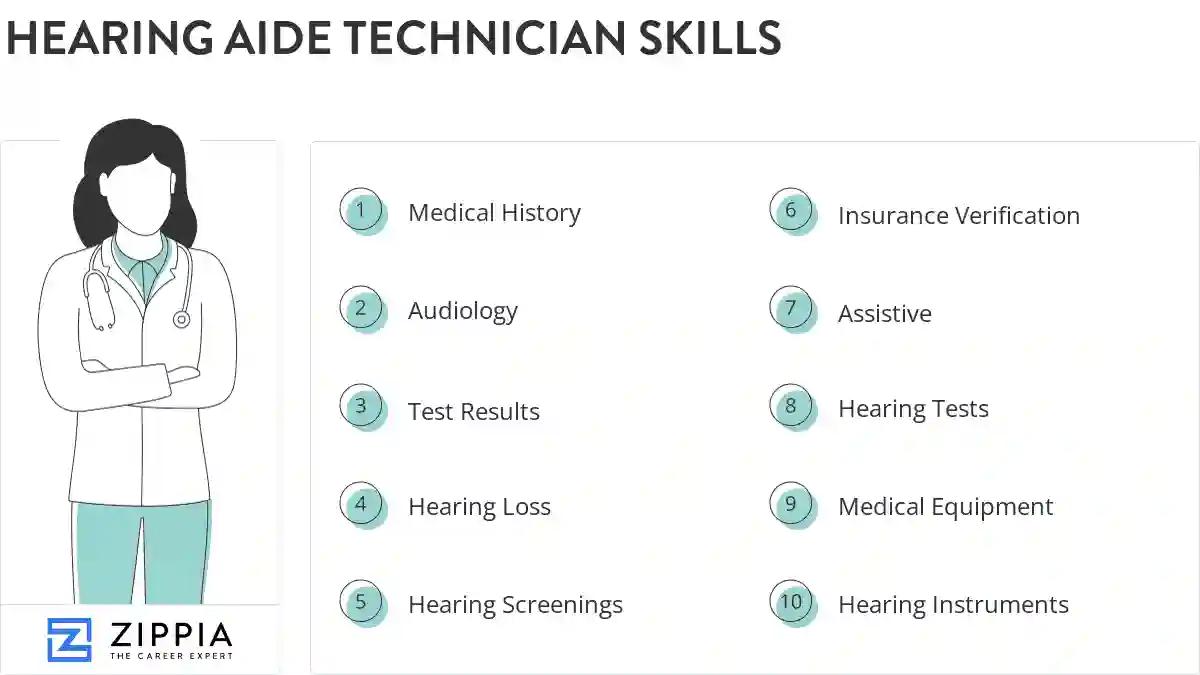
The most important skills for a hearing aide technician resume and required skills for a hearing aide technician to have include:
- Medical History
- Audiology
- Test Results
- Hearing Loss
- Hearing Screenings
- Insurance Verification
- Assistive
- Hearing Tests
- Medical Equipment
- Hearing Instruments
- Direct Phone Calls
- School Health
- Front Desk
- Patient Care
- Troubleshoot
- Schedule Appointments
- Exam Rooms
Updated January 8, 2025
