
Automatically apply for jobs with Zippia
Upload your resume to get started.
Heavy media operator skills for your resume and career
14 heavy media operator skills for your resume and career
1. Video Signals
- Experience in patching audio and video signals.
2. Ingest
- Performed Quality Control of audio/video levels upon ingest and preparation of material for air, documented work completed QC documents.
- Lead Trainer for new and existing employees on numerous positions Ingest, PING, VOD, and tape.
3. Master Control
- Feed each segment to master control after taping is over.
- Master Control Operator Monitoring live and tape programming.
4. Broadcast Equipment
- Operated commercial radio broadcast equipment, including portable audio and video multimedia devices.
- Operated a variety of broadcast equipment such as video/audio/IP routers, patch panels, video servers.
5. News Stories
News Story is a term that is quite self-explanatory as it refers to all the information that is recorded either in writing or as an interview and aims to inform the public about any particular matter, event, idea or mishap. A news story can be very short as well lengthy depending on the type and quantity of content and consist of relevant facts and figures.
- Documented and broadcasted video feeds for live breaking news stories.
6. QC
Quality control is a set of instructions or procedures to ensure a manufactured product or a service is up to the highest quality standards. This set of quality control criteria are either defined by the clients or the company itself.
- Digitized, encoded, transcoded and QC'd all on-air media for over 30 broadcast networks.
- Analyzed different pH meter options by researching vendors, models, specifications to ensure compliance with QC and Media Prep standards.
Choose from 10+ customizable heavy media operator resume templates
Build a professional heavy media operator resume in minutes. Our AI resume writing assistant will guide you through every step of the process, and you can choose from 10+ resume templates to create your heavy media operator resume.7. HD
- Utilized Fission HD Core and Adobe Premiere for ingesting and formatting broadcast programming.
- Ingested and recorded live sporting events and studio productions to Qanatel Servers, HD D5, and DVCPro.
8. Encode
- Encode and transcode content followed with proper quality control standards.
9. Facebook
- Managed Facebook, Twitter, and Yelp duties daily providing special events and Food/Drink to inform attract current and potential customers.
- Tracked analytics provided by Bit.ly, YouTube, Flickr, Twitter and Facebook.
10. NFL
- Spearheaded Live operations for media streaming projects of clients handling the NFL Network and the Indycar Race circuit.
- Provided voiceover Spanish audio mixing for games in the NFL, NBA, and college football and basketball.
11. Adobe Photoshop
- Created mock up advertisements in Adobe Photoshop for prospective advertisers.
- Issued updates to the media decks in an ongoing basis and tailored presentation materials with Microsoft PowerPoint and Adobe Photoshop.
12. Clips
- Identified clips with top-level metadata so they could be located for later use in the Archive.
- Used Adobe Premiere Pro to edit video, add voice overs and organize clips.
13. Digital Assets
Digital assets come in different digital formats. They can be documents, photographs, videos, presentations, audio files, and other materials.
- Maintained accurate digital asset management processes, with critical attention to detail.
- Entered metadata for all digital assets.
14. PowerPoint
- Developed PowerPoint's and word documents for church service every Sunday.
- Set up and operate sound and video equipment every Friday and Sunday Create and operate PowerPoint for worship service

What skills help Heavy Media Operators find jobs?
Tell us what job you are looking for, we’ll show you what skills employers want.
List of heavy media operator skills to add to your resume
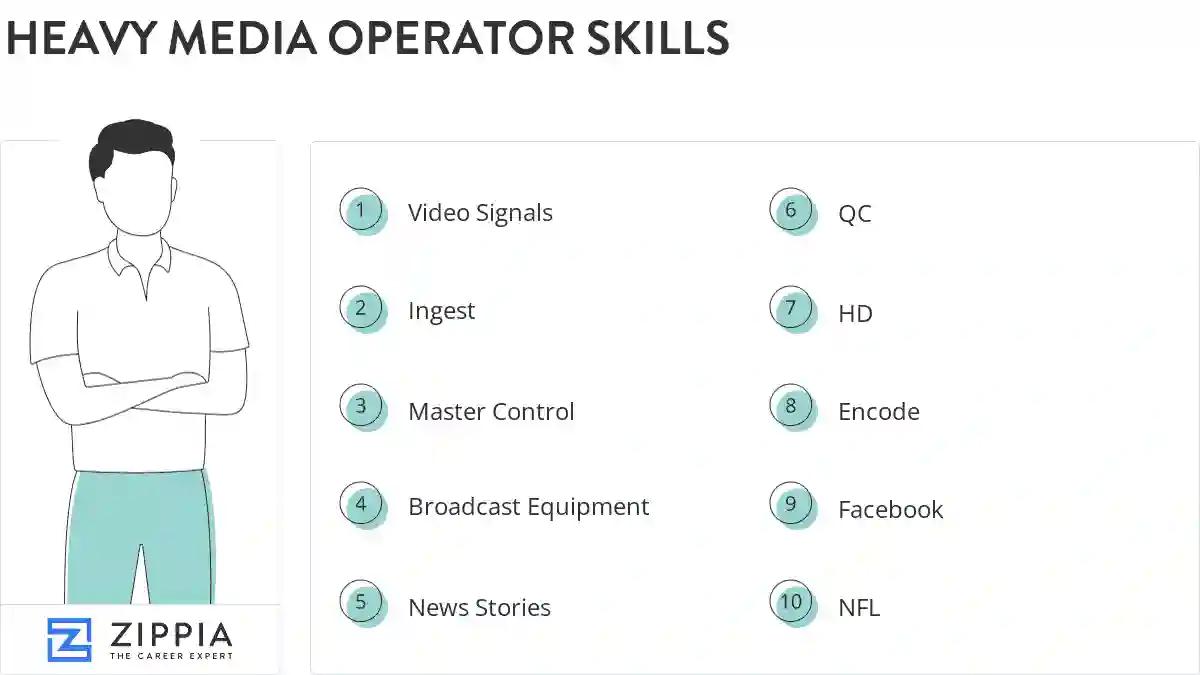
The most important skills for a heavy media operator resume and required skills for a heavy media operator to have include:
- Video Signals
- Ingest
- Master Control
- Broadcast Equipment
- News Stories
- QC
- HD
- Encode
- NFL
- Adobe Photoshop
- Clips
- Digital Assets
- PowerPoint
Updated January 8, 2025
