What does a horticultural worker do?
Horticultural worker responsibilities
Here are examples of responsibilities from real horticultural worker resumes:
- Used spade, trowels, rakes, sprayers and hedge trimmers for gardening.
- Operate leaf blowers, hedge trimmers, weed whackers and mow lawns to maintain gardens and beautify parks.
- Remove and mow weeds or grass.
- Operate powered equipment such as mowers, chainsaws, electric clippers, edger's.
- Maintain a sanitary environment by following company procedures such as raking grass and garbage removal.
- Operate power lawnmowers, handsaws, pruners, etc.
Horticultural worker skills and personality traits
We calculated that 23% of Horticultural Workers are proficient in Mowing, GRASS, and Prune. They’re also known for soft skills such as Physical stamina, Self-motivated, and Customer-service skills.
We break down the percentage of Horticultural Workers that have these skills listed on their resume here:
- Mowing, 23%
Accomplished mowing lawns and all job related requests given by managers precisely and accurately.
- GRASS, 14%
Participated in mass plantings and sidewalk construction Cut grass, planted trees and watered plants and flowers Cleaned exhibits
- Prune, 10%
Helped to trim shrubs and prune dead branches.
- Hand Saws, 7%
Operated hedge trimmers, lawn mowers, hand saws, leaf blowers, weed whackers and pruners to maintain park grounds.
- Plant Identification, 7%
Experience in plant identification and plant maintenance.
- Flower Beds, 7%
Water flower beds, shrubs, trees and lawns as needed.
Common skills that a horticultural worker uses to do their job include "mowing," "grass," and "prune." You can find details on the most important horticultural worker responsibilities below.
Physical stamina. To carry out their duties, the most important skill for a horticultural worker to have is physical stamina. Their role and responsibilities require that "grounds maintenance workers must be able to do strenuous labor for long periods of time, occasionally in extreme heat or cold." Horticultural workers often use physical stamina in their day-to-day job, as shown by this real resume: "provided in-home physical therapy, food preparation, light housework and transportation to and from errands and medical appointments. "
Self-motivated. Many horticultural worker duties rely on self-motivated. "because they often work with little supervision, grounds maintenance workers must be able to do their tasks independently.," so a horticultural worker will need this skill often in their role. This resume example is just one of many ways horticultural worker responsibilities rely on self-motivated: "be self-motivated to do a great job after mowing the lawn, the lawn was weed whipped. "
Dexterity. For certain horticultural worker responsibilities to be completed, the job requires competence in "dexterity." The day-to-day duties of a horticultural worker rely on this skill, as "grounds maintenance workers must have good eye, foot, and hand coordination when using dangerous or heavy equipment such as backhoes, mowers, and tractors." For example, this snippet was taken directly from a resume about how this skill applies to what horticultural workers do: "used riding lawnmowers, skidsteer, forklift, and dump truck. "
The three companies that hire the most horticultural workers are:
- Service Corporation International1 horticultural workers jobs
- Rose Hills Mortuary1 horticultural workers jobs
- City of Pueblo1 horticultural workers jobs
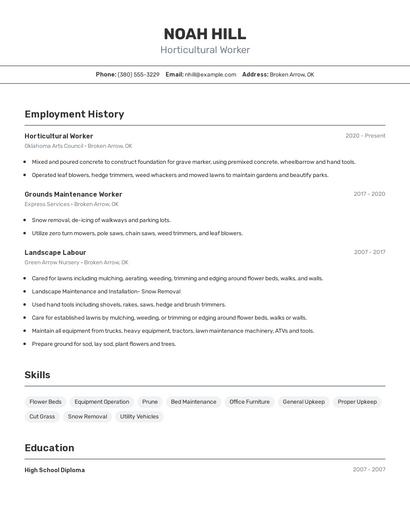
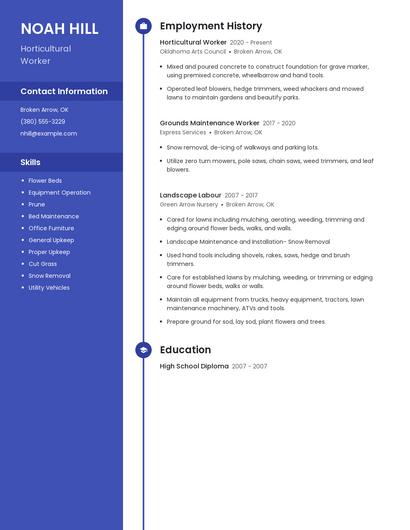
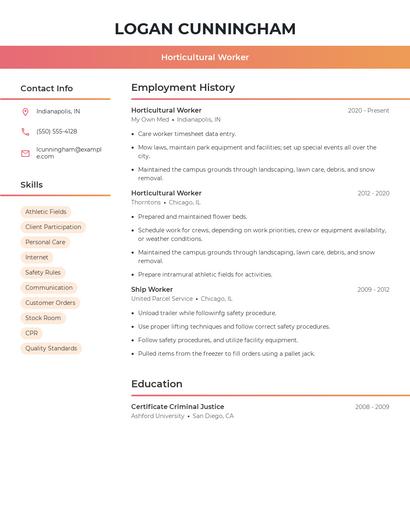
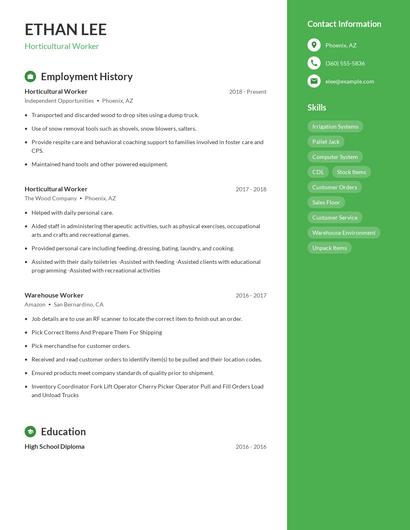
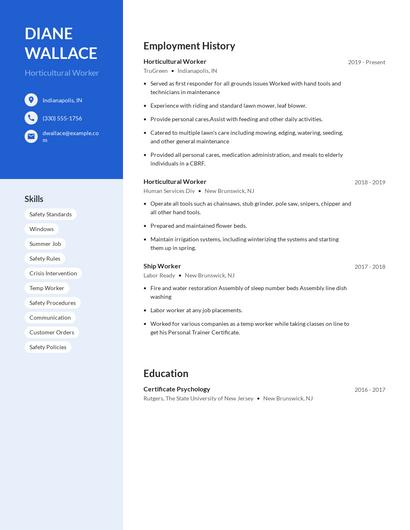
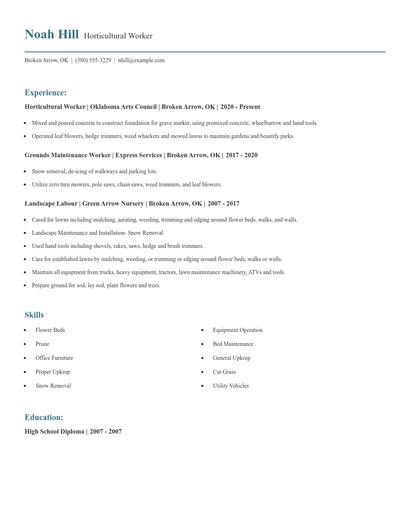
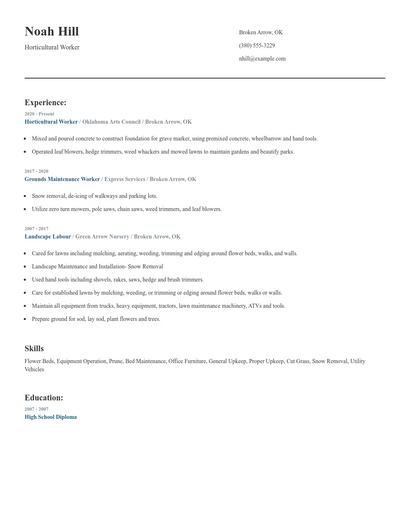
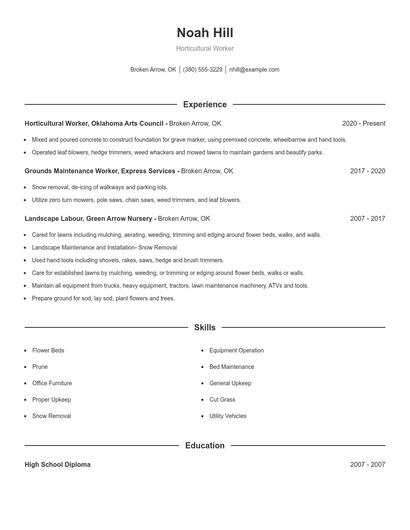
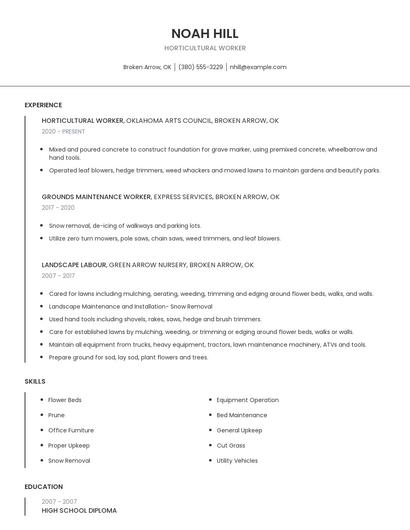
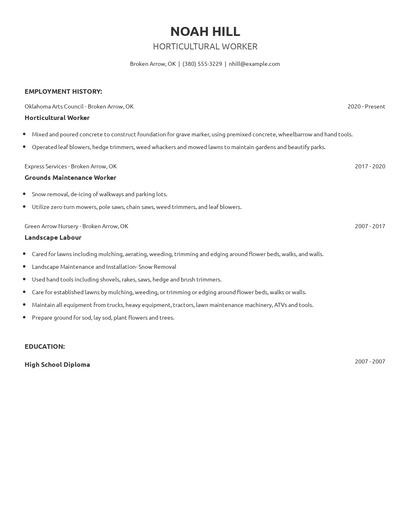
Choose from 10+ customizable horticultural worker resume templates
Build a professional horticultural worker resume in minutes. Our AI resume writing assistant will guide you through every step of the process, and you can choose from 10+ resume templates to create your horticultural worker resume.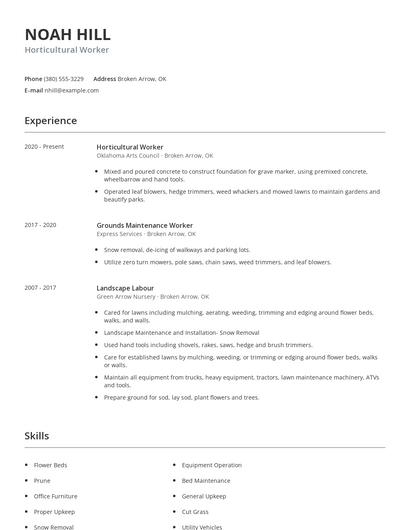

Compare different horticultural workers
Horticultural worker vs. Landscape technician
A storekeeper is responsible for managing all a store's operations and overseeing the care and maintenance of stocks, including inventory management. Your duties will include receiving, unloading, and shelving supplies, inspecting deliveries for discrepancies and damage, and managing all documentation. In addition, you will be responsible for maintaining inventory control and coordinating freight handling. You are also responsible for planning campaigns to promote new products, mediating any conflicts between clients and staff, maintaining a sales record, and purchasing new products.
These skill sets are where the common ground ends though. The responsibilities of a horticultural worker are more likely to require skills like "hand saws," "plant identification," "backpack," and "loppers." On the other hand, a job as a landscape technician requires skills like "grounds maintenance," "snow removal," "hand tools," and "lawn care." As you can see, what employees do in each career varies considerably.
Landscape technicians tend to make the most money working in the hospitality industry, where they earn an average salary of $31,317. In contrast, horticultural workers make the biggest average salary, $28,173, in the health care industry.The education levels that landscape technicians earn slightly differ from horticultural workers. In particular, landscape technicians are 1.8% more likely to graduate with a Master's Degree than a horticultural worker. Additionally, they're 0.2% more likely to earn a Doctoral Degree.Horticultural worker vs. Keeper
When it comes to landscape labor, one of the primary responsibilities is to perform landscape support tasks such as trimming the lawn, digging holes, planting flowers and trees, placing garden designs, and installing devices such as sprinkler systems. The majority of the tasks require physical work; there are instances where they must create structures such as ponds, fences, borders, patios, and other outdoor features. Furthermore, most of the tasks are in a group setting, which is why it is essential to coordinate with team members and adhere to the directives of supervisors or clients.
While some skills are similar in these professions, other skills aren't so similar. For example, resumes show us that horticultural worker responsibilities requires skills like "grass," "prune," "hand saws," and "plant identification." But a keeper might use other skills in their typical duties, such as, "guest rooms," "dependability," "excellent guest," and "animal husbandry."
On average, keepers earn a higher salary than horticultural workers. Some industries support higher salaries in each profession. Interestingly enough, keepers earn the most pay in the manufacturing industry with an average salary of $38,817. Whereas horticultural workers have higher pay in the health care industry, with an average salary of $28,173.In general, keepers achieve similar levels of education than horticultural workers. They're 3.3% more likely to obtain a Master's Degree while being 0.2% more likely to earn a Doctoral Degree.Horticultural worker vs. Landscape labour
There are many key differences between these two careers, including some of the skills required to perform responsibilities within each role. For example, a horticultural worker is likely to be skilled in "hand saws," "plant identification," "flower beds," and "backpack," while a typical landscape labour is skilled in "hand tools," "mow lawns," "sprinklers," and "snow removal."
Landscape labours earn the highest salary when working in the health care industry, where they receive an average salary of $29,929. Comparatively, horticultural workers have the highest earning potential in the health care industry, with an average salary of $28,173.landscape labours typically earn similar educational levels compared to horticultural workers. Specifically, they're 0.8% more likely to graduate with a Master's Degree, and 0.1% more likely to earn a Doctoral Degree.Horticultural worker vs. Lawn technician
Even though a few skill sets overlap between horticultural workers and lawn technicians, there are some differences that are important to note. For one, a horticultural worker might have more use for skills like "grass," "hand saws," "plant identification," and "backpack." Meanwhile, some responsibilities of lawn technicians require skills like "lawn care," "quality customer service," "weed control," and "fertilize lawns. "
In general, lawn technicians earn the most working in the construction industry, with an average salary of $33,766. The highest-paying industry for a horticultural worker is the health care industry.In general, lawn technicians hold similar degree levels compared to horticultural workers. Lawn technicians are 1.5% more likely to earn their Master's Degree and 0.1% more likely to graduate with a Doctoral Degree.Types of horticultural worker
Updated January 8, 2025
