
Automatically apply for jobs with Zippia
Upload your resume to get started.
Implementation analyst skills for your resume and career

15 implementation analyst skills for your resume and career
1. Client Facing
- Worked in a client facing roll to improve SaaS products through UI testing and process flow automation.
- Managed successful client facing HCM Talent Management implementations for Fortune 500 global companies with multiple country and language translation requirements.
2. Data Analysis
- Conducted data analysis to identify operational changes required for using new electronic health record.
- Worked on tax data analysis project related to Consumer Application/Research Profile Deployments.
4. Project Management
- Worked with Project Management and development teams to insure project requirements and specifications were in accordance with product offerings.
- Project management and implementation of mission-critical, web-based scheduling, and resource management applications for multiple clients.
5. Customer Service
Customer service is the process of offering assistance to all the current and potential customers -- answering questions, fixing problems, and providing excellent service. The main goal of customer service is to build a strong relationship with the customers so that they keep coming back for more business.
- Provided excellent customer service by demonstrating a solid executive presence and providing administrative, customer service and office management skills.
- Capture detailed benefit information into benefit summary document which is used by customer service to quote benefits.
6. Process Improvement
- Facilitated organizational continuous process improvement initiatives.
- Deliver clear, consistent and accurate communication of process improvements as they are developed and prepared for deployment.
Choose from 10+ customizable implementation analyst resume templates
Build a professional implementation analyst resume in minutes. Our AI resume writing assistant will guide you through every step of the process, and you can choose from 10+ resume templates to create your implementation analyst resume.7. QA
QA, or Quality Assurance is a procedure that entails all of the steps taken to avoid any errors in the manufacturing process or in the production of the goods that a company produces. It can also include ensuring the consistency of the services rendered. Quality assurance ensures that the quality of the service delivered to consumers meets or exceeds the promised expectations. This greatly aids in the prevention of any complications that might arise after the goods or services have been distributed. It makes sure that customers are satisfied.
- Collaborated with vendor team on software QA defects and implementation procedures enhancements.
- Provided documentation for client interface certification, QA approval and auditing.
8. Financial Institutions
Financial Institutions come in all sizes, forms, and are meant for all sorts of purposes. Some only keep money, some only trade it, some focus on extending loans, some work with only other financial corporations or regular business and companies, and some are built to be useful and multi-purpose. A central bank, for example, is a banking institution meant to keep an eye on other banks and ensure that no laws or rules are broken or bent.
- Aggregated portfolios including interest accruals, corporate action calculations for clients and financial institutions to manage over a broad range.
- Serve as a system expert, and analyze underwriting criteria for Financial Institutions.
9. Troubleshoot
Troubleshooting is the process of analyzing and fixing any kind of problem in a system or a machine. Troubleshooting is the detailed yet quick search in the system for the main source of an issue and solving it.
- Partnered with IT Support to troubleshoot existing production issues and execute quarterly release enhancements.
- Manage website implementation and troubleshoot issues.
10. Strong Analytical
- Delivered strong analytical skills in order to present an understanding of the organizational benefits a project may provide.
- Provided sound solutions to clients with a strong functional understanding, and strong analytical skills that allow for quick problem resolution.
11. Windows
Windows is a chain of operating systems that controls a computer and is developed by Microsoft. Every version of Windows consists of GUI (graphical user interface), with a desktop that allows the user to open their files.
- Designed and installed custom software solutions in Unix/Linux and Windows environments.
- Know infrastructure and troubleshooting for deployment into Windows environments.
12. PC
- Walked through client for installation for CD-ROM Image Viewer software on server and local PC.
- Handled calls pertaining to bio-med device, PC, monitors, and system malfunctions.
13. Technical Specifications
A technical specification is a document that clearly explains the specific requirements needed to get a project, product, material, or system ready for public or private use. It's the preliminary stage of any engineering or product design that must be followed to the letter because it defines the technical standard and safety measures for the product in the field of engineering design.
- Assisted financial consultants in translating client needs into technical specifications for desktop software use in LaSalle Finance Integration Project.
- Developed functional and technical specifications for web-, print- and telephone-based benefit enrollment systems.
14. System Configuration
System configuration involves regulating the device on a computer. It explains all the essential elements that contribute to building the system as a whole. A well-configured system steers clear of resource-conflict issues, and uses the latest equipment to enhance overall performance. System configuration will allow you to keep your data up to date. From the hardware to the software, we can configure different aspects of a computer system. It improves all the functionality of design, which helps to increase performance.
- Test and analyze system configuration against requirement documents during implementation and administration; Execute test plans for client configuration.
- Order Entry Implementation AnalystLead initial consultation, implementation planning, custom system configuration within CHS Corporate standards.
15. Implementation Process
An implementation process is a procedure by which a team turns a plan or strategy into action. A straightforward implementation process is the teams' roadmap to achieving its strategic goals and objectives. It's essential to have an established, well-defined, and practical implementation process.
- Conducted post-implementation follow-up to resolve any issues and to measure the efficacy and efficiency of the implementation process.
- Followed through with clients to obtain necessary enrollment information and upload information into database to finalize implementation process.
5 Implementation Analyst resume examples
Build a professional implementation analyst resume in minutes. Browse through our resume examples to identify the best way to word your resume. Then choose from 5+ resume templates to create your implementation analyst resume.

What skills help Implementation Analysts find jobs?
Tell us what job you are looking for, we’ll show you what skills employers want.
What skills stand out on implementation analyst resumes?
Hanna Kim Ph.D.
Associate Professor, Chair, Adelphi University
I say "try to" as the reality is that having faculty in all 4 subfields is not possible for many reasons. (The 4 subfields are cultural anthropology, archeology, biological anthropology (sometimes physical anthropology), and anthropological linguistics. These subfields are mirrored in graduate school where students going for PhDs will be focused on 1 subfield.)
For undergraduates with an anthropology degree seeking employment, I can speak only from the faculty side, not the employer side. My students report these factors as relevant to their being hired (and accepted into competitive schools in museum studies, social work, law school, etc.:
Analytical skills; clear writing; ability to synthesize large amounts of reading and data into well-supported arguments and interpretations; open-mindedness toward different identities and ways of being.
A hugely important skill that anthropology graduates have is the ability to be presented with a complex situation or problem, and to be able to chart a plan on how to approach the problem, gather data and other necessary information to solve the problem, and then to come up with a solution or possible strategies. Too often, particularly in situations involving human behavior, what is needed is a stronger grasp of social and cultural factors that could impede the desired outcome. Students of anthropology know that ways of doing things, and even seeing and thinking, are profoundly influenced by categories of thought that are culturally situated. This means that problem solving has to consider a network of variables that have an impact on behavior. Anthropology students, I would argue, would embrace this complexity rather than be hesitant to acknowledge it in favor of a more expedient and, in the long run, less successful solution.
What soft skills should all implementation analysts possess?
Hanna Kim Ph.D.
Associate Professor, Chair, Adelphi University
What hard/technical skills are most important for implementation analysts?
Hanna Kim Ph.D.
Associate Professor, Chair, Adelphi University
What implementation analyst skills would you recommend for someone trying to advance their career?
A.J. Arreguin
Professor, Our Lady of the Lake University
Students should volunteer with small/local businesses or create their brand (start a blog or become a niche social media influencer) to practice and build on their experience. Once the student/graduate does that, they should keep a weekly log with analytics to help them understand how to improve moving forward. This will be beneficial when applying for a communication/public relations job during an interview. The degree gets the student/graduate the talk, but the experience lands them the job.
What type of skills will young implementation analysts need?
Lise Abrams Ph.D.
Professor of Linguistics and Cognitive Science; Coordinator of Cognitive Science, Pomona College
List of implementation analyst skills to add to your resume
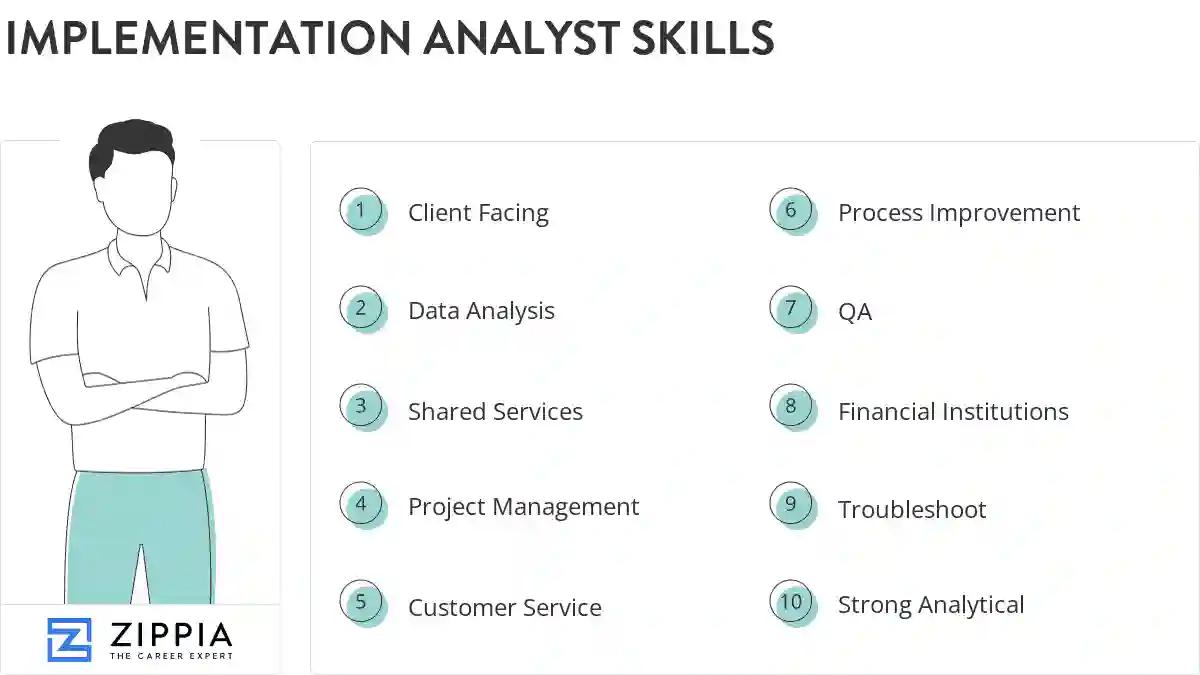
The most important skills for an implementation analyst resume and required skills for an implementation analyst to have include:
- Client Facing
- Data Analysis
- Shared Services
- Project Management
- Customer Service
- Process Improvement
- QA
- Financial Institutions
- Troubleshoot
- Strong Analytical
- Windows
- PC
- Technical Specifications
- System Configuration
- Implementation Process
- Contract Implementation
- UAT
- EDI
- Lifecycle Management
- Post Implementation
- HR
- Implementation Projects
- Technical Support
- Customer Support
- HIPAA
- Technical Issues
- Test Scripts
- Business Processes
- Manage Change
- Visio
- FIS
- User Acceptance
- Project Scope
- User Training
- CRM
- FTP
- Workflow Analysis
- Java
- SQL Server
- Ongoing Support
- EHR
- Oracle Sql
- Status Reports
- Customer Satisfaction
Updated January 8, 2025
