
Automatically apply for jobs with Zippia
Upload your resume to get started.
Information operator skills for your resume and career
15 information operator skills for your resume and career
1. Co-Op
A co-op is an organization that is owned and controlled by its members and that operates for the benefit of its members. In other words, co-ops are made up of people who have a specific need and are willing to work together to run and organize a business that meets those needs. The members of the co-op own, control and use the products and services of the cooperative.
- Explored most aspects of the Information Services department during an 11 quarter co-op assignment.
2. Desktop
The term desktop commonly refers to the desktop computer also called a personal computer. A PC is named after a desktop as it is placed on or under the desk. A desktop computer consists of different accessories such as CPU, monitor, mouse, keyboard, speakers, etc. The desktop also refers to the graphical user interface that appears on a computer, displaying all the icons on the monitor screen.
- Provided desktop support for 120 users, covering software and hardware, as well as peripherals such as printers and phones.
- Worked with end-users to troubleshoot problems with packaged applications Provided local and remote desktop and network support for 1,500+ users.
3. Troubleshoot
Troubleshooting is the process of analyzing and fixing any kind of problem in a system or a machine. Troubleshooting is the detailed yet quick search in the system for the main source of an issue and solving it.
- Interfaced with numerous internal support groups while under tremendous pressure to troubleshoot and resolve communication problems for clients using MQ communications.
- Monitor, supported and managed server, applications troubleshoot and validate the performance functionality of IT supported application.
4. Linux
Linux is a Unix-like operating system. Just like Windows, Mac OS, and IOS, Linux is an operating system used by millions across the globe. Android itself is powered by the Linux operating system. Linux manages all the hardware resources that are associated with your computer. The software is famous because of the protection it grants from viruses, malware, and crashes. The Linux operating system is entirely free and is an open-source software meaning it can be altered by those equipped with the knowledge to code.
- Network based Red Hat Linux 9.0 Kick-Start client installation.
- Build Linux box Operated high-speed laser printers
5. Java
Java is a widely-known programming language that was invented in 1995 and is owned by Oracle. It is a server-side language that was created to let app developers "write once, run anywhere". It is easy and simple to learn and use and is powerful, fast, and secure. This object-oriented programming language lets the code be reused that automatically lowers the development cost. Java is specially used for android apps, web and application servers, games, database connections, etc. This programming language is closely related to C++ making it easier for the users to switch between the two.
- Championed the selection and ultimate use of Java and object-oriented design and programming on a web-based financial inventory management system.
- Design and implement Java programs to collect and incorporate cancer related data from regional hospital medical records into Tumor Registry Database.
6. Computer System
- Perform operational daily computer systems needs for the company and supported departments.
- Operated NCIC computer system; tracking vehicle registration/licenses.
Choose from 10+ customizable information operator resume templates
Build a professional information operator resume in minutes. Our AI resume writing assistant will guide you through every step of the process, and you can choose from 10+ resume templates to create your information operator resume.7. VMware
- Deployed VM s using VMware & Hyper-V for testing & troubleshooting before live production deployment.
- Implemented VMware EXSI server replacing 5 physical servers.
8. Project Management
- Delivered server support, technical operations support and project management expertise.
- Diversified experience spans client services, training and project management.
9. Unix
UNIX is a computer operating system that was first created in the 1960s and has been constantly updated since then. The operating system refers to the set of programs that enable a machine to function. It is a multi-user, multi-tasking device that works on computers, laptops, and servers. UNIX systems also have a graphical user interface (GUI), similar to Microsoft Windows, that makes it simple to use.
- Created and Modified UNIX files used to transfer data for customer invoicing.
- Monitored Oracle databases and UNIX servers to ensure there is adequate space.
10. Technical Support
Technical support or tech support are the services provided by any hardware or software company to users. They help in solving the technical difficulties the customers face with their products or services. Moreover, the tech support employees maintain, manage, and repair the IT faults. They are also responsible for resolving the network problems, installing and configuring hardware and software.
- Provide ongoing technical support and nutritional information for Child care operators.
- Provided general technical support for all locations.
12. Virtualization
- Provided continuing support and administration for server migrations projects, to include VMWare virtualization.
- Implemented VMware virtualization for development and test server environment.
13. Software Systems
Software system is a system of components that form the software part of a computer. The major categories of software systems include application, programming, and system software.
- Operate and provide technical and problem resolution support for the company's computer/communications system hardware and operating software systems.
- Develop comprehensive documentation and support materials for all new hardware and software systems.
14. Windows Server
- Documented help desk tickets/resolutions, and provided overall assistance in daily administration of a Windows Server 2003 Network.
- Repaired Dell and HP server hardware including completely re-installing Windows Server software that significantly reduced support costs and downtime.
15. Computer Software
- Trained other information operators on newly installed computer software and hardware.
- Executed software compliance, data security, and computer software imaging tasks.
5 Information Operator resume examples
Build a professional information operator resume in minutes. Browse through our resume examples to identify the best way to word your resume. Then choose from 5+ resume templates to create your information operator resume.

What skills help Information Operators find jobs?
Tell us what job you are looking for, we’ll show you what skills employers want.
What type of skills will young information operators need?
Peter Dordal Ph.D.
Director for Information Technology, Loyola University Chicago
IT students entering the business world will need to know how to get the maximum leverage out of business systems. In many cases, this will mean writing their own specialized queries to extract the precise business intelligence needed; general-purpose "canned" queries just won't cut it. They will need a broad understanding of what software can accomplish for the enterprise and how to deploy new software effectively; this applies to software used in the office as well as to software used in manufacturing and shipping. And they will need to understand how to lease storage and computing resources from the cloud to meet not only predictable, long-term demands but also sudden short-term business projects.
Students working in database administration and management will need to be able to manage much larger volumes of data than a few years ago. They will need to be familiar with the great variety of new databases in order to pick the best tool for the job.
Students working in network management will need to be able to ensure that everyone has the bandwidth and server access they need, as those demands expand to include extensive video, low-latency real-time connectivity, and the regular transfer of huge amounts of data.
Students in cybersecurity will need to be fully acquainted with all the recommended best practices. However, they will also have to be able to anticipate and guard against potential new vulnerabilities. "By the book" protection is no longer sufficient.
What technical skills for an information operator stand out to employers?
Dr. Matthew Shirrell Ph.D.
Assistant Professor of Educational Leadership and Administration, George Washington University
List of information operator skills to add to your resume
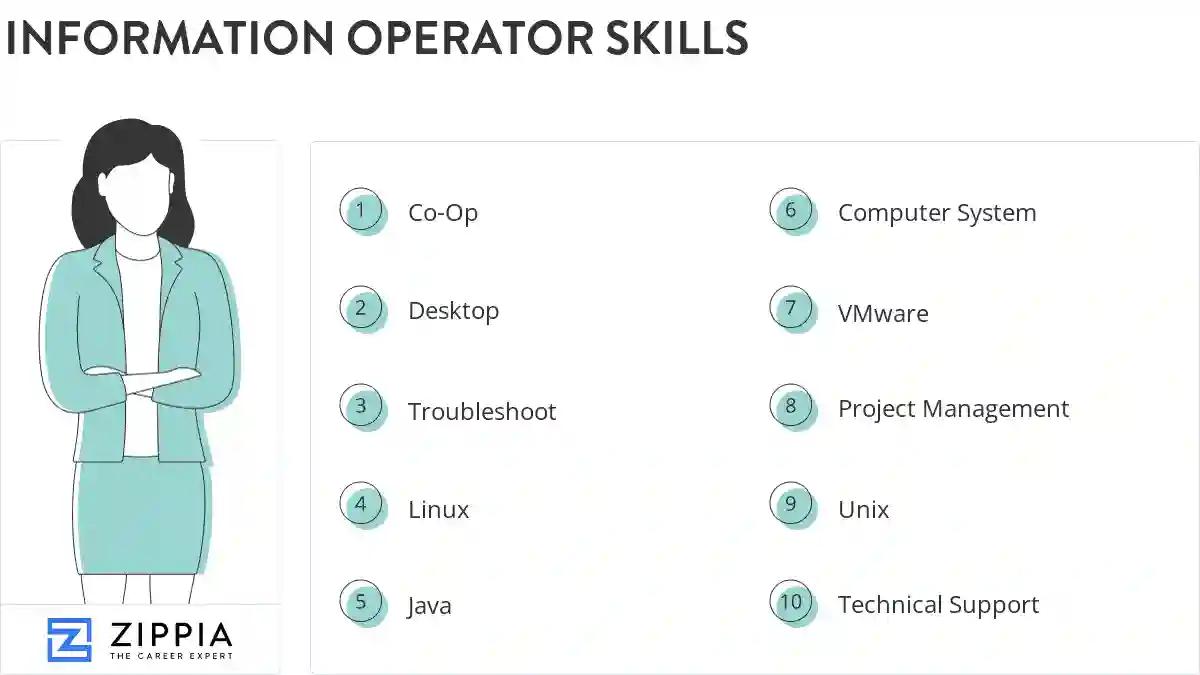
The most important skills for an information operator resume and required skills for an information operator to have include:
- Co-Op
- Desktop
- Troubleshoot
- Linux
- Java
- Computer System
- VMware
- Project Management
- Unix
- Technical Support
- SharePoint
- Virtualization
- Software Systems
- Windows Server
- Computer Software
- Customer Support
- National Security
- OS
- Switches
- Customer Satisfaction
- PCS
- Mac
- Windows XP
- SQL Server
- HTML
- Technical Issues
- Telephone Numbers
- Peripheral Equipment
- Workstations
- Software Installation
- SCCM
- Lan
- VPN
- Software Issues
- User Accounts
- ERP
- Inbound Calls
- Technical Assistance
- SLA
- AS/400
- VoIP
- Emergency Calls
- Microsoft Exchange
- Telephone Calls
- Server Monitoring
- NCIC
- Pc Support
Updated January 8, 2025
