
Automatically apply for jobs with Zippia
Upload your resume to get started.
Information technology technical trainer skills for your resume and career
15 information technology technical trainer skills for your resume and career
1. Training Materials
- Developed curricula and training materials for BlackBerry; P-card usage and monthly reconciliation; Hyperion Financial Management and Reporting; others.
- Developed techniques in conducting technical training, provides additional instructions and training materials to students.
2. Learning Management System
A learning management system or LMS is application software used for administration, tracking, or documentation purposes in education institutes, offices, learning, or training programs. It streamlines the daily chores and reduces the time spent on manual administration tasks. LMS provides a broad array of access to eLearning platforms and also reduces learning and development costs. Google Classrooms, Blackboard Learn are examples of learning management systems
- Utilized learning management systems (LMS) to develop and track training content, including experience in developing online learning.
- Established and maintained a training environment for IT and Operations associates in the current learning management system.
3. Training Sessions
- Developed learning material and conducted training sessions at various locations.
- Facilitated training sessions for parents and children on basic Windows OS, Internet, and Microsoft Office operation and navigation.
4. Training Programs
- Collaborate with team members to establish and clarify Epic course objectives, project development, and evaluate customized training programs.
- Designed and developed training programs to ensure that staff is properly trained on company policies and Standard Operating Procedures.
5. Course Materials
- Developed course material and offered training in Business Analysis, Risk Analysis and Risk Mitigation Management and SDLC process steps.
- Maintain and update instructional course materials.
6. Photoshop
- Designed and updated company logos, advertising posters and technical pamphlets using Adobe Photoshop.
- Retouched items in Photoshop before uploading them to TurboLister.
Choose from 10+ customizable information technology technical trainer resume templates
Build a professional information technology technical trainer resume in minutes. Our AI resume writing assistant will guide you through every step of the process, and you can choose from 10+ resume templates to create your information technology technical trainer resume.7. Technical Support
Technical support or tech support are the services provided by any hardware or software company to users. They help in solving the technical difficulties the customers face with their products or services. Moreover, the tech support employees maintain, manage, and repair the IT faults. They are also responsible for resolving the network problems, installing and configuring hardware and software.
- Configure and provide technical support for secondary school schedules in Pearson Student information systems extensively.
- Provided internal technical support for software.
8. Training Classes
A training class is a series of classes/lessons designed to impart skills and knowledge for a specific job or activity or to develop skills and knowledge or fitness to specific useful skills in oneself or others. There are a variety of benefits for the trainee, including improved self-esteem, motivation, and confidence, acquiring a new skill or qualification, updating skills, and keeping in touch with new developments in the field.
- Assist with desktop support by responding to inquiries about departmental applications, conducting and assisting with follow-up training classes.
- Created end user training material for packaged software and customized applications and held structured training classes.
9. Technical Training
Technical Training refers to the act of teaching individuals the technical skills needed for various positions. This training may be on a form of software (though this doesn't include any coding technology), how to repair a piece of machinery, or how to operate a piece of machinery.
- Delivered technical training to both public and corporate audiences based on customer requirements.
- Created and taught internal Lotus Notes end-user technical training curriculum.
10. ELearning
- Developed eLearning and computer-based training course- ware and training material using Adobe Captivate.
- Utilized Captivate to create new eLearning demonstration from an existing IT101 PowerPoint presentation.
11. HTML
- Assisted senior level representatives with HTML conversions while ensuring accurate and complete documentation.
- Coordinated and designed informational packets, implemented website designs consistent with company standards utilizing HTML coding.
12. Adobe Captivate
- Post ICT training content on the department SharePoint site including courseware, sample files, and Adobe Captivate demos.
- Create engaging task-based e-learning modules using Adobe Captivate.
14. Troubleshoot
Troubleshooting is the process of analyzing and fixing any kind of problem in a system or a machine. Troubleshooting is the detailed yet quick search in the system for the main source of an issue and solving it.
- Work closely with internal and external Customer IT Departments to troubleshoot technical problems in what type of applications or databases.
- Connected patch cable from Cisco switch to patch panel, troubleshoot Network Problems.
15. Java
Java is a widely-known programming language that was invented in 1995 and is owned by Oracle. It is a server-side language that was created to let app developers "write once, run anywhere". It is easy and simple to learn and use and is powerful, fast, and secure. This object-oriented programming language lets the code be reused that automatically lowers the development cost. Java is specially used for android apps, web and application servers, games, database connections, etc. This programming language is closely related to C++ making it easier for the users to switch between the two.
- Completed major enhancements to file management application, using java swing and SOAP services, automating many previously manual administrative functions.
- Championed the selection and ultimate use of Java and object-oriented design and programming on a web-based financial inventory management system.
5 Information Technology Technical Trainer resume examples
Build a professional information technology technical trainer resume in minutes. Browse through our resume examples to identify the best way to word your resume. Then choose from 5+ resume templates to create your information technology technical trainer resume.

What skills help Information Technology Technical Trainers find jobs?
Tell us what job you are looking for, we’ll show you what skills employers want.
What skills stand out on information technology technical trainer resumes?
Bipin Prabhakar
Chairperson, Information Systems Graduate Programs, Clinical Professor, Fettig/Whirlpool Faculty Fellow, Indiana University
What information technology technical trainer skills would you recommend for someone trying to advance their career?
Ranganathan Chandrasekaran
Professor and Director of Graduate Studies, University of Illinois
What type of skills will young information technology technical trainers need?
Peter Dordal Ph.D.
Director for Information Technology, Loyola University Chicago
IT students entering the business world will need to know how to get the maximum leverage out of business systems. In many cases, this will mean writing their own specialized queries to extract the precise business intelligence needed; general-purpose "canned" queries just won't cut it. They will need a broad understanding of what software can accomplish for the enterprise and how to deploy new software effectively; this applies to software used in the office as well as to software used in manufacturing and shipping. And they will need to understand how to lease storage and computing resources from the cloud to meet not only predictable, long-term demands but also sudden short-term business projects.
Students working in database administration and management will need to be able to manage much larger volumes of data than a few years ago. They will need to be familiar with the great variety of new databases in order to pick the best tool for the job.
Students working in network management will need to be able to ensure that everyone has the bandwidth and server access they need, as those demands expand to include extensive video, low-latency real-time connectivity, and the regular transfer of huge amounts of data.
Students in cybersecurity will need to be fully acquainted with all the recommended best practices. However, they will also have to be able to anticipate and guard against potential new vulnerabilities. "By the book" protection is no longer sufficient.
What technical skills for an information technology technical trainer stand out to employers?
John Talburt Ph.D.
Professor of Information Science, University of Arkansas at Little Rock
List of information technology technical trainer skills to add to your resume
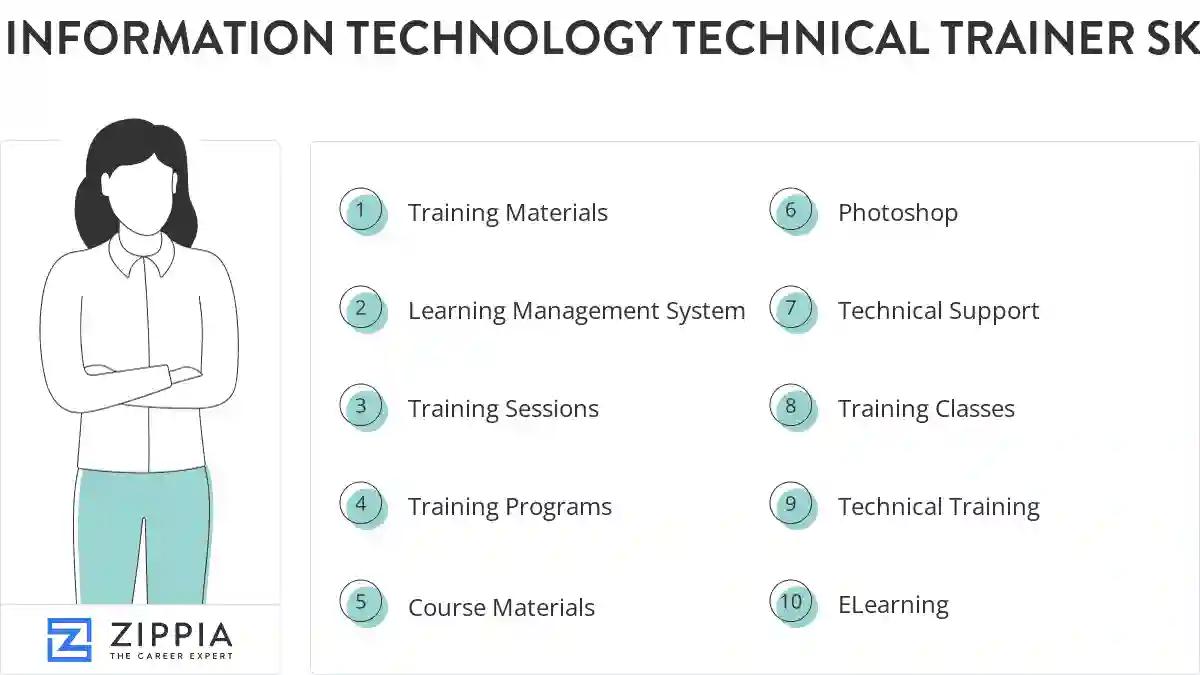
The most important skills for an information technology technical trainer resume and required skills for an information technology technical trainer to have include:
- Training Materials
- Learning Management System
- Training Sessions
- Training Programs
- Course Materials
- Photoshop
- Technical Support
- Training Classes
- Technical Training
- ELearning
- HTML
- Adobe Captivate
- SharePoint
- Troubleshoot
- Java
- EMR
- PC
- Training Courses
- Training Curriculum
- Instructional Materials
- Software Applications
- Windows Server
- Software Training
- Led Training
- Computer System
- Desk Support
- SME
- ERP
- A+
- OS
- Training Manuals
- User Guides
- Database
- Intranet
- Technical Documentation
- Software Products
- SQL Server
- Linux
- Mac
- Technical Issues
- Blended Learning
- Adobe Connect
- VPN
- Windows XP
- Syllabus
- Unix
Updated January 8, 2025
