
Automatically apply for jobs with Zippia
Upload your resume to get started.
Infrastructure analyst skills for your resume and career

15 infrastructure analyst skills for your resume and career
1. Customer Service
Customer service is the process of offering assistance to all the current and potential customers -- answering questions, fixing problems, and providing excellent service. The main goal of customer service is to build a strong relationship with the customers so that they keep coming back for more business.
- Earned solid reputation for resolving complex issues and providing exceptional customer service after installing computers to customer's office.
- Provided a high first call resolution and ensured customers maintain productivity while experiencing a very customer service oriented environment.
2. Troubleshoot
Troubleshooting is the process of analyzing and fixing any kind of problem in a system or a machine. Troubleshooting is the detailed yet quick search in the system for the main source of an issue and solving it.
- Assembled/configured laptop and desktop computers, maintained network hardware, software, troubleshoot common computer/printer problems.
- Worked with off-shored network and data-center operations staff to troubleshoot problems.
3. Azure
- Azure Queues to receive the Inventory messages in the design communication layer.
- Azure Websites & ASP.MVC for the presentation/reporting layer of the design.
4. PC
- Documented information regarding PC network connections.
- Support IBM PC hardware and Toyota Dealer related applications on an OS/2 platform (some experience in AS-400 support included).
5. Desktop Support
- Collaborated with Desktop Support to establish and monitor metrics on service delivery and customer satisfaction.
- Identify and document desktop support policies and procedures for improving service delivery and systems maintenance.
6. Deskside Support
- Delivered comprehensive deskside support for end users and provided software recommendations to enhance client productivity and generate revenues for IBM Corporation.
- Analyzed individual site procedures for deskside support team in Kalamazoo Pfizer for site procedure creation project currently underway.
Choose from 10+ customizable infrastructure analyst resume templates
Build a professional infrastructure analyst resume in minutes. Our AI resume writing assistant will guide you through every step of the process, and you can choose from 10+ resume templates to create your infrastructure analyst resume.7. Technical Support
Technical support or tech support are the services provided by any hardware or software company to users. They help in solving the technical difficulties the customers face with their products or services. Moreover, the tech support employees maintain, manage, and repair the IT faults. They are also responsible for resolving the network problems, installing and configuring hardware and software.
- Performed Level II Technical Support for Pearson Education Services Testing application products supporting the education environment.
- Gathered customer requirements, designed new systems, and performed customer installations and technical support follow-up.
8. SCCM
- Imaged Windows 7 computers using Microsoft Windows SCCM and installed/configured and/or updated seven additional applications manually.
- Installed company applications using SCCM and manual installation.
9. OS
In technical terms, OS stands for "Operating System". It is a software that is used to run programs on the computer. An operating system acts as a link between the user and the hardware components. Windows, macOS, iOS, Linux are examples of an operating system.
- Installed and used Hyper-V, SQL, IIS, SCOM 2007, Microsoft Data Protection Manager, and other OS varieties.
- Make sure the machine name and or IP address were correct to our excel spreadsheet before we pushed the new OS.
10. Remote Desktop
- Perform logistics of incoming and outgoing hardware/software, while updating warehouse database via remote desktop.
- Used windows share desktop application, remote desktop connection and IBM remote application to do remote migration and troubleshooting.
11. Laptop Computers
- Project roles include the imaging of laptop computers to migrate users from the Windows XP environment to the Windows 7 environment.
- Provided on site support for client Desktop and Laptop computers, running Windows 95/98, Windows 2000 and XP Professional.
12. Network Printers
- Provide second level support to all infrastructure including desktops, mobile devices, LAN connectivity, network printers and application support.
- Transferred all end-user data and profile settings including network printers, mapped drives, and local privilege settings.
13. User Support
- Provide Windows and Unix system and network administration to include business continuity planning/implementation and end-user support.
- Provided end-user support including software/hardware installations, maintenance, security, and troubleshooting.
14. LAN
A Local Area Network (LAN) is a collection of devices that are connected in the same building, office, or network to facilitate the transmission of information among devices. The area of LAN depends upon the number of devices connected which vary according to the size of a building or an office. It includes cables, computers, switches, routers, access points, and other networking components.
- Established and maintained both local and remote connectivity to LAN resources including print, mail, Internet, and file shares.
- Provided PC, LAN, printer, and laptop hardware support, repairs, upgrades, installations, and virus removal.
15. Asset Management
Asset management describes the management of assets that are invested on behalf of various industries. It is the process of developing, operating, maintaining, and selling assets for profit and managing the money for individuals and companies through stocks, bonds, and cash equivalents, among other things.Alternatively, asset management enables a business to keep track of all of its assets, helps ensure correct depreciation rates, helps identify and manage risk, and removes ghost assets from business inventory.
- Managed global production team administration and production environments for incident/asset management system, teams on call paging system and shared drive.
- Put into action Asset Management services using asset management tools while supporting productivity applications.
5 Infrastructure Analyst resume examples
Build a professional infrastructure analyst resume in minutes. Browse through our resume examples to identify the best way to word your resume. Then choose from 5+ resume templates to create your infrastructure analyst resume.

What skills help Infrastructure Analysts find jobs?
Tell us what job you are looking for, we’ll show you what skills employers want.
What infrastructure analyst skills would you recommend for someone trying to advance their career?
Kate Marek Ph.D.
Director and Professor, Dominican University
What type of skills will young infrastructure analysts need?
George Miller
Associate Professor Computer Science, Tiffin University
Going back to the previous answer I believe graduates in all fields of study will need a better knowledge of technology and easier adaptability to changing technology. Again, an IS degree is already preparing students for this.
What technical skills for an infrastructure analyst stand out to employers?
Chirag Parikh Ph.D.
Computer Engineering Chair, Grand Valley State University
As a Computer Engineering professor, I would say the job opportunities are tremendous for students out of college as they can venture into hardware field (technical support, hardware engineer, test engineer and much more) as well as software field (software engineer, software developer, software tester and much more). The possibilities are endless.
With COVID and employees working remotely there is still ample opportunity to enhance your technical and interpersonal skills as I believe remote working might stay for a while till things get back to normal.
List of infrastructure analyst skills to add to your resume
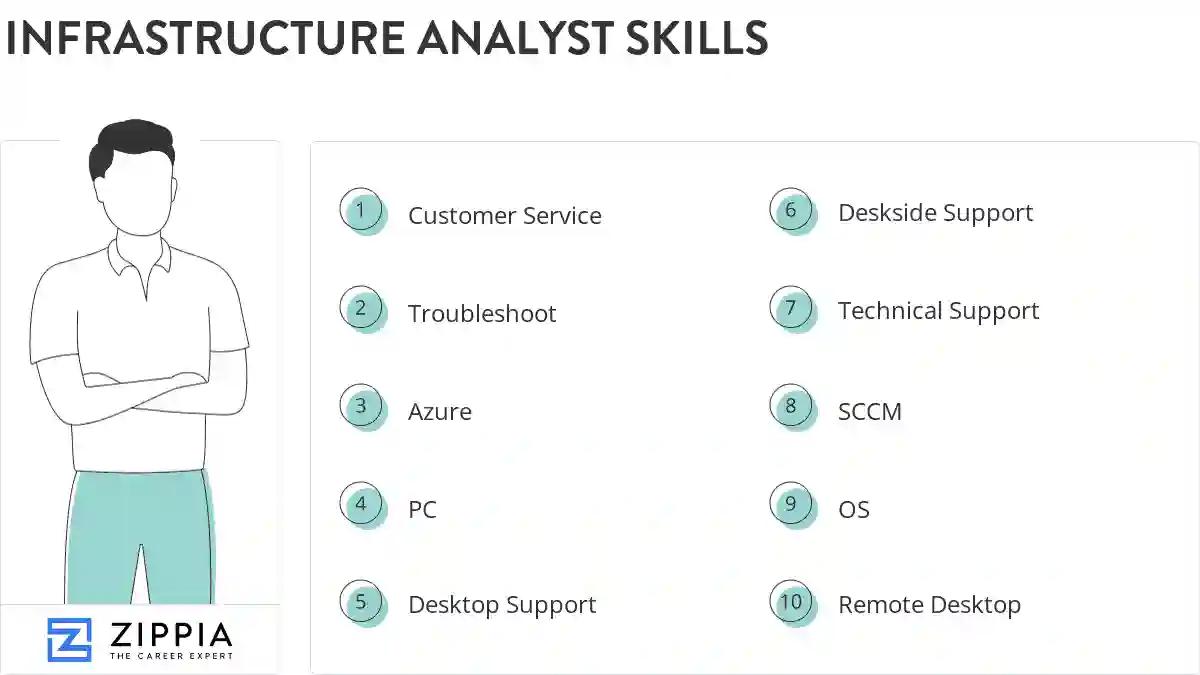
The most important skills for an infrastructure analyst resume and required skills for an infrastructure analyst to have include:
- Customer Service
- Troubleshoot
- Azure
- PC
- Desktop Support
- Deskside Support
- Technical Support
- SCCM
- OS
- Remote Desktop
- Laptop Computers
- Network Printers
- User Support
- LAN
- Asset Management
- VMware
- SQL
- Linux
- Windows XP
- Mobile Device Management
- VPN
- Citrix
- SLA
- Technical Issues
- Workstations
- Computer System
- SAN
- Customer Support
- Software Support
- SharePoint
- Microsoft Exchange
- Virtualization
- Windows Server
- Technical Assistance
- DOD
- Problem Resolution
- TCP/IP
- Software Issues
- Software Installation
- User Accounts
- User Data
- Network Connectivity
- Remote Support
- Data Migration
- Pc Support
- Software Applications
- VoIP
- Level Support
Updated January 8, 2025
