What does an insert operator do?
An insert operator's job is to set up, maintain, and troubleshoot the insert machine to produce accurate work on a timely basis. The operator conducts quality checks and performs other tasks whenever needed as he/she works with one or more machines from time to time depending on workload and date of delivery (DOD). He/she may be able to adapt to changing dynamic production environment since the job involves multitasking, must possess good verbal and written communication skills, basic mechanical and trouble-shooting skills, and must be flexible in the work schedule based on volume needs.
Insert operator responsibilities
Here are examples of responsibilities from real insert operator resumes:
- Manage the master calendar and schedule resources such as communication equipment, weapons, transportation and ammunition forecast and delivery.
- Operate PC and rf-base computer systems with a high level of accuracy.
- Mail sorting, prepare mail for USPS, and other methods of shipping.
- Sort tray, strap and prepare finished mail pieces in compliance with USPS regulations.
- Supervise over technicians who work the manual labor of creating book, magazines and catalogs.
- Make sure all work is put in the computer properly to be run in the machine.
- Maintain production equipment, including cleaning of stackers, bottom wrappers, tyers and bundle scales.
- Control and monitor programmed electronic equipment used to bleach, dye and finish cotton and synthetic sewing threads.
- Print addresses for magazines, verify accuracy of postal codes, maintain ink jet and integrity of addresses.
- Load and maintain the APS inserter for the insertion of documentation and checks into envelopes for the shipment to customers.
- Check for correct amount of dye usage on fabric, cut fabric off beam and put onto pallets and operating forklift.
- Monitor combat missions through satellite and computer global positioning systems in order to prepare accurate reports for unit commanders.
- Set up and run MCS ink jet system.
- Feed and unload mailing equipment for transportation to sortation stations.
- Monitor combat missions through satellite and computer global positioning systems in order to prepare accurate reports for unit commanders.
Insert operator skills and personality traits
We calculated that 17% of Insert Operators are proficient in Quality Standards, Quality Checks, and Machine Operation. They’re also known for soft skills such as Communication skills, Coordination, and Mechanical skills.
We break down the percentage of Insert Operators that have these skills listed on their resume here:
- Quality Standards, 17%
Ensured stringent Six Sigma quality standards handling confidential client information.
- Quality Checks, 14%
Performed frequent quality checks during equipment operations.
- Machine Operation, 9%
Prepare newspapers through machine operation for delivery.
- Routine Maintenance, 8%
Performed routine maintenance on equipment as well as minor repairs.
- APS, 7%
Read work order confirm components, and running Piney bowes FPS , APS and Bell & Howell
- Hand Tools, 6%
Clean containers, materials, supplies, or work areas, using cleaning solutions and hand tools.
Common skills that an insert operator uses to do their job include "quality standards," "quality checks," and "machine operation." You can find details on the most important insert operator responsibilities below.
Communication skills. The most essential soft skill for an insert operator to carry out their responsibilities is communication skills. This skill is important for the role because "material moving machine operators signal and direct workers to load and unload material." Additionally, an insert operator resume shows how their duties depend on communication skills: "maintain ongoing communication with mail departments on new postal regulations. "
Coordination. Another essential skill to perform insert operator duties is coordination. Insert operators responsibilities require that "material moving machine operators must have steady hands and feet to guide and control heavy machinery precisely." Insert operators also use coordination in their role according to a real resume snippet: "meet productivity goals & quality standards- communicate in english, both verbal and written- good hand-eye coordination- attention to detail"
Mechanical skills. This is an important skill for insert operators to perform their duties. For an example of how insert operator responsibilities depend on this skill, consider that "material moving machine operators make minor adjustments to their machines and perform basic maintenance on them." This excerpt from a resume also shows how vital it is to everyday roles and responsibilities of an insert operator: "job duties: flo- master operation andmechanical, pitney bowes operation andmechanical, stand-up operation, pallettruck operation".
Visual ability. insert operator responsibilities often require "visual ability." The duties that rely on this skill are shown by the fact that "material moving machine operators must be able to see clearly where they are driving or what they are moving." This resume example shows what insert operators do with visual ability on a typical day: "train management and associates in customer service, standards of procedure and visual merchandising. "
The three companies that hire the most insert operators are:
- Broadridge20 insert operators jobs
- PCI Group19 insert operators jobs
- RRD17 insert operators jobs
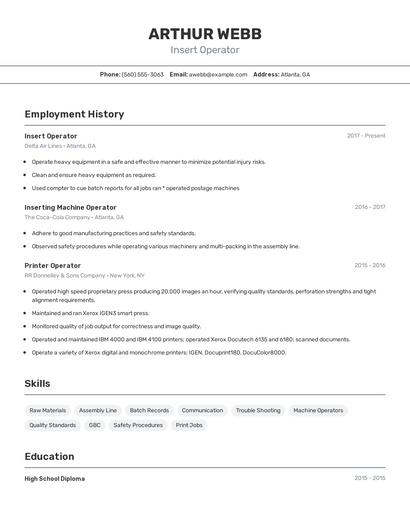
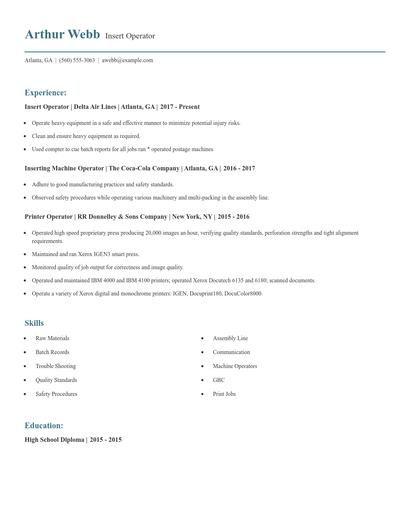
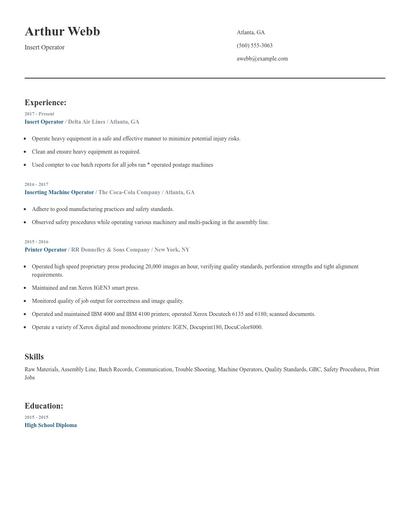
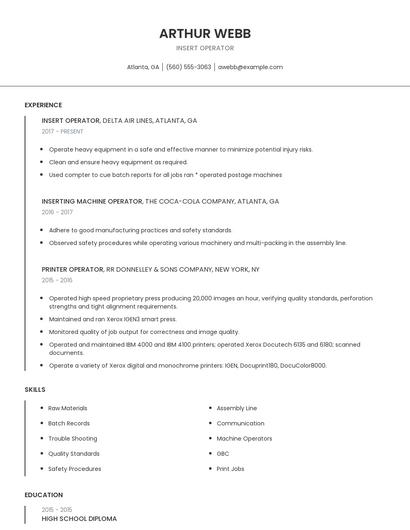
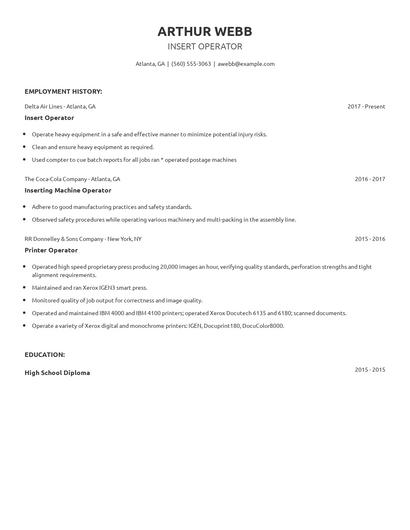
Choose from 10+ customizable insert operator resume templates
Build a professional insert operator resume in minutes. Our AI resume writing assistant will guide you through every step of the process, and you can choose from 10+ resume templates to create your insert operator resume.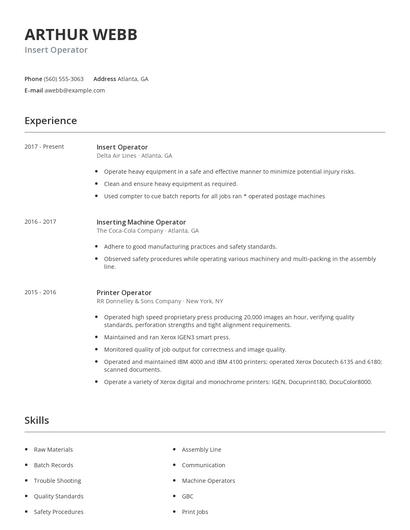



Compare different insert operators
Insert operator vs. Mailroom assistant
Mailroom assistants receive incoming mail and then process, sort, and distribute it to the proper recipients. They may maintain mailroom supply inventories and sort office mail and messages. It is part of their responsibilities to check outgoing mail by preparing it for delivery, including distribution of packages and logging. Moreover, they usually operate mailroom tools such as envelope openers, postage meters, mail sorting machines, mail sealers, fold-and-insert machines, labeling machines, and scanners.
There are some key differences in the responsibilities of each position. For example, insert operator responsibilities require skills like "quality standards," "quality checks," "basic math," and "machine operation." Meanwhile a typical mailroom assistant has skills in areas such as "office equipment," "data entry," "hr," and "mail room." This difference in skills reveals the differences in what each career does.
Mailroom assistants tend to make the most money working in the government industry, where they earn an average salary of $32,606. In contrast, insert operators make the biggest average salary, $33,806, in the manufacturing industry.mailroom assistants tend to reach similar levels of education than insert operators. In fact, mailroom assistants are 1.1% more likely to graduate with a Master's Degree and 0.0% less likely to have a Doctoral Degree.Insert operator vs. Direct mail clerk
A mailroom clerk specializes in handling and distributing mail and packages within a company or establishment, ensuring accuracy and timeliness. They are responsible for scanning and sorting out every parcel through a system, making sure to document everything in and out of the building. Furthermore, there are instances where they must process all outgoing mail by processing it into postal stamping machines, respond to mail inquiries from employees, and maintain records of all transactions.
Each career also uses different skills, according to real insert operator resumes. While insert operator responsibilities can utilize skills like "quality standards," "quality checks," "basic math," and "machine operation," direct mail clerks use skills like "press releases," "direct care," "ran," and "a+."
In general, direct mail clerks achieve higher levels of education than insert operators. They're 9.1% more likely to obtain a Master's Degree while being 0.0% less likely to earn a Doctoral Degree.Insert operator vs. Mail technician
The required skills of the two careers differ considerably. For example, insert operators are more likely to have skills like "quality standards," "quality checks," "basic math," and "machine operation." But a mail technician is more likely to have skills like "inbound calls," "customer inquiries," "courier services," and "state agencies."
Mail technicians typically earn similar educational levels compared to insert operators. Specifically, they're 0.1% less likely to graduate with a Master's Degree, and 0.0% less likely to earn a Doctoral Degree.Insert operator vs. Mailroom clerk
Types of insert operator
Updated January 8, 2025
