
Automatically apply for jobs with Zippia
Upload your resume to get started.
Integration analyst skills for your resume and career
15 integration analyst skills for your resume and career
1. Healthcare
Healthcare is the maintenance or improvement of a person's health by the diagnosis and treatment of a person's injury, illness, or any other disease. Healthcare is a basic necessity of human life and is the responsibility of the country's government to ensure that each person gets healthcare. Providing healthcare is the job of certified health professionals that includes doctors, surgeons, nurses, and other physicians. Pharmaceutical companies, hospitals, dentistry, therapy, and health training all come under healthcare. Healthcare plays a vital role in the country's economy and its development.
- Modified and updated ADT interface for GE HealthCare CPN (fetal monitoring).
- Researched and assist in executing programs addressing healthcare payer policy changes and/or other topics identified as potential risk areas.
2. Data Analysis
- Performed research and statistical data analysis.
- Perform systems and data analysis as well as produce and gather requirements.
3. Project Management
- Provided input to estimates for project management and change management activities through analysis of requirements effort, resources, and technology.
- Manage a client portfolio focusing on improving business processes through integration and project management.
4. Customer Service
Customer service is the process of offering assistance to all the current and potential customers -- answering questions, fixing problems, and providing excellent service. The main goal of customer service is to build a strong relationship with the customers so that they keep coming back for more business.
- Develop more efficient methodology with management to resolve pricing issue and render better customer service to members and clubs.
- Monitor accuracy and timeliness of claims, membership and customer service to meet performance and service level goals.
5. CPT
CPT is a medical term that stands for Current Procedural Terminology. Whenever a procedure like surgery or diagnosis occurs or some other medical service is rendered to a patient, it is reported to the concerned physician, insurance company, or organization. The aforementioned practice is widely referred to as CPT.
- Attained knowledge of ICD-9, CPT and HCPCS codes and benefit configuration as elements of the claims processing.
- Assign CPT and ICD codes for Outpatient and ER encounters
6. HL7
(HL7) Health Level Seven International is a non-profit ANSI-accredited standards development organization dedicated to providing benchmarks and solutions that empower overall health data unification. This framework enables sharing, integration, and recovery of electronic health information. This information strengthens clinical practices along with the evaluation, management, and deliver health services.
- Hired to develop new interface products and standardize existing HL7 integration processes for company wide expansion initiative.
- Developed better validation methodology for development, coding and conversion of HL7 interfaces.
Choose from 10+ customizable integration analyst resume templates
Build a professional integration analyst resume in minutes. Our AI resume writing assistant will guide you through every step of the process, and you can choose from 10+ resume templates to create your integration analyst resume.7. Troubleshoot
Troubleshooting is the process of analyzing and fixing any kind of problem in a system or a machine. Troubleshooting is the detailed yet quick search in the system for the main source of an issue and solving it.
- Run SQL queries in AS400 to extract data and troubleshoot issues.
- Implement, develop, test and troubleshoot system interfaces.
8. Cerner
Cerner is a leading American supplier of (HIT) health care information technology devices, services, and hardware that enhances clinical and financial outcomes.
- Assisted with Cerner Millennium CORE application build to satisfy interface specifications with downstream vendors.
- Created training materials for physicians and practice managers for Cerner HealtheIntent, a web-based population health solution.
9. Queues
- Developed 'Queue Activity Management', which encompassed defining team objectives in order to reach service level goals and meet initiatives.
- Manage ticket queue providing direct communications and resolutions to client's ad appeals inquiries concerning disabled accounts.
10. Strong Analytical
- Demonstrated strong analytical and business problem solving skills; able to understand complex business system functionality and develop strategies.
- Applied strong analytical and organizational skills including thoroughness and attention to detail to accommodate changing priorities and work assignments.
11. Java
Java is a widely-known programming language that was invented in 1995 and is owned by Oracle. It is a server-side language that was created to let app developers "write once, run anywhere". It is easy and simple to learn and use and is powerful, fast, and secure. This object-oriented programming language lets the code be reused that automatically lowers the development cost. Java is specially used for android apps, web and application servers, games, database connections, etc. This programming language is closely related to C++ making it easier for the users to switch between the two.
- Integrate Company to Company EDI and EDIFACT documents using SQL, Shell Scripting and Java scripting
- Developed extraction, transformation and load procedures (PL/SQL, Java) between systems.
12. Client Facing
- Plan and facilitate Gap Analysis/Requirement gathering workshops on existing client processes and solution to be implemented for large client facing engagements.
- Developed new product implementation materials including procedures, process flows, client facing materials and lead-time guidelines.
13. Business Process
A business process is a group of tasks that are performed by people working in a business to attain a worthy product and to present it to their customers. A business process can also be defined as performing several steps to achieve a certain goal set by a company. Business processes need to set purposeful goals and the outcome of that goal should be clear.
- Document business processes and network architecture for effective consolidation.
- Installed, implemented and trained Premier II Teller, Integrated Teller and Business Process Manager for new bank or clients.
14. CMS
A Content Management System or CMS is computer software that works as a framework where content can be assembled and managed by using a database. CMS is an important asset in web development. This platform enables users to create, edit, collaborate on, publish and store digital content. It helps users to manage their content and modify it from a single system.
- Comply with State (DHS) and Federal (CMS) contracts.
- Perform Duals (Medicare/Medicaid Program) contract audit reviews to ensure CMS adherence.
15. XML
XML is a medium for storing and transporting data that is independent of software and hardware. XML stands for eXtensible Markup Language. XML, like HTML, is a markup language that was created to store and transport data. It was created with the intention of being self-descriptive. There are no predefined tags in the XML language. Another feature is that XML is extensible.
- Analyzed client extracted files and specs to prepare documents for data migration between multiple XML environments using deduction and payroll coding.
- Have created, modified, analyzed, and mapped XML payloads as required to support interface development and testing.
5 Integration Analyst resume examples
Build a professional integration analyst resume in minutes. Browse through our resume examples to identify the best way to word your resume. Then choose from 5+ resume templates to create your integration analyst resume.

What skills help Integration Analysts find jobs?
Tell us what job you are looking for, we’ll show you what skills employers want.
What skills stand out on integration analyst resumes?
Michael McLaughlin
Faculty, Brigham Young University - Idaho
What soft skills should all integration analysts possess?
Hanna Kim Ph.D.
Associate Professor, Chair, Adelphi University
What hard/technical skills are most important for integration analysts?
Hanna Kim Ph.D.
Associate Professor, Chair, Adelphi University
What integration analyst skills would you recommend for someone trying to advance their career?
A.J. Arreguin
Professor, Our Lady of the Lake University
Students should volunteer with small/local businesses or create their brand (start a blog or become a niche social media influencer) to practice and build on their experience. Once the student/graduate does that, they should keep a weekly log with analytics to help them understand how to improve moving forward. This will be beneficial when applying for a communication/public relations job during an interview. The degree gets the student/graduate the talk, but the experience lands them the job.
What type of skills will young integration analysts need?
Missy Gutkowski
Assistant Dean, Bucknell University
New employees should be prepared to communicate well and often, not only expressing expectations of what they need to complete their work but also to frequently updating supervisors and coworkers. Quickly learning the communication preferences and style of a supervisor and organization will set a new employee up for success in any industry.
List of integration analyst skills to add to your resume
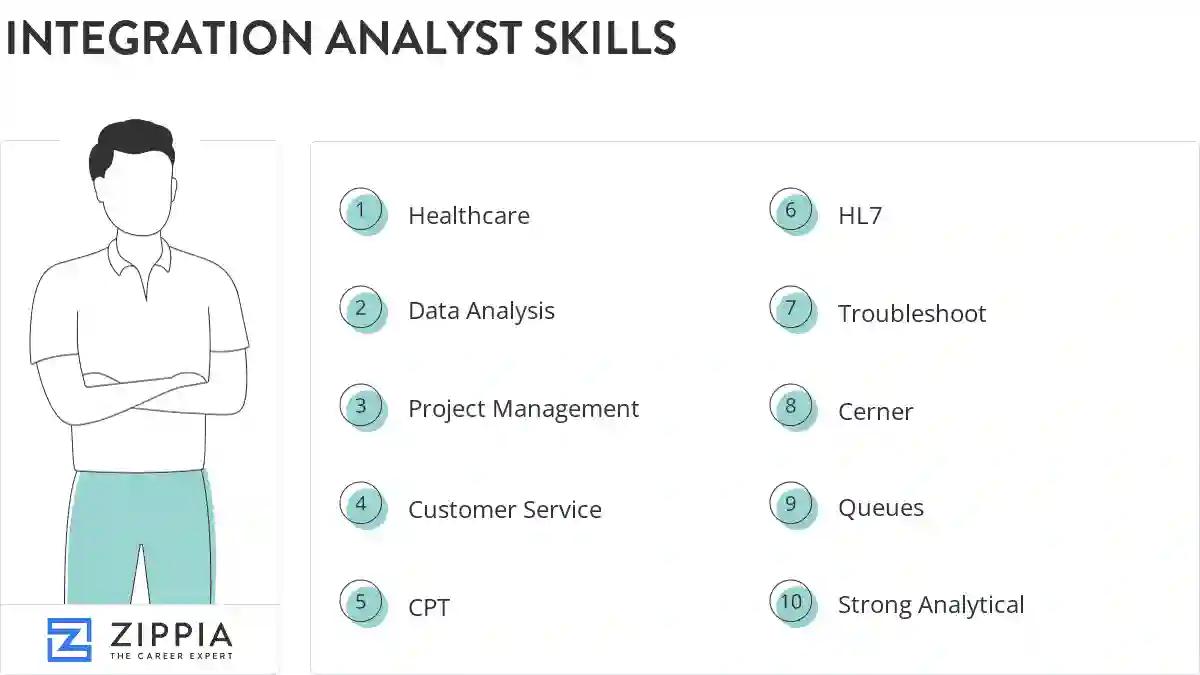
The most important skills for an integration analyst resume and required skills for an integration analyst to have include:
- Healthcare
- Data Analysis
- Project Management
- Customer Service
- CPT
- HL7
- Troubleshoot
- Cerner
- Queues
- Strong Analytical
- Java
- Client Facing
- Business Process
- CMS
- XML
- EMR
- Web Services
- Technical Specifications
- Shared Services
- EDI
- Medicaid
- Windows
- SQL Server
- Emerging Technologies
- Go-Live
- FTP
- Interface Specifications
- SharePoint
- Data Integrity
- Technical Support
- Process Improvement
- SME
- JavaScript
- ERP
- CDM
- Epic Bridges
- EHR
- Leveraged
- PC
- Unix
- ETL
- HIPAA
- Interface Engine
- Oracle Sql
- Linux
- QA
- ICD-9
- Visio
- CRM
Updated January 8, 2025
