
Automatically apply for jobs with Zippia
Upload your resume to get started.
Integration architect skills for your resume and career

15 integration architect skills for your resume and career
1. Cloud
Cloud is a server that is accessed over the internet. There are different programs and software that also run on these servers. These clouds can be accessed from anywhere in the world as they are not present in your computer storage, but have their online servers. Cloud consists of data centers all across the world.
- Install and Supported to IBM CloudBurst, which is a hardware appliance designed to private cloud deployment.
- Involved in end to end integration of on premise and cloud based applications within chevron.
2. API
- Collaborated with three business partners to evaluate leveraging integration and API technology functionality with the dynamic business requirements.
- Utilized C# COM API to automatically log test results and defects to SDLC management system (HP Quality Center).
3. Java
Java is a widely-known programming language that was invented in 1995 and is owned by Oracle. It is a server-side language that was created to let app developers "write once, run anywhere". It is easy and simple to learn and use and is powerful, fast, and secure. This object-oriented programming language lets the code be reused that automatically lowers the development cost. Java is specially used for android apps, web and application servers, games, database connections, etc. This programming language is closely related to C++ making it easier for the users to switch between the two.
- Designed a Java based Enterprise Architecture Integration (EAI) system that linked the United States Armed Forces order supply chain.
- Involved in the Map development and customized the mapping using java programming language.
4. Linux
Linux is a Unix-like operating system. Just like Windows, Mac OS, and IOS, Linux is an operating system used by millions across the globe. Android itself is powered by the Linux operating system. Linux manages all the hardware resources that are associated with your computer. The software is famous because of the protection it grants from viruses, malware, and crashes. The Linux operating system is entirely free and is an open-source software meaning it can be altered by those equipped with the knowledge to code.
- Designed and executed migration of integration software from Windows physical servers to Linux virtual servers.
- Administer IBM WebSphere MQ environment with 55 queue managers on 43 servers including AS400, Windows, Linux and AIX.
5. SOA
- Provided architectural expertise for World Vision's SOA implementation.
- Designed and delivered SOA deployment methodologies.
6. Pre Sales
- Interacted with the sales team, customers, channel partners and team of the organization regarding post and pre sales.
- Enhanced role from product pre sales expert to solutions architect to afford clients the benefits of an expanded portfolio.
Choose from 10+ customizable integration architect resume templates
Build a professional integration architect resume in minutes. Our AI resume writing assistant will guide you through every step of the process, and you can choose from 10+ resume templates to create your integration architect resume.7. Infrastructure
Infrastructure includes the organizational and physical structures needed to run an area or a society smoothly. It is a group of basic facilities required for any society or firm to run sustainably and efficiently. The infrastructural system is a high investing area and helps majorly in flourishing the economy and prosperity of a country. It is an underlying system needed for ensuring the safety and comfort of the public and to run a country smoothly. All the tasks needed to be performed for a flourishing economy and a happy and healthy public are included in infrastructure.
- Performed complex event-driven infrastructure implementations.
- Supported projects across the enterprise to use integration infrastructure and implement integration interfaces on ESB.
8. Saas
- Design and implement separation of client's corporate domains from external access commercial SaaS application infrastructures following strong security methodologies.
- Developed new SaaS revenue model and solution including business strategy.
9. MDM
MDM stands for master management data. It pertains to the process of developing and organizing data on various aspects, such as customers, products, and businesses.
- Provided best-practice consulting to Architecture team on operational metadata standards to be incorporated into MDM development guidelines.
- Involved in SAP MDM master data setup for products to make it available for syndication, Authoring and executing test scripts.
10. Middleware
- Designed Integration Architecture involving middleware and databases for 10+ enterprise portals.
- Project Description: Paragon Aftermarket Parts Middleware conversion.
11. Integration Solutions
- Standardized architectural design of BizTalk development mapping for integration solutions.
- Provided delivery responsibility for Integration solutions.
12. Unix
UNIX is a computer operating system that was first created in the 1960s and has been constantly updated since then. The operating system refers to the set of programs that enable a machine to function. It is a multi-user, multi-tasking device that works on computers, laptops, and servers. UNIX systems also have a graphical user interface (GUI), similar to Microsoft Windows, that makes it simple to use.
- Worked with UNIX admin team for carving out different environments.
- Create custom UNIX based tools to aid in the transition.
13. Http
Hypertext Transfer Protocol (HTTP) is an application-layer protocol for transmitting hypermedia documents, such as HTML. It follows the classic client server model, and it is a stateless protocol. It was created for transmission between web servers and web browsers; however it can also be used for other purposes.
- Implemented and the configured the gateway components to us SSL and HTTP Authentication.
- Worked with HTTP transports to send IO/XML messages to a web application.
14. Web Services
A web service is software that is available on the internet and uses a specific messaging system. A web service is a kind of service that is not bound to any specific programming language or operating system. Web services help every device to communicate over the world wide web.
- Developed web service based interfaces for IVR-SAP integration for order create/change, order summary, delivery calendar interfaces.
- Configured and created new web services to provide various application integration.
15. Digital Transformation
- Envisioned and championed long-term IT strategy for Annuity Management platform, a key Digital Transformation initiative.
- Engage with customers and map out solutions to solve their IT challenges and help with digital transformation including migration to cloud.
5 Integration Architect resume examples
Build a professional integration architect resume in minutes. Browse through our resume examples to identify the best way to word your resume. Then choose from 5+ resume templates to create your integration architect resume.

What skills help Integration Architects find jobs?
Tell us what job you are looking for, we’ll show you what skills employers want.
What skills stand out on integration architect resumes?
Korydon Smith
Professor and Chair, University at Buffalo – The State University of New York
What soft skills should all integration architects possess?
Randall Randall
Program Head Architecture, Professor, University of Idaho
What hard/technical skills are most important for integration architects?
Randall Randall
Program Head Architecture, Professor, University of Idaho
What integration architect skills would you recommend for someone trying to advance their career?
Dak Kopec Ph.D.
Associate Professor, Coordinator, BA Interior Architecture and Design and Master of Design Program, University Of Nevada, Las Vegas
Additionally, I would recommend learning about disease transmission and pathology. With a stronger foundation in these areas, the interior designer will be better equipped to address the infection control expectations that will likely be required of future Interior Designers.
What type of skills will young integration architects need?
Michael Armstrong
CEO, NCARB
We also encourage graduates, and all who are considering the licensed practice as a career, to explore our newly-launched Destination Architect site, an interactive guide with video tutorials and useful tips.
What technical skills for an integration architect stand out to employers?
Marc Neveu Ph.D.
Architecture Program Head, Arizona State University
List of integration architect skills to add to your resume
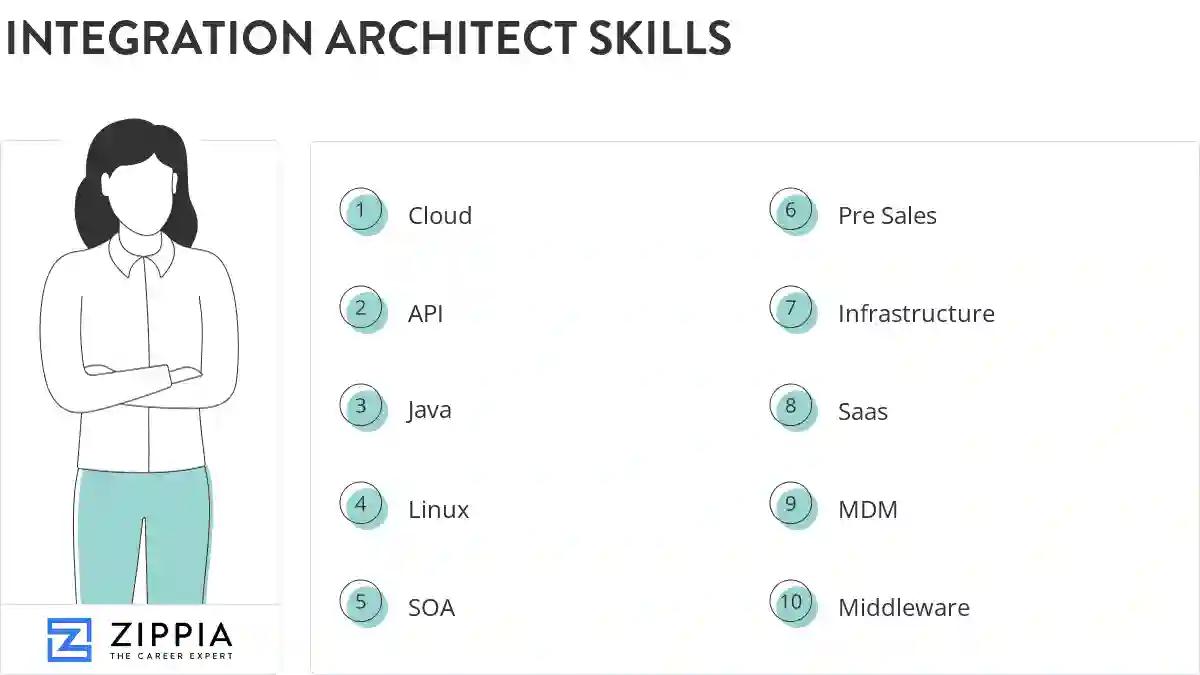
The most important skills for an integration architect resume and required skills for an integration architect to have include:
- Cloud
- API
- Java
- Linux
- SOA
- Pre Sales
- Infrastructure
- Saas
- MDM
- Middleware
- Integration Solutions
- Unix
- Http
- Web Services
- Digital Transformation
- Azure
- Scrum
- Application Integration
- SFTP
- Post Sales
- Salesforce
- C #
- XML
- ERP
- Ruby
- CRM
- System Integration
- Service Oriented Architecture
- Emerging Technologies
- Microservices
- ETL
- OSB
- Technical Liaison
- Business Process
- Enterprise Architecture
- ESB
- Provisioning
- Debugging
- IDOC
- PeopleSoft
- EDI
- SDLC
- Amazon Web Services
- Unified Communications
- SQL Server
- Driven Design
- RFC
- Client Facing
Updated January 8, 2025
