
Automatically apply for jobs with Zippia
Upload your resume to get started.
Integration technician skills for your resume and career
15 integration technician skills for your resume and career
1. Dexterity
- Installed plastic coverings around the metal chassis and LCD touch screens by using hand dexterity.
- Operate and manipulate machinery and various hand and power tools requiring manual dexterity.
2. Hand Tools
- Used precision measuring instruments, power tools, rivets, bolts, clamps, pins, hand tools and other fasteners.
- Performed bench-type processes to complete mechanical and electrical assemblies and sub-assemblies, using hand tools, and electronic and pneumatic tooling.
3. Calipers
- Use of mechanical tools and precision calibrated tools - torque wrenches, micrometers and calipers.
- Use standard electromechanical standard techniques working with power and data cables, pliers and sockets, micrometers and calipers.
4. Quality Standards
Quality standards are a specific level of standards of products that are set by the companies for the customers that have to be met and maintained throughout the process until the time of delivery. Quality standards are information that includes the customer's requirements, guidelines, and characteristics for the needed final product or service.
- Experience as an installation and commissioning technician, know and understand quality standards and installation procedures.
- Help train and support new crew leaders and field survey/bell hole technicians in operations, industry and quality standards.
5. Engineering Drawings
Engineering drawings are technical drawings that tell about the requirements for engineering components or equipment. Such drawings have standardized languages and symbols. There are multiple types of engineering drawings such as isometric drawing, orthographic or multiview drawing, schematic drawings, one view, and two view drawings, etc.
- Construct vehicle to exact specifications indicated on engineering drawings.
- Read and interpreted engineering drawings or other written media for performing work and assisted with any other duties as assigned.
6. PC
- Resolved hardware and software problems on various computer platforms, including PC client/server, mid-range, and mainframe processors.
- Remove old PC's, place classification label on old hard drives, install new PC's.
Choose from 10+ customizable integration technician resume templates
Build a professional integration technician resume in minutes. Our AI resume writing assistant will guide you through every step of the process, and you can choose from 10+ resume templates to create your integration technician resume.7. Technical Support
Technical support or tech support are the services provided by any hardware or software company to users. They help in solving the technical difficulties the customers face with their products or services. Moreover, the tech support employees maintain, manage, and repair the IT faults. They are also responsible for resolving the network problems, installing and configuring hardware and software.
- Fostered cross-vendor functionality, provided applications training, and post-sales technical support.
- Provided technical support to enterprise information team in their various applications.
8. CAD
- Communicate effectively with other internal departments regarding information related to CAD drawing change requests.
- Create and modify CAD drawings per work order change requests using AutoCAD.
9. RF
- Operated RF Chambers during SIM verification and recorded statistics related to network performance.
- Performed avionics integration of rocket boosters and payload, including installation of electronic assemblies, harnessing, and RF devices.
10. Java
Java is a widely-known programming language that was invented in 1995 and is owned by Oracle. It is a server-side language that was created to let app developers "write once, run anywhere". It is easy and simple to learn and use and is powerful, fast, and secure. This object-oriented programming language lets the code be reused that automatically lowers the development cost. Java is specially used for android apps, web and application servers, games, database connections, etc. This programming language is closely related to C++ making it easier for the users to switch between the two.
- Designed and coded custom functionality using Computer Associates IdentityMinder API's for a federal government system using Java 1.6.
- Converted St. Thomas University, converted entire Hennepin County Library locations to HTML5 away from Java Envision
11. Linux
Linux is a Unix-like operating system. Just like Windows, Mac OS, and IOS, Linux is an operating system used by millions across the globe. Android itself is powered by the Linux operating system. Linux manages all the hardware resources that are associated with your computer. The software is famous because of the protection it grants from viruses, malware, and crashes. The Linux operating system is entirely free and is an open-source software meaning it can be altered by those equipped with the knowledge to code.
- Install, configure, and manage various Linux RedHat, Windows 7, and Windows Server 2008 R2 systems.
- Support a Medical Software package OS supported Xenix Unix AIX Linux Windows MS-DOS Migration to new servers and setup and maintained.
12. Test Equipment
Test equipment is a mechanical tool or a device which is used create signals and gather response from an electronic device under test. It helps in detecting any faults in the device and it also proves the proper operation of the electronic device.
- Operated test equipment to isolate faults and performed restoration actions.
- Use test equipment, read electronic schematics, use Microsoft Office and various other software for engineering.
13. Control Systems
- Performed design review, then fabricated large-scale electrical/mechanical control systems.
- Design electrical control systems for older equipment and wright code to support those new designs.
14. AV
- Work involves developing and coordinating plans and technical approaches to solve IT and AV problems.
- Considered an expert technical authority in new IT and AV developments and advanced techniques.
15. GPS
GPS stands from Global Positioning System. It is a navigation system comprising of satellites that helps in determining the location, velocity, and synchronize time data for different modes of travel like air, sea, or land.
- Upgrade firmware and CONFIGURE Garmin GPS for remote terminal to modem positioning communication.
- Contracted to provide installation and troubleshooting services which combined GPS and wireless technology with powerful golf course management applications.
5 Integration Technician resume examples
Build a professional integration technician resume in minutes. Browse through our resume examples to identify the best way to word your resume. Then choose from 5+ resume templates to create your integration technician resume.

What skills help Integration Technicians find jobs?
Tell us what job you are looking for, we’ll show you what skills employers want.
List of integration technician skills to add to your resume
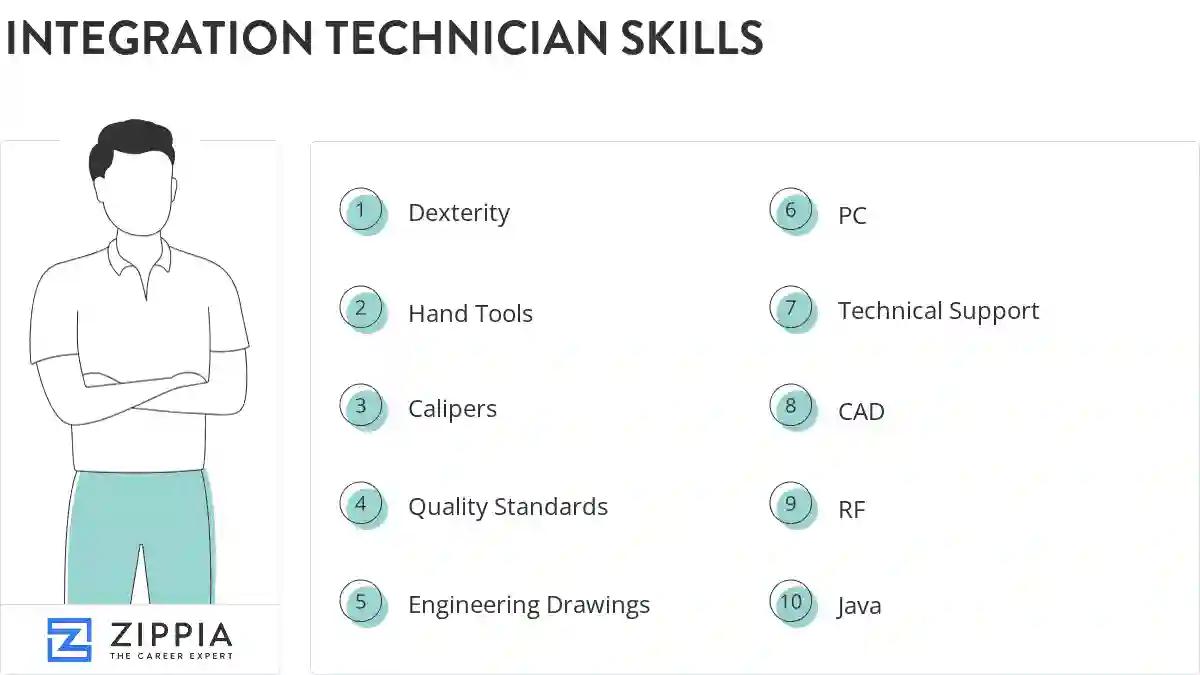
The most important skills for an integration technician resume and required skills for an integration technician to have include:
- Dexterity
- Hand Tools
- Calipers
- Quality Standards
- Engineering Drawings
- PC
- Technical Support
- CAD
- RF
- Java
- Linux
- Test Equipment
- Control Systems
- AV
- GPS
- SQL
- Customer Satisfaction
- Switches
- System Integration
- QA
- Emerging Technologies
- ESD
- Level Troubleshooting
- Test Procedures
- Routers
- DOD
- Tcp Ip
- Windows XP
- Unix
- PLC
- Computer System
- LAN
- Technical Issues
- Perform Routine Maintenance
- Ethernet
- Refurbishment
- AMX
- TCP/IP
- A/V
Updated January 8, 2025
