What does an irrigation worker do?
Irrigation worker responsibilities
Here are examples of responsibilities from real irrigation worker resumes:
- General farm operations including health checks and care of calves, manage cleanliness of barns, milking
- Dig trenches, set ground rods and wire, minor concrete work, traffic control, set cabinets, install pipes.
- Dig trenches, set ground rods and wire, minor concrete work, traffic control, set cabinets, install pipes.
Irrigation worker skills and personality traits
We calculated that 85% of Irrigation Workers are proficient in Harvest, Hand Tools, and Sprinklers. They’re also known for soft skills such as Dexterity, Listening skills, and Physical strength.
We break down the percentage of Irrigation Workers that have these skills listed on their resume here:
- Harvest, 85%
Operated all harvest equipment also delivered and transferred grain to customers.
- Hand Tools, 11%
Repaired using hand tools as needed.
- Sprinklers, 3%
Helped around the farm with various responsibilities including cattle herding, planting crops, fixing and moving irrigation sprinklers.
- Wheel Lines, 1%
Moved hand lines and wheel lines Managed and entire area of agricultural crops Repaired irrigation equipment
Most irrigation workers use their skills in "harvest," "hand tools," and "sprinklers" to do their jobs. You can find more detail on essential irrigation worker responsibilities here:
Dexterity. The most essential soft skill for an irrigation worker to carry out their responsibilities is dexterity. This skill is important for the role because "agricultural workers need excellent hand-eye coordination to harvest crops and operate farm machinery." Additionally, an irrigation worker resume shows how their duties depend on dexterity: "used forklift, skip loader, tractor, saws, drills and other power and hand tools. "
Listening skills. Many irrigation worker duties rely on listening skills. "agricultural workers must listen carefully to ensure that they understand instructions from farmers and other agricultural managers and supervisors.," so an irrigation worker will need this skill often in their role. This resume example is just one of many ways irrigation worker responsibilities rely on listening skills: "followed safety procedures and communicated with supervisor. "
Physical strength. irrigation workers are also known for physical strength, which are critical to their duties. You can see how this skill relates to irrigation worker responsibilities, because "agricultural workers must be strong enough to lift heavy objects, including tools and crops." An irrigation worker resume example shows how physical strength is used in the workplace: "worked long hours doing physical labor managed social media for the farm"
Mechanical skills. irrigation worker responsibilities often require "mechanical skills." The duties that rely on this skill are shown by the fact that "agricultural workers must be able to operate complex farm machinery." This resume example shows what irrigation workers do with mechanical skills on a typical day: "repair and maintain farm vehicles, implements, and mechanical equipment. "
The three companies that hire the most irrigation workers are:
- Montana3 irrigation workers jobs
- Firstservice Residential California, Inc.2 irrigation workers jobs
- BrightView Landscape Development Inc1 irrigation workers jobs
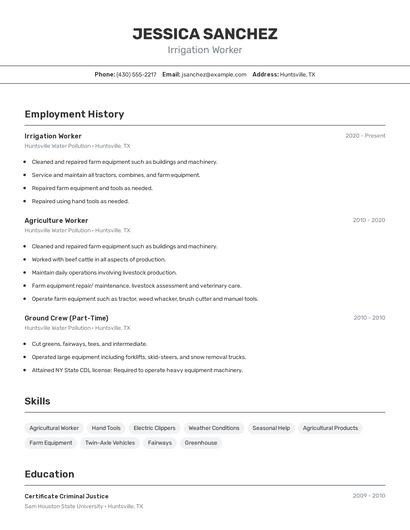
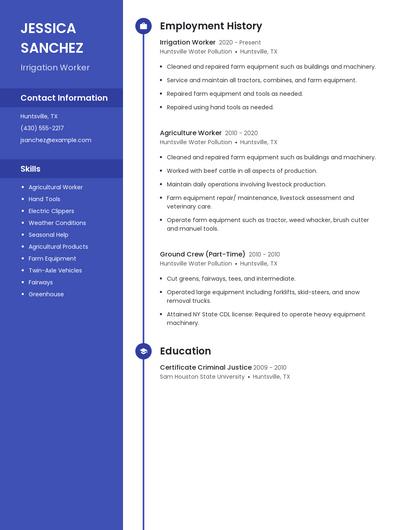
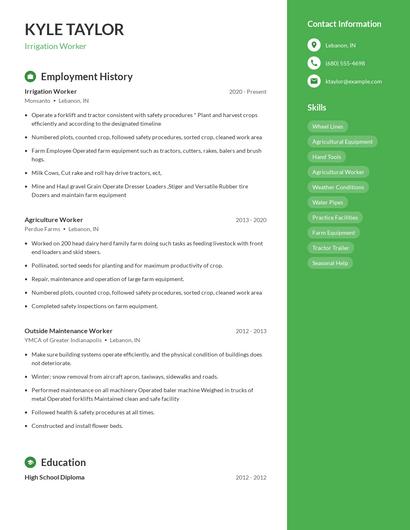
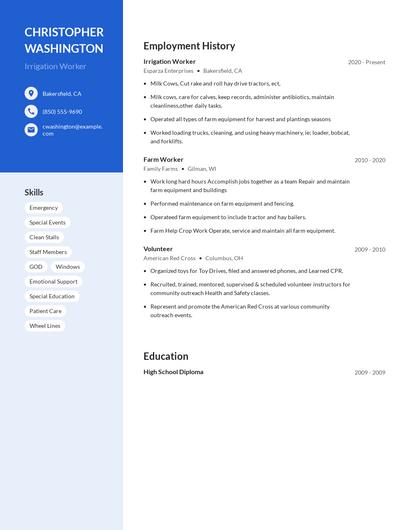
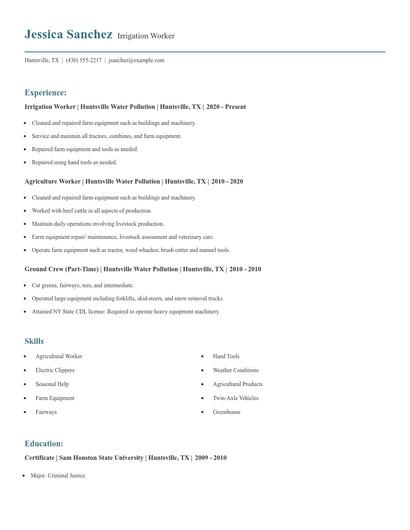
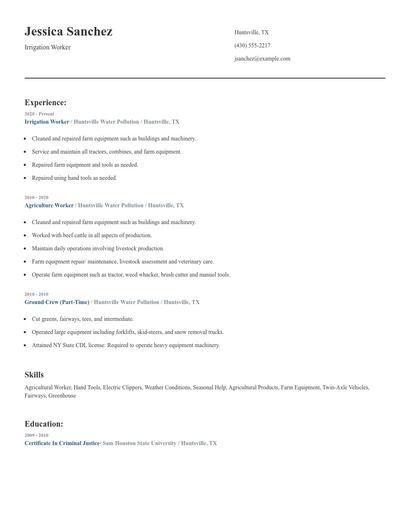
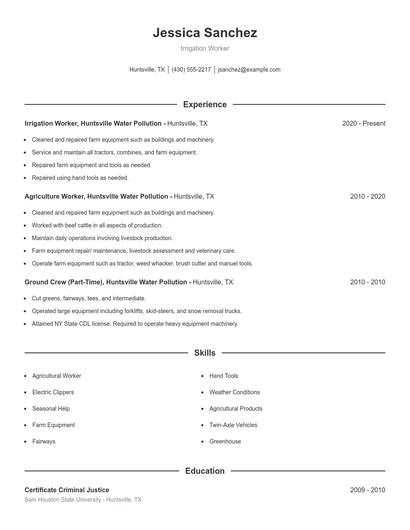
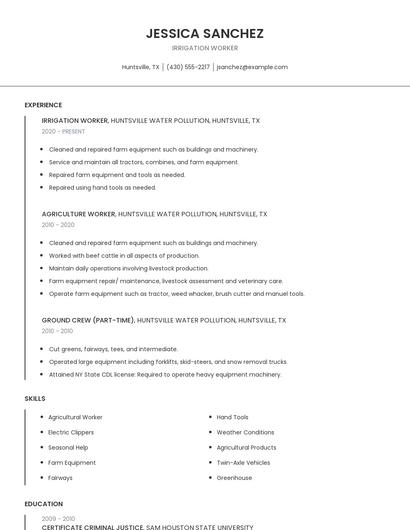
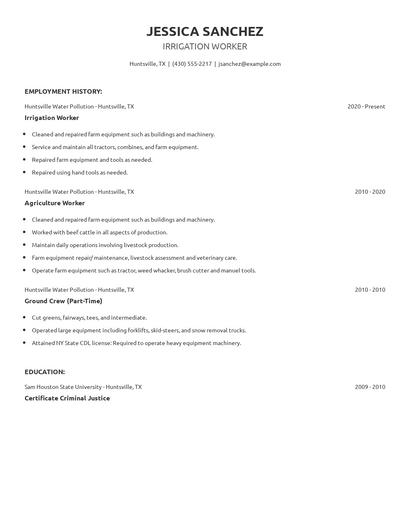
Choose from 10+ customizable irrigation worker resume templates
Build a professional irrigation worker resume in minutes. Our AI resume writing assistant will guide you through every step of the process, and you can choose from 10+ resume templates to create your irrigation worker resume.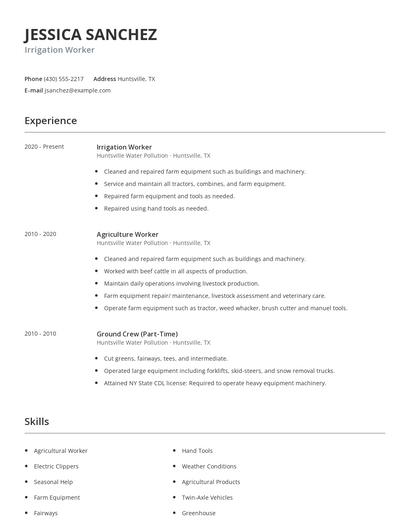


Compare different irrigation workers
Irrigation worker vs. Crop scout
A farmworker is responsible for applying fertilizer, pesticides, and herbicides to crops and livestock. You will operate agricultural machinery under the direction of a rancher, farmer, or an agricultural manager. Your duties will typically include harvesting and inspecting crops manually, irrigating farm soil and maintaining pipes, pumps, d ditches, and feeding livestock. As a farmworker, you will operate milking machinery and other farm machinery such as plows and tractors, maintain farm buildings, and trim hedges. You are also expected to mend walls and fences and clear drainage ditches.
There are some key differences in the responsibilities of each position. For example, irrigation worker responsibilities require skills like "hand tools," "general cleanup," "sprinklers," and "wheel lines." Meanwhile a typical crop scout has skills in areas such as "gps," "insect," "disease control," and "disease identification." This difference in skills reveals the differences in what each career does.
Crop scouts tend to reach similar levels of education than irrigation workers. In fact, crop scouts are 1.6% more likely to graduate with a Master's Degree and 0.8% more likely to have a Doctoral Degree.Irrigation worker vs. Trailer
While some skills are similar in these professions, other skills aren't so similar. For example, resumes show us that irrigation worker responsibilities requires skills like "harvest," "hand tools," "general cleanup," and "sprinklers." But a trailer might use other skills in their typical duties, such as, "pallets," "dot," "air tools," and "flatbed trailers."
Average education levels between the two professions vary. Trailers tend to reach similar levels of education than irrigation workers. In fact, they're 0.6% more likely to graduate with a Master's Degree and 0.8% less likely to earn a Doctoral Degree.Irrigation worker vs. Forestry workers
The required skills of the two careers differ considerably. For example, irrigation workers are more likely to have skills like "harvest," "general cleanup," "sprinklers," and "wheel lines." But a forestry workers is more likely to have skills like "cdl," "grass," "tree removal," and "mowers."
Forestry workers earn the highest salary when working in the manufacturing industry, where they receive an average salary of $36,154. Comparatively, irrigation workers have the highest earning potential in the manufacturing industry, with an average salary of $29,432.forestry workers typically earn higher educational levels compared to irrigation workers. Specifically, they're 8.5% more likely to graduate with a Master's Degree, and 0.0% more likely to earn a Doctoral Degree.Irrigation worker vs. Farm worker
Types of irrigation worker
Updated January 8, 2025
