What does a law researcher do?
Law researcher responsibilities
Here are examples of responsibilities from real law researcher resumes:
- Work with supervising attorneys handling all aspects of litigation in relation to an ongoing lawsuit regarding potential constitutional law violations.
- Research proposed legislative bill allowing survivor access to a decedent s online accounts in probate proceedings.
Law researcher skills and personality traits
We break down the percentage of Law Researchers that have these skills listed on their resume here:
- Civil Law, 100%
Trained in civil, criminal, constitutional, and civil law.
Communication skills. The most essential soft skill for a law researcher to carry out their responsibilities is communication skills. This skill is important for the role because "paralegals must be able to document and present their research and related information to their supervising attorney." Additionally, a law researcher resume shows how their duties depend on communication skills: "prepared documents for litigation, conducted legal research, and facilitated communication with clients. "
Computer skills. Many law researcher duties rely on computer skills. "paralegals need to be familiar with using computers for legal research and litigation support," so a law researcher will need this skill often in their role. This resume example is just one of many ways law researcher responsibilities rely on computer skills: "maintained law library; compiled, analyzed databases; used complex multi-function machines, computers, presentation media. "
Research skills. This is an important skill for law researchers to perform their duties. For an example of how law researcher responsibilities depend on this skill, consider that "paralegals gather facts of the case and research information on relevant laws and regulations to prepare drafts of legal documents for attorneys and help them prepare for a case." This excerpt from a resume also shows how vital it is to everyday roles and responsibilities of a law researcher: "conducted statistical analyses in stata and drafting ten-page final research paper. ".
Interpersonal skills. For certain law researcher responsibilities to be completed, the job requires competence in "interpersonal skills." The day-to-day duties of a law researcher rely on this skill, as "paralegals spend most of their time working with clients and other professionals and must be able to develop good relationships." For example, this snippet was taken directly from a resume about how this skill applies to what law researchers do: "established oral argument and public speaking techniques as well as effective interpersonal, written & oral communication skills. "
Organizational skills. Another common skill required for law researcher responsibilities is "organizational skills." This skill comes up in the duties of law researchers all the time, as "paralegals may be responsible for many cases at one time." An excerpt from a real law researcher resume shows how this skill is central to what a law researcher does: "assisted in the development and management of new law firm, including the creation of organizational protocols. "
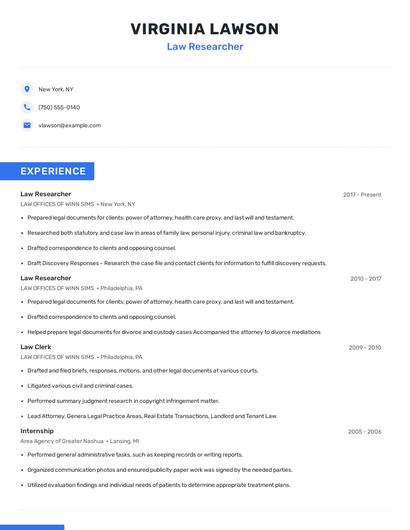
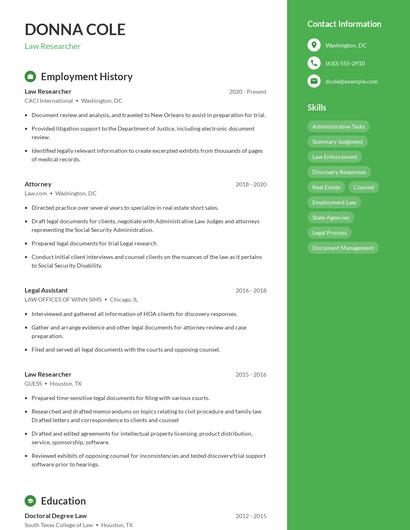
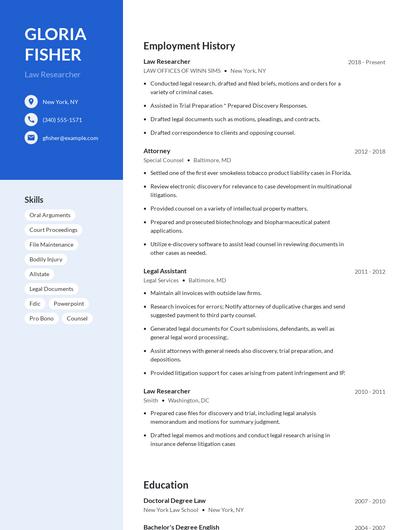
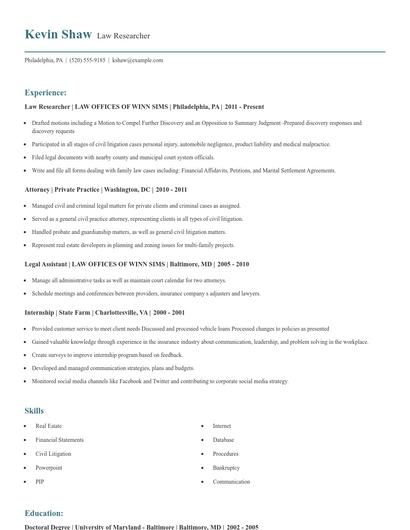
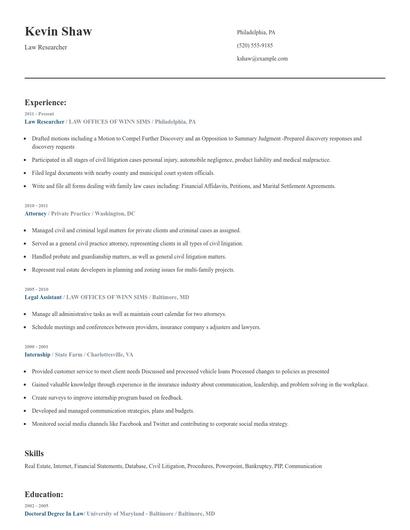
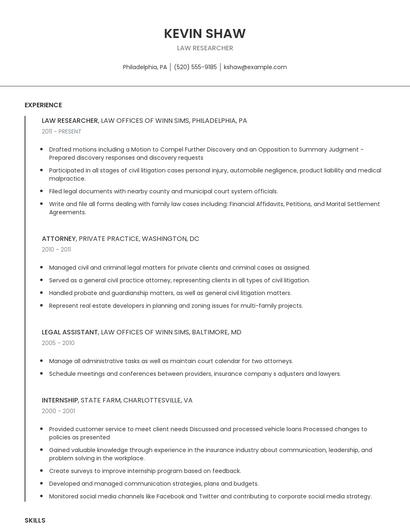
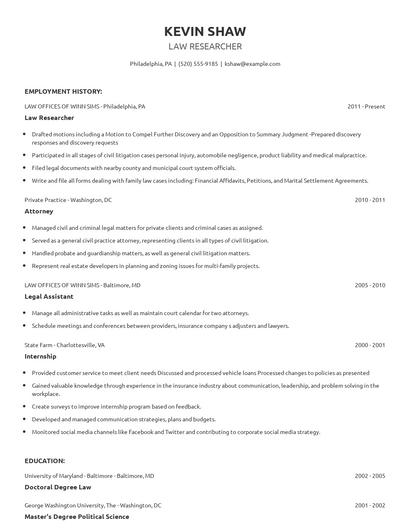
Choose from 10+ customizable law researcher resume templates
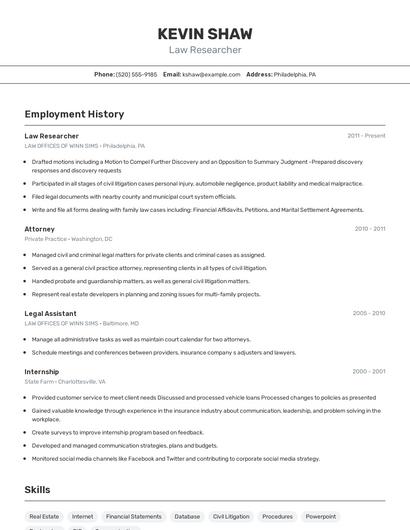
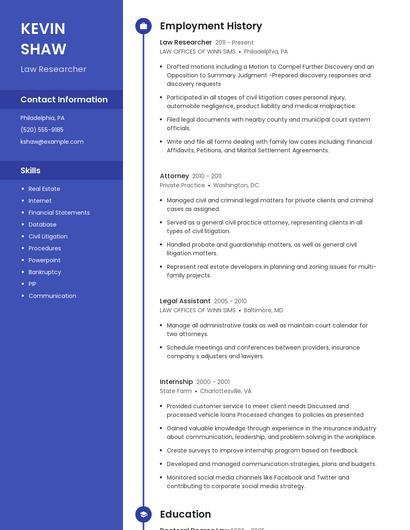
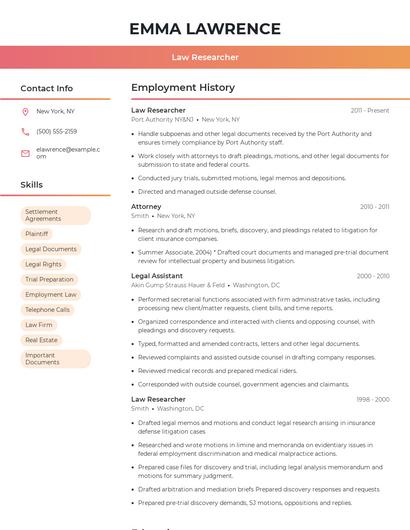
Build a professional law researcher resume in minutes. Our AI resume writing assistant will guide you through every step of the process, and you can choose from 10+ resume templates to create your law researcher resume.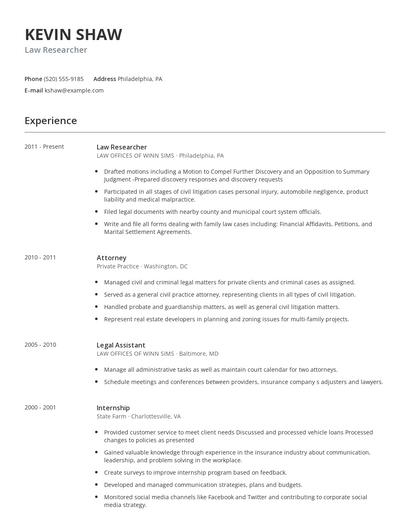

Compare different law researchers
Law researcher vs. Legislative aide
A Legislative Assistant develops and plans legislative initiatives and monitors legislative developments. They usually work for elected and appointed officials, advocacy groups, or non-profit organizations.
These skill sets are where the common ground ends though. The responsibilities of a law researcher are more likely to require skills like "civil law," "international tax law," "tax professionals," and "fatca." On the other hand, a job as a legislative aide requires skills like "policy issues," "press releases," "committee hearings," and "legislative process." As you can see, what employees do in each career varies considerably.
The education levels that legislative aides earn slightly differ from law researchers. In particular, legislative aides are 0.3% less likely to graduate with a Master's Degree than a law researcher. Additionally, they're 11.4% less likely to earn a Doctoral Degree.Law researcher vs. Legislative assistant
A law internship is a program that is designed for law students to give them valuable insight into the professional lives of attorneys and judges. Law interns need to understand and observe what being a lawyer involves. They are required to conduct research and present it to their superiors for case preparations. They must assist their senior lawyers in organizing all of their legal paperwork that includes case files, evidence records, and legal documents. Law interns are also required to be present in the courtroom to assist lawyers and experience actual courtroom proceedings.
Each career also uses different skills, according to real law researcher resumes. While law researcher responsibilities can utilize skills like "civil law," "international tax law," "tax professionals," and "fatca," legislative assistants use skills like "policy issues," "press releases," "legislative process," and "committee hearings."
In general, legislative assistants achieve similar levels of education than law researchers. They're 0.4% more likely to obtain a Master's Degree while being 11.4% less likely to earn a Doctoral Degree.Law researcher vs. Law internship
Law clerks are employees in a legal firm who handle clerical tasks for the office. They handle the office's official phone lines, answering incoming calls, and making outgoing calls. They also field office correspondence, often receiving incoming mail and distributing them to their addressees. They manage office documents and ensure that they are correctly filed and labeled in their respective storage bins. Law clerks help make office life more comfortable because they make sure that the office is running well. They also manage appointments and office calendars.
There are many key differences between these two careers, including some of the skills required to perform responsibilities within each role. For example, a law researcher is likely to be skilled in "international tax law," "tax professionals," "fatca," and "law library," while a typical law internship is skilled in "litigation," "legal issues," "trial preparation," and "legal memos."
Law interns typically earn similar educational levels compared to law researchers. Specifically, they're 3.1% less likely to graduate with a Master's Degree, and 0.1% less likely to earn a Doctoral Degree.Law researcher vs. Law clerk
Even though a few skill sets overlap between law researchers and law clerks, there are some differences that are important to note. For one, a law researcher might have more use for skills like "civil law," "international tax law," "tax professionals," and "fatca." Meanwhile, some responsibilities of law clerks require skills like "litigation," "legal issues," "legal memos," and "pre-trial motions. "
The average resume of law clerks showed that they earn similar levels of education compared to law researchers. So much so that theyacirc;euro;trade;re 4.9% less likely to earn a Master's Degree and more likely to earn a Doctoral Degree by 11.7%.Types of law researcher
Updated January 8, 2025
