What does a layer do?
Layer responsibilities
Here are examples of responsibilities from real layer resumes:
- Install glue down LVT and LVP.
- Clean all construction areas to avoid hazards.
- Complete indoor and outdoor, residential and commercial construction projects.
- Do demo work to get ready for tile to be place.
- Work as pipe layer, laying water and sewer lines.make water and sewer taps for sewer lines.
- Remodel and refurbish homes and commercial buildings, install windows, sheetrock, sinks, bathrooms, kitchens.
- Mix all tiling materials such as thin-set grouts and mud work; follow all chemical usage instructions and safety standards.
- Utilize interlocking installations for hardwood floors.
- Complete indoor and outdoor, residential and commercial construction projects.
Layer skills and personality traits
We calculated that 16% of Layers are proficient in Shingles, Assembly Line, and Reference Points. They’re also known for soft skills such as Physical strength, Dexterity, and Unafraid of heights.
We break down the percentage of Layers that have these skills listed on their resume here:
- Shingles, 16%
Remove shingles, lay shingles, transport shingles, clear debris
- Assembly Line, 15%
Worked on assembly line with 20 other employees.
- Reference Points, 12%
Measured distance from reference points to ensure that bricks are placed in the correct places.
- Retaining Walls, 10%
Work with retaining walls, pavers, large stones, residential and commercial properties.
- Building Materials, 9%
Delivered building materials and machinery to requested locations.
- Water Lines, 9%
Mainline Pipe layer - Performed installation of pipe for storm, sewer and water lines.
Most layers use their skills in "shingles," "assembly line," and "reference points" to do their jobs. You can find more detail on essential layer responsibilities here:
Physical strength. To carry out their duties, the most important skill for a layer to have is physical strength. Their role and responsibilities require that "flooring installers and tile and stone setters must be able to lift, carry, and set heavy pieces of flooring material into position." Layers often use physical strength in their day-to-day job, as shown by this real resume: "preformed tasks involving physical labor at construction sites. "
The three companies that hire the most layers are:
- Tyson Foods4 layers jobs
- Wayne RESA3 layers jobs
- Cobb-Vantress2 layers jobs
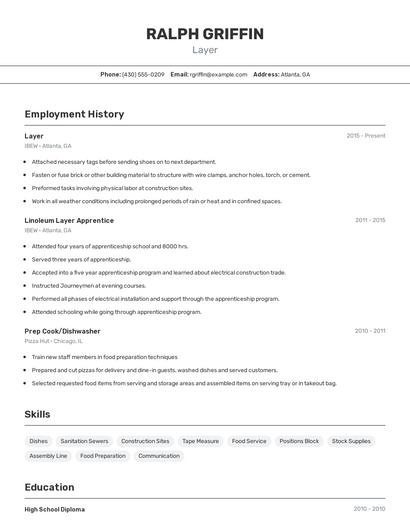
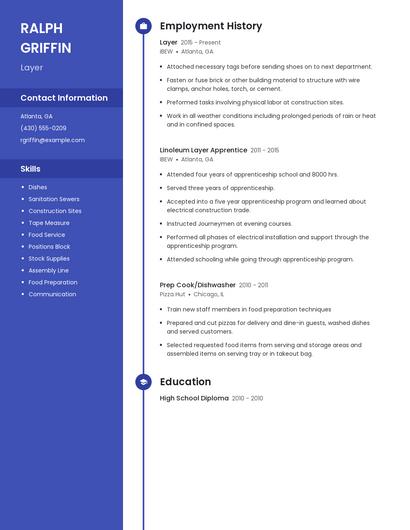
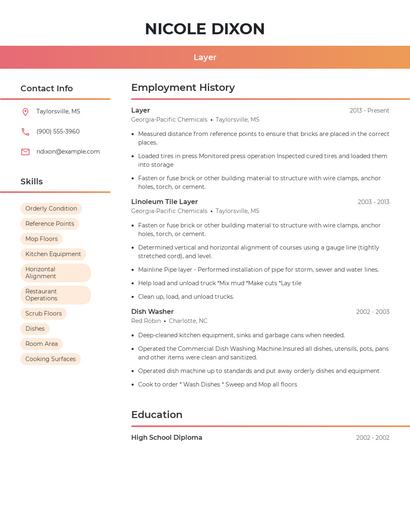
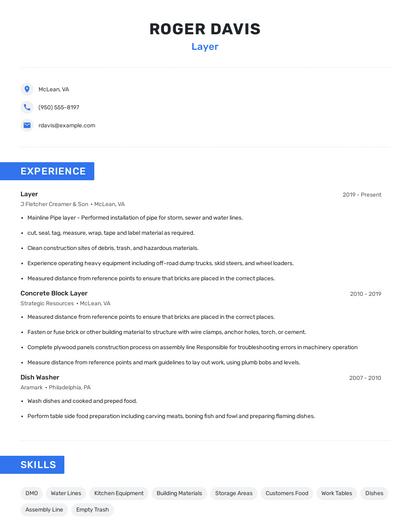
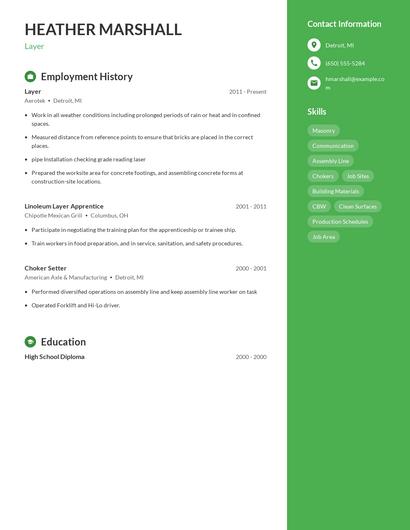
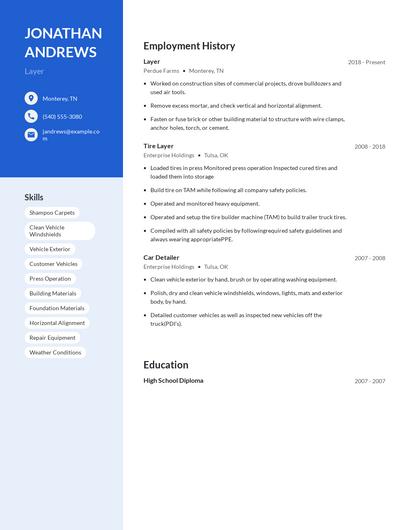
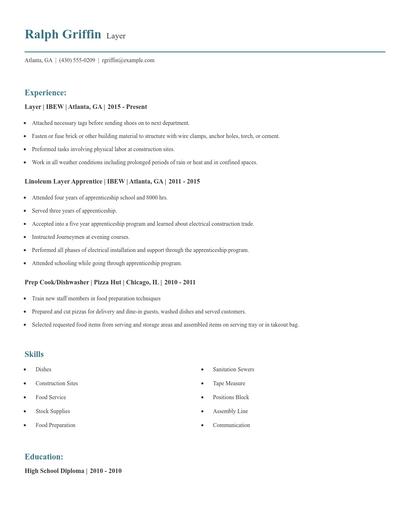
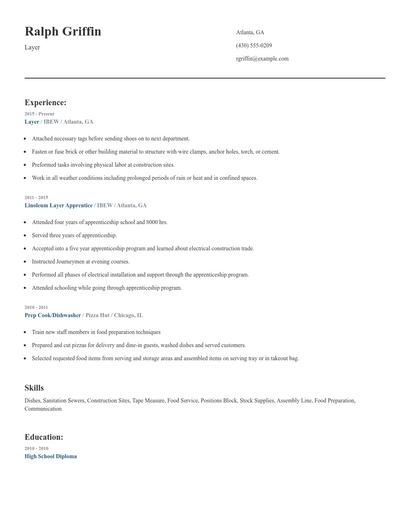
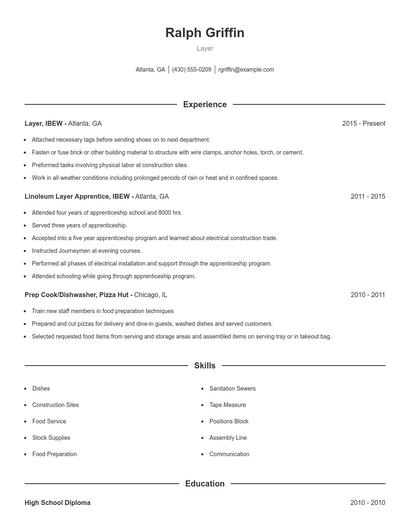
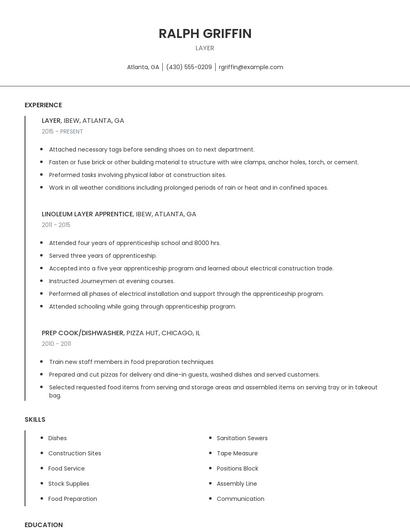
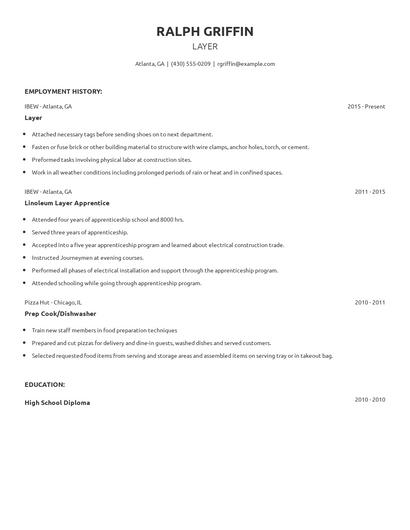
Choose from 10+ customizable layer resume templates
Build a professional layer resume in minutes. Our AI resume writing assistant will guide you through every step of the process, and you can choose from 10+ resume templates to create your layer resume.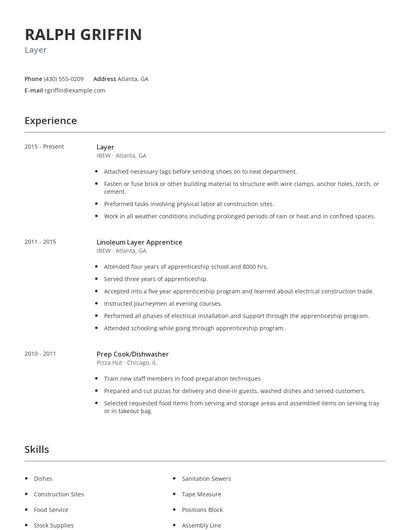
Compare different layers
Layer vs. Floor covering contractor
These skill sets are where the common ground ends though. The responsibilities of a layer are more likely to require skills like "ran," "shingles," "assembly line," and "reference points." On the other hand, a job as a floor covering contractor requires skills like "sheet vinyl," "vct," "construction trades," and "carpet-vinyl." As you can see, what employees do in each career varies considerably.
The education levels that floor covering contractors earn slightly differ from layers. In particular, floor covering contractors are 2.4% less likely to graduate with a Master's Degree than a layer. Additionally, they're 0.5% less likely to earn a Doctoral Degree.Layer vs. Floor covering installer
In addition to the difference in salary, there are some other key differences worth noting. For example, layer responsibilities are more likely to require skills like "ran," "shingles," "assembly line," and "reference points." Meanwhile, a floor covering installer has duties that require skills in areas such as "sheet vinyl," "vct," "floor coverings," and "skilled installation." These differences highlight just how different the day-to-day in each role looks.
In general, floor covering installers achieve similar levels of education than layers. They're 2.4% less likely to obtain a Master's Degree while being 0.5% more likely to earn a Doctoral Degree.Layer vs. Composition floor setter
Some important key differences between the two careers include a few of the skills necessary to fulfill the responsibilities of each. Some examples from layer resumes include skills like "ran," "shingles," "assembly line," and "reference points," whereas a composition floor setter is more likely to list skills in "sales floor," "washers," "cpm," and "layout flow. "
Most composition floor setters achieve a similar degree level compared to layers. For example, they're 2.4% less likely to graduate with a Master's Degree, and 0.5% less likely to earn a Doctoral Degree.Layer vs. Floor installer
Even though a few skill sets overlap between layers and floor installers, there are some differences that are important to note. For one, a layer might have more use for skills like "ran," "shingles," "assembly line," and "reference points." Meanwhile, some responsibilities of floor installers require skills like "hardwood floors," "sheet vinyl," "vct," and "tape measure. "
Floor installers reach similar levels of education compared to layers, in general. The difference is that they're 1.8% more likely to earn a Master's Degree, and 0.3% less likely to graduate with a Doctoral Degree.Updated January 8, 2025
