
Automatically apply for jobs with Zippia
Upload your resume to get started.
Layout designer skills for your resume and career

15 layout designer skills for your resume and career
1. CAD
- Participated in screening resumes and interviewing potential candidates for CAD layout positions.
- Worked with Process, Device and Cad Engineers in developing Test Pattern structures, Macro blocks and Process Evaluation Modules.
2. CMOS
- Established strong schematic to layout translation skills needed to produce fully custom digital layouts used in CMOS and SOI advanced technology.
- Created custom layout of ESDRAM, CMOS and analog IC from floor plan to tape out using Cadence design tools.
3. Layout Design
- Authored four custom layout design guideline documents (microprocessor and memory)
- Assisted associate layout designers in library maintenance.
4. Cadence Virtuoso
- Utilized Cadence Virtuoso and Diva technologies during design and verification.
- Tool used, Cadence Virtuoso XL (6.15), verification Chip including IO pads and their ESD circuitry DRC/LVS/Antenna/Density.
5. Virtuoso
- Designed using Cadence Opus Virtuoso Diva and Hercules verification !
- Used Opus 5.1 Virtuoso for Design Verification was accomplished using.
6. Analog Circuits
- Worked closely with designers to layout both digital and analog circuits.
Choose from 10+ customizable layout designer resume templates
Build a professional layout designer resume in minutes. Our AI resume writing assistant will guide you through every step of the process, and you can choose from 10+ resume templates to create your layout designer resume.7. DFM
Design for manufacturability, or DFM, is an engineering methodology used to create a product that is easy to both manufacture and use. When taking DFM into consideration, engineers look into the relevant processes, information about the product, and ways to make future upgrades easy. For designers, engineers, or other experts who use DFM, their main goal is to create a product that is easy to produce at a reasonable price. This can be done with carefully aligned steps and compromise throughout the design process to create a product design that maximizes utility and minimizes cost.
- Completed and managed process design verification for DRC, LVS, DFM and Antenna concerns.
- Debugged DRC, LVS, and DFM errors in device-level and block-level layout.
8. ERC
- Core Assembly, Full Chip Assembly, DRC, LVS, ERC verification & abstract generation.
- Performed reliability verification, DRC, ERC and LVS.
9. ESD
- Participate in full-chip assembly including pad ring, I/0 devices, ESD ring & global signal routing, post layout fixes.
- Implemented layout improvements to high speed pad libraries that doubled Electrostatic Discharge (ESD) voltage protection.
10. IC
It is an abbreviation for "integrated circuits" and is also called a microelectronic circuit or a chip. It is an assembly of electronic elements combined in a single unit in which devices like transistors, diodes, capacitors are built on semiconductor material like silicon.
- Worked as layout major block lead of memory core, analog, mixed signal and digital IC layout cell/block.
- Performed custom Integrated Circuit (IC) layout and design using Mentor Graphics software in Unix environment.
11. Verification Tools
- Documented/reported correlation issues between several industry standard layout and verification tools to minimize the number of iterations on ASIC designs.
- Worked on new Standard Cell library using both Cadence and Intel in house tools and verification tools.
12. Capacitors
- Worked with diodes, capacitors, resistors and guard rings.
- Designed capacitors in common centroid.
13. RC
- Implemented solutions for layouts to overcome the issues such as RC delay, Timing, Noise and integrations.
- Designed blocks in 12 GHz datapath that met tight restrictions on noise and RC delay.
14. IR
Optics is a branch of physics that encapsulates everything about the science of light. Infrared, also called infrared light, is electromagnetic energy with wavelengths longer than visible light. Therefore, it is invisible to the naked human eye. IR is generally encompassing wavelengths from the nominal red edge of the visible spectrum around 700 nanometers, to 1 millimetre. Infrared (IR) optical fibres may be defined as fibre optics that transmit radiation.
- Top level timing sign-off including noise, clock, data transitions, Apache RedHawk IR Drop, EM.
- Used technique to reduce IR drop, ElectroMigration, latch-up and Antenna issues.
15. Resistors
- Triple well process/CMOS devices with diodes, caps, resistors, and bi-polar.
- Metal resistors and metal-oxide-metal (mom) cap connections.
5 Layout Designer resume examples
Build a professional layout designer resume in minutes. Browse through our resume examples to identify the best way to word your resume. Then choose from 5+ resume templates to create your layout designer resume.

What skills help Layout Designers find jobs?
Tell us what job you are looking for, we’ll show you what skills employers want.
What skills stand out on layout designer resumes?
Samantha Osborne
Assistant Professor of Graphic Design, Owner, Samantha Osborne Design, Eastern Illinois University
What soft skills should all layout designers possess?
Samantha Osborne
Assistant Professor of Graphic Design, Owner, Samantha Osborne Design, Eastern Illinois University
i. An ability to see big picture: there are an infinite number of details in graphic design, whether you work in website design on the front or back end, or in print media with physical outputs. It's easy to get caught up on the details, especially when clients are making specific demands about things such as paper type. A skilled designer must be able to see beyond the details and look at the big picture for an effective design solution. For example, a client may be asking for an invitation design for an up-coming event. A skilled designer will ask questions and dig in, eventually uncovering that perhaps for a successful event, the client also needs a splash page and social media, either in place of or in addition to an invitation. A skilled designer addresses design problems holistically, rather than minutely.
ii. An ability to "read" people: designers are trained in art-specific vocabulary. Hue, saturation, pixels, gestalt...most non-art folks don't use or speak that language. When clients are describing their goals, they aren't using art-vocabulary. It's a designer's job to translate what the client is saying into an advanced and effective creative solution. They must be able to speak and understand the language of non-creative folks, as well as the language of the broader creative industry.
iii. An ability to make a convincing argument for your design solution(s): many young and inexperienced designer tend to get their hearts broken when a client smashes one of their [very well thought-out] ideas. Rather than rolling over, a designer must learn to navigate how best to build support for their idea(s). That might mean in some instances you work more fluidly with the client throughout the design process, so that they feel they have ownership in the development of the solution. In other instances it might mean that the designer is presenting options, rather than a single solution, so that the client feels empowered to make choices throughout the design process. And in some instances, it might be a matter of better explaining and presenting your idea to a client; perhaps the designer needs to push back more, perhaps they need to provide more research as to why their solution is best, or maybe they simply need to present it with more excitement and enthusiasm.
What layout designer skills would you recommend for someone trying to advance their career?
Carmita Sanchez-Fong
Professor and Chairperson, Fashion Institute of Technology, SUNY
What type of skills will young layout designers need?
Nancy Miller
Program Coordinator and Assistant Professor of Graphic Design, Texas A&M University
At a minimum, technical proficiency in industry-standard software applications like Adobe InDesign, Illustrator, Photoshop, and Acrobat are expected for new graduates. They should be able to use these applications for composition and layout in creating various print and digital touchpoints. As social media continues to rise in importance to companies, students will need to stay abreast of changes with popular social networking sites to constantly appeal to users and engage audiences across the board. Behind social media design, knowledge of marketing fundamentals (research, tactics, media, copywriting), interactive user design (websites, apps, interactive displays), and motion design (animated graphics, videos, ads) are also critical to applicants in setting them apart and making them more competitive in the candidate pool. Strategic competencies such as creative problem solving, visual communication, and the ability to parse information uniquely and originally will allow candidates to seize career opportunities and stand out in the current labor market. In addition to successful coursework and projects, students should aspire to showcase work done for clients, in order to establish a record of imaginative, creative strategy in response to client needs and/or business goals.
Many of the aforementioned skills should be evident in the curated work shown and supported in the new graduate's professionally-vetted portfolio website. In her book, "Stand Out: Design a personal brand. Build a killer portfolio. Find a great design job.," author and Assistant Professor, Denise Anderson (2016, viii) declares, "In the field of professional design, your portfolio is the single most important apparatus you have for demonstrating your talents, skills, and body of work." The visual portfolio is a critical and non-negotiable part of a job application for new graduates. Students should support their polished works with concise and reflective contextual statements to give potential employers insight into their challenges, process, and solutions for each project. In the typical hiring process, the portfolio is the apparatus that allows the student to be vetted for the ensuing in-person or virtual interview. It is in this more intimate opportunity that the student will sell their interpersonal skills in collaborative dialogues with professionals. They are establishing a level of comfort talking with professionals and clients before this juncture that will prepare students for exceptional performance in this defining employment situation.
What hard/technical skills are most important for layout designers?
Diana Boyd
Faculty, Highline College
-Adobe Photoshop - Working with raster images
-Adobe InDesign - Layout skills
-Adobe Animate - Animation
-Adobe XD - UX/UI prototyping
-Wordpress/Adobe Portfolio/Adobe Dreamweaver - web design/development
-Microsoft Word /PowerPoint
List of layout designer skills to add to your resume
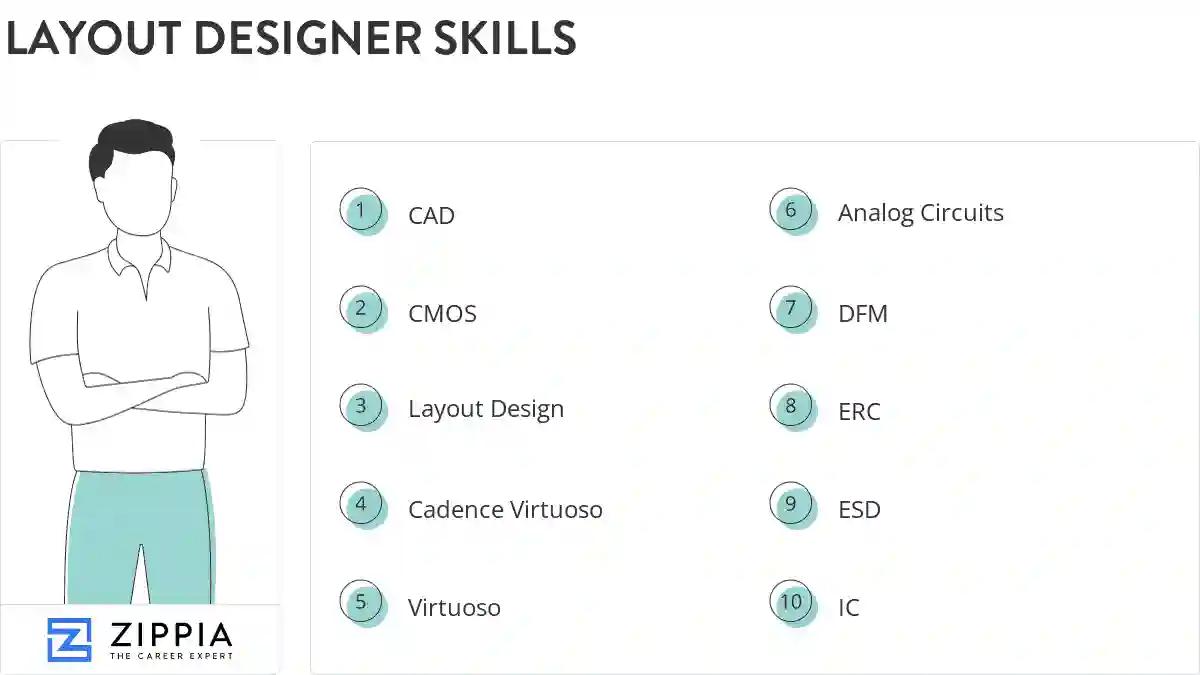
The most important skills for a layout designer resume and required skills for a layout designer to have include:
- CAD
- CMOS
- Layout Design
- Cadence Virtuoso
- Virtuoso
- Analog Circuits
- DFM
- ERC
- ESD
- IC
- Verification Tools
- Capacitors
- RC
- IR
- Resistors
- Floor Planning
- PCB
- Mentor Graphics
- Autocad
- IP
- R
- Design Rules
- Adobe Indesign
- Unix
- Lvs
- Drc
- Calibre DRC
- Debugging
- Circuit Boards
- Finfet
- Linux
- Microprocessors
- Adobe Photoshop
- PC
- DAC
- LNA
- Adobe Illustrator
- LDO
- Tsmc
- Assembly Drawings
- PLL
- I/O
- Power Management
- Retrofit
- Digital Layout
- VCO
Updated January 8, 2025
