
Automatically apply for jobs with Zippia
Upload your resume to get started.
Lead project analyst skills for your resume and career
15 lead project analyst skills for your resume and career
1. Process Improvement
- Utilized SharePoint to create, update and support process documentation for current initiatives, including the recommendation for future process improvements.
- Supported business units in areas identified for process improvement and worked directly with both internal and external constituents.
2. Status Reports
- Project tasks included conducting team meetings, managing issues, coordinating testing events, preparing status reports and escalated issues lists.
- Determine and enforce the frequency and content of status reports from the project team, analyze results and resolve problem areas.
3. Java
Java is a widely-known programming language that was invented in 1995 and is owned by Oracle. It is a server-side language that was created to let app developers "write once, run anywhere". It is easy and simple to learn and use and is powerful, fast, and secure. This object-oriented programming language lets the code be reused that automatically lowers the development cost. Java is specially used for android apps, web and application servers, games, database connections, etc. This programming language is closely related to C++ making it easier for the users to switch between the two.
- Developed and implemented new RPG/ILE applications VB, and Java utilizing WebSphere, applications for sales reporting.
- Implemented Java Chat Server component for online Customer Care and Support.
4. Project Plan
- Developed department project plans and modified software.
- Defined strategy for and developed, executed, and managed comprehensive project plan(s).
5. Business Process
A business process is a group of tasks that are performed by people working in a business to attain a worthy product and to present it to their customers. A business process can also be defined as performing several steps to achieve a certain goal set by a company. Business processes need to set purposeful goals and the outcome of that goal should be clear.
- Partnered with Technology PMO to determine appropriate project methodology and business processes for various projects.
- Led business process requirement team sessions and cross functional analysis.
6. Data Warehouse
Data warehouse, often abbreviated as either DW or DWH is a system used in computing for data analysis as well reporting. The DW is also considered to be an integral component of business intelligence as they also provide storage facilities for both real-time and historical data. ETL and ELT are the two driving forces behind a data warehouse system.
- Facilitated Data Warehouse design meetings and created Entity Relationship Diagram for dimensional model.
- Worked in partnership with core data warehouse providers to create standard data extract application files to feed financial software products.
7. SQL Server
- Implemented Platinum accounting package, Windows 95/NT on a SQL Server 6.5 database, conversion from AS400 PRMS.
- Developed different ETL mappings and packages through SSIS and deployed to SQL Server.
8. DB2
The DB2, known as the Relational Database Management System, is a type of procedure developed by IBM to run and operate software applications such as Windows, Unix, and the Linux System. This type of system is designed mainly for IBM but was innovated to run in various operating systems. The main feature of the DB2 is to handle and manage a big chunk of data while allowing the users to enter the database engine without any problem.
- Created data dictionaries to all business units with IO cards, DB2 tables, Input files to the calculator rules engine.
- Updated DB2 tables, tested, implemented the changes and ran SQL queries against them.
9. Technical Specifications
A technical specification is a document that clearly explains the specific requirements needed to get a project, product, material, or system ready for public or private use. It's the preliminary stage of any engineering or product design that must be followed to the letter because it defines the technical standard and safety measures for the product in the field of engineering design.
- Created technical specifications, user, operations, and administrative technical documentation.
- Performed requirements analysis on technical specifications of equipment.
10. Windows
Windows is a chain of operating systems that controls a computer and is developed by Microsoft. Every version of Windows consists of GUI (graphical user interface), with a desktop that allows the user to open their files.
- Analyzed, designed, documented, developed and tested C++ classes for Windows and Macintosh CD-ROM software product lines.
- Implemented a Unix-hosted software revision control system (RCS) concurrently accessible by Microsoft Windows workstations using SAMBA.
11. Project Scope
- Documented project scope and project implementation plan including risk and opportunity.
- Assisted with cost estimates while defining risk and project scope (SOW) to adhere to the needs of the client.
12. COBOL
- Used Micro Focus COBOL to write conversion programs and my knowledge of INFORMIX to perform many of the conversion tasks.
- Developed and maintained several applications using RPG IV, RPG III, COBOL, FOCUS, SYNON, and SMALLTALK.
13. PMO
Project management office or, as is often abbreviated, PMO is a part often found in larger companies, agencies, and other organizations of varying sizes. This department's main focus is to create, alter, and help implement project management policies and regulations within their enterprise, through a number of methods and means, such as documents, guides, and personal assistance. A PMO is truly helpful in standardising and improving the way projects are handled, and thus should be good at minimising costs, errors, and incidents.
- Managed SharePoint site folder structure, design, and content per PMO standards, at Program and Project levels.
- Trained Project Managers on PMO newly established procedures and governance mechanisms to ensure standardized and effective project execution.
14. Unix
UNIX is a computer operating system that was first created in the 1960s and has been constantly updated since then. The operating system refers to the set of programs that enable a machine to function. It is a multi-user, multi-tasking device that works on computers, laptops, and servers. UNIX systems also have a graphical user interface (GUI), similar to Microsoft Windows, that makes it simple to use.
- Developed inventory management system in SCO UNIX, GNU C++, X/Motif, and Oracle.
- Incorporated Unix scripts into running of jobs and truncating database tables.
15. Party Vendors
Party vendors, also known as third-party vendors, refers to a private company or business that signs an agreement to work under the company for its customers. They can provide various services and include many sectors, e.g., marketing agencies, supply providers, telephone companies, consultants and more.
- Delivered training to third-party vendors on PeopleSoft applications.
- Direct the coordination of all implementation tasks involving third party vendors as well as provide consultation to clients on system implementation.

What skills help Lead Project Analysts find jobs?
Tell us what job you are looking for, we’ll show you what skills employers want.
What lead project analyst skills would you recommend for someone trying to advance their career?
Travis Grosser Ph.D.
Associate Professor of Management (@ UConn School of Business), University of Connecticut
1. Innovative and Critical Thinking: The ability to think creatively and critically to solve complex problems will be highly valued, especially in a rapidly changing business landscape.
2. Emotional Intelligence: The ability to understand and manage one's own emotions, as well as empathize with others, will be crucial for successfully navigating a workplace where change, diversity, and collaboration will continue to increase.
3. Leadership and Change Management: Skills in leading teams, managing change, and inspiring innovation will be essential as businesses navigate through transitions and transformations.
4. Digital Literacy and Technological Proficiency: As technology continues to evolve rapidly, proficiency in digital tools and platforms will be crucial. Understanding emerging technologies like artificial intelligence, blockchain/Web3, and data analytics will be increasingly valuable.
What hard/technical skills are most important for lead project analysts?
Jason Caudill Ph.D.
Professor of Business, King University
List of lead project analyst skills to add to your resume
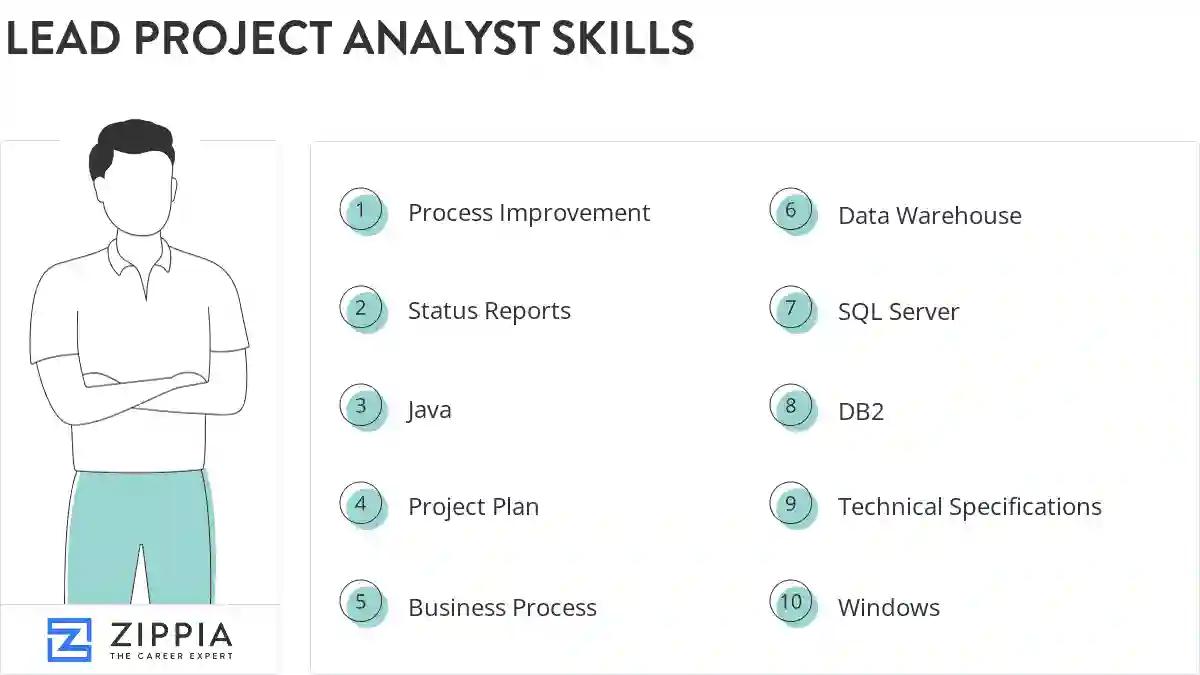
The most important skills for a lead project analyst resume and required skills for a lead project analyst to have include:
- Process Improvement
- Status Reports
- Java
- Project Plan
- Business Process
- Data Warehouse
- SQL Server
- DB2
- Technical Specifications
- Windows
- Project Scope
- COBOL
- PMO
- Unix
- Party Vendors
- C++
- Management System
- QA
- Data Analysis
- Mainframe
- Test Cases
- SharePoint
- SAS
- UAT
- HR
- BI
- Technical Issues
- Application Development
- SDLC
- Payroll
- Work Breakdown Structure
- EDI
- User Acceptance
- ERP
- ETL
- SME
- HTML
- XML
- Test Scripts
- JCL
- CICS
- System Design
- AIX
- PC
- SOX
- VBA
- Test Scenarios
- VSAM
Updated January 8, 2025
