
Automatically apply for jobs with Zippia
Upload your resume to get started.
Lieutenant, shift supervisor skills for your resume and career
15 lieutenant, shift supervisor skills for your resume and career
1. Patrol
- Promoted from Corporal to Sergeant to Master Sergeant to Lieutenant/Assistant Patrol
- Provided armed vehicular patrol to defend the site and enforce security regulations according to Federal and Texas Laws.
2. Emergency Situations
- Responded to emergency situations, leading and orchestrating immediate staff response.
- Responded to emergency situations to assist and direct staff on what needed to be done in order to contain situation.
3. Criminal Justice
- Graduated Kentucky Criminal Justice Executive Development Program 2015.
- Served as Security guard Lieutenant for Naval Air Station Whiting Field-- Certificate from the Institute of Criminal Justice and Security.
4. Direct Supervision
Direct supervision is a term used to indicate that a person is supervising a certain task or a certain person while being physically present or in close proximity. It refers to the presence of a person and the availability of their supervision in something if it is needed.
- Provided direct supervision to assigned staff, ensured orders, policies, and procedures were followed.
- Report to the Major for direct supervision.
5. Security Procedures
A security procedure is a verification protocol used to check if an electronic signature, record, or performance belongs to that specific person. It is a set of necessary procedures that need to be performed to maintain security. These procedures are step-by-step guidelines on how to implement, enable, or enforce security.
- Planned training programs for security procedures/activities
- Established security procedures for companies engaged in manufacturing products and processing data and material for federal government.
6. Incident Reports
An Incident Report, in a medical facility such as hospitals and nursing homes, is a type of paperwork filled out immediately after and in the case of an incident of some sort, with the goal of describing the incident and its consequences, as well as the measurements taken after or during the incident, as well as any other information relevant to said incident. Such an incident might be a patient acting out or a patient being injured.
- Investigated and prepared incident reports.
- Complete daily security reports, emergency reports, schedules, weapons log, post inspections, incident reports.
Choose from 10+ customizable lieutenant, shift supervisor resume templates
Build a professional lieutenant, shift supervisor resume in minutes. Our AI resume writing assistant will guide you through every step of the process, and you can choose from 10+ resume templates to create your lieutenant, shift supervisor resume.7. Emergency Response
- Developed procedures for the emergency response and crisis management, physical security, information protection, incident management and investigation units.
- Planned and scheduled work operations such as projects on a consistent basis with consideration to unknown emergency responses
8. Firearms
A firearm is a type of weapon or device used by police, uniformed personnel or other related professional for security and protection purposes. This lethal and destructive weapon can often shoot bullet or missiles. A firearm usually consists of a chamber or barrel, frame body, breech bolt, and a magazine.
- Functioned as the departments Field Training Officer, Firearms Instructor, and First Responder Instructor.
- Delegated and assigned tasks to employees* Operate Surveillance Systems and computers* Certification of firearms, TASER, C.P.R., and A.E.D.
9. Security Operations
- Conduct Closed Circuit Television reviews on daily basis monitoring over 100 camera ensuring smooth security operations.
- Assess and identify potential security threats and deficiencies and implement policies and procedures that correct any deficiencies in security operations.
10. Correctional Facility
A correctional facility is a place where people who commit crimes and have been lawfully arrested are kept for some time. The facility is also reserved to correct bad behaviors in citizens of a particular region. A correctional facility can be a prison, jail, penitentiary, detention center, or any other building exclusive for housing incarcerated people (people sentenced to jail terms by law).
- Provided scheduling, organization, security and accountability for Corrections Officers and inmates in a State of Maryland Correctional facility.
- Supervised inmates and staff in a community based correctional facility in accordance with established policies, regulations and procedures.
11. Law Enforcement Agencies
- Established professional open liaison relationships between Federal, State and Local Law Enforcement Agencies and private sector entities.
- Worked close with Local Law Enforcement Agencies and appeared in court as needed.
12. Payroll
Payroll is the sum of all the compensation that an organization has to pay to employees at a specified time. Payroll is managed by the finance or HR department while small business owners may handle it themselves. Payroll isn't fixed as it varies every month due to sick leaves, overtime, etc.
- Completed payroll reports, insurance, new hires, terminations, general office duties, filing, etc.
- Answer switchboard and transfer calls; Escorted visitors, issued payroll checks; Train new security officers.
13. Security Systems
A security system refers to any device that can perform security operations such as surveillance, access control, alarm, or intrusion control in a facility or area through a system of components and multifunctional devices designed to protect people and the property against a variety of hazards including crime, arson, accidents, espionage, sabotage, subversion, and attack. A security system also detects several other threats, including smoke, carbon monoxide poisoning, and water damage.
- Recommend improvements in security systems or procedures.
- Inspect fire, intruder detection, or other security systems.
14. Physical Security
Physical security refers to the services of protection offered by guards, surveillance, barriers, access controls, or other specially designed security systems. All of these aforementioned security systems are an integral part of physical security and ensure the safety of not just people but also of physical property including valuable items, resources, and more. It further includes the provision of security against potential intruders, thefts, and even attacks.
- Conducted numerous security audits per month to identify potential problems related to physical security, staff safety and asset protection.
- Collaborated with business owners to enhance crime prevention through environmental design strategies to safeguard the physical security of their facilities.
15. Local Law Enforcement
- Maintain a harmonious relationship with the company's employees, authorization of visitors, local law enforcement and dignitaries.
- Acted as the point of contact for local law enforcement when services were required.
5 Lieutenant, Shift Supervisor resume examples
Build a professional lieutenant, shift supervisor resume in minutes. Browse through our resume examples to identify the best way to word your resume. Then choose from 5+ resume templates to create your lieutenant, shift supervisor resume.

What skills help Lieutenant, Shift Supervisors find jobs?
Tell us what job you are looking for, we’ll show you what skills employers want.
List of lieutenant, shift supervisor skills to add to your resume
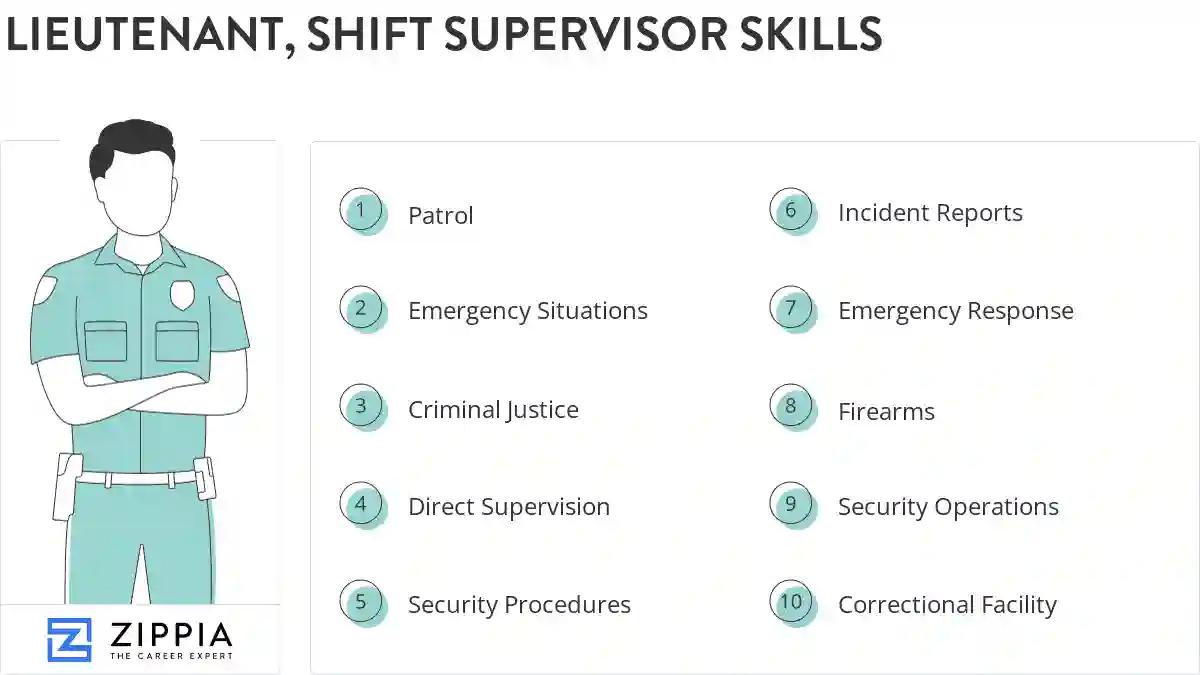
The most important skills for a lieutenant, shift supervisor resume and required skills for a lieutenant, shift supervisor to have include:
- Patrol
- Emergency Situations
- Criminal Justice
- Direct Supervision
- Security Procedures
- Incident Reports
- Emergency Response
- Firearms
- Security Operations
- Correctional Facility
- Law Enforcement Agencies
- Payroll
- Security Systems
- Physical Security
- Local Law Enforcement
- CCTV
- CPR
- Disciplinary Actions
- Emergency Calls
- EMT
- Performance Evaluations
- EMS
- Security Checks
- Security Equipment
- Ammunition
- Security Audits
- Security Policies
- Institutional Policies
- DOE
Updated January 8, 2025
