
Automatically apply for jobs with Zippia
Upload your resume to get started.
Life skills instructor skills for your resume and career

15 life skills instructor skills for your resume and career
1. Developmental Disabilities
- Establish and enforce rules for appropriate behavior for adults with developmental disabilities to facilitate living independently or in a different environment.
- Help participants that have developmental disabilities with daily living activities, also redirecting participants in crisis situations using CPI training.
2. CPR
Cardiopulmonary resuscitation or CPR is a medical procedure that involves chest compression to help a patient breathe. This artificial ventilation helps in keeping the brain function in place and regulates blood throughout the body. CPR is a lifesaving procedure that is used in emergencies.
- Teach lifesaving CPR, AED (automated external defibrillator), and first aid courses for the medical and non-medical communities.
- Certified Medication Aide, trained in CPR and First Aid, and have completed all PARC-specific training & re-certifications as scheduled.
3. Kids
- Helped teach kids different life skills and kept them occupied and safe while their mothers were in their weekly skills meeting.
- Worked one on one with kids with many different forms of autism and Down syndrome.
4. Adaptive
- Instruct clients in Adaptive Living Skills as authorized by the regional centers.
- Utilize adaptive techniques for students with physical and mental disabilities.
5. Independent Living
- Provided a safe, structured environment meeting functional rehabilitation of adults with Acute Brain Injury while providing independent living skills/ support.
- Administered independent Living Skills to individuals with behavioral disorder and severe chronic mental illness resulting from brain injuries.
6. Incident Reports
An Incident Report, in a medical facility such as hospitals and nursing homes, is a type of paperwork filled out immediately after and in the case of an incident of some sort, with the goal of describing the incident and its consequences, as well as the measurements taken after or during the incident, as well as any other information relevant to said incident. Such an incident might be a patient acting out or a patient being injured.
- Maintained accurate and detailed records of enrollments, attendance, health and safety, emergency contact and incident reports.
- Maintained detailed case notes, incident reports, and progress reports on a daily basis for each client.
Choose from 10+ customizable life skills instructor resume templates
Build a professional life skills instructor resume in minutes. Our AI resume writing assistant will guide you through every step of the process, and you can choose from 10+ resume templates to create your life skills instructor resume.7. Meal Preparation
- Assisted with basic daily living skills, hygiene, eating, meal preparations, cleaning/chores, activities and administering medications.
- Assist residents with daily activities such as meal preparation and planning and cleaning.
8. Mental Health
Mental health is the state of wellbeing in which an individual can cope with the regular stresses and tensions of life, and can work productively without having any emotional or psychological breakdown. Mental health is essential for a person of any age and helps them make the right decisions in their life.
- Monitored and provided mental health and chemical dependency education/training services to adults with serious mental illness and/or chronic addiction.
- Assisted consumers with securing housing, employment, mental health referrals, securing necessary identification and or paperwork.
9. Money Management
- Educate participants in money management and budgeting skills.
- Instructed recent high school graduates age 19-21 in money management, job seeking, food preparation and other life skills.
10. Community Resources
Community resources are a set of resources that are used in the day to day life of people which improves their lifestyle in some way. People, sites or houses, and population assistance can come under the services offered by community resources.
- Provided assistance with and advocated or interpreted community resources, as needed, for maximum benefits and understanding.
- Coordinated participant referrals to various community resources to accomplish established goals to obtain and maintain employment.
11. Direct Care
Direct care is the act of identifying people with special needs and offering the necessary care for them.
- Provided direct care and Person Centered Planning to assigned consumers utilizing behavior programs.
- Improved management and staff relations and personally provided direct care when necessary.
12. Medication Administration
- Executed and monitored consumers Medication Administration, personal hygiene, and nutrition guidelines.
- Completed progress notes, medication administration records and other work related documents.
13. Physical Disabilities
- Provided support and opportunities for people with intellectual/developmental and physical disabilities throughout the community and in the home.
- Consist of assisting/monitoring/teaching individuals with developmental and physical disabilities in their homes and in the community.
14. Direct Supervision
Direct supervision is a term used to indicate that a person is supervising a certain task or a certain person while being physically present or in close proximity. It refers to the presence of a person and the availability of their supervision in something if it is needed.
- Monitored clients by providing direct supervision.
- Provided direct supervision for inmates which included, managing inmate behavior, discipline procedures and gain time reporting.
15. Intellectual Disabilities
- Assist individuals with intellectual disabilities with work, volunteer and recreational services.
- Assisted clients with intellectual disabilities one-on-one on activities of daily living.
5 Life Skills Instructor resume examples
Build a professional life skills instructor resume in minutes. Browse through our resume examples to identify the best way to word your resume. Then choose from 5+ resume templates to create your life skills instructor resume.

What skills help Life Skills Instructors find jobs?
Tell us what job you are looking for, we’ll show you what skills employers want.
What life skills instructor skills would you recommend for someone trying to advance their career?
Melissa Boas
Director of Professional School Counseling, Assistant Professor, Lancaster Bible College
What type of skills will young life skills instructors need?
Dr. Thomas Dearden Ph.D.
Assistant Professor of Sociology, Virginia Polytechnic Institute and State University
What soft skills should all life skills instructors possess?
Kacie Blalock Ph.D.
Associate Professor; Director, Master of Counseling, Louisiana State University at Shreveport
What hard/technical skills are most important for life skills instructors?
Kacie Blalock Ph.D.
Associate Professor; Director, Master of Counseling, Louisiana State University at Shreveport
List of life skills instructor skills to add to your resume
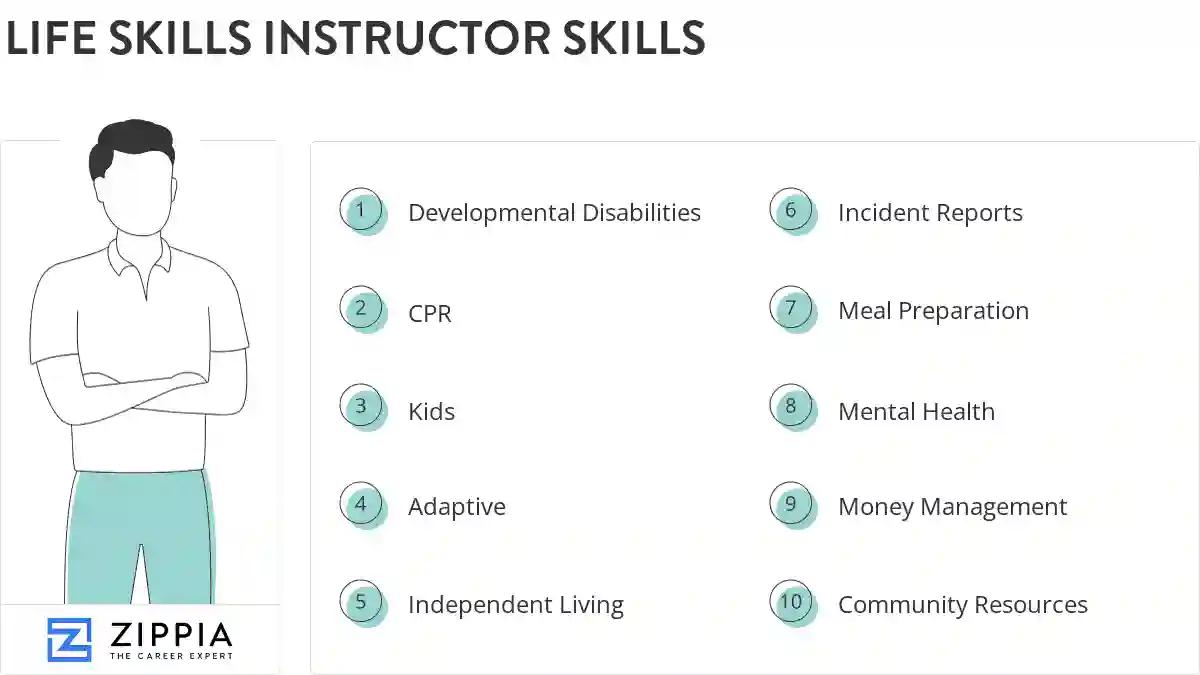
The most important skills for a life skills instructor resume and required skills for a life skills instructor to have include:
- Developmental Disabilities
- CPR
- Kids
- Adaptive
- Independent Living
- Incident Reports
- Meal Preparation
- Mental Health
- Money Management
- Community Resources
- Direct Care
- Medication Administration
- Physical Disabilities
- Direct Supervision
- Intellectual Disabilities
- Acls
- Substance Abuse
- Advanced Life Support
- Crisis Intervention
- Community Involvement
- Meal Planning
- Community Integration
- Direct Support
- Conflict Resolution
- CPI
- Anger Management
- Medical Appointments
- Resuscitation
- Individual Preferences
- ISP
- ADL
- Home Management
- Syllabus
- Mental Illness
- Crisis Situations
- Community Outings
- Group Homes
- Behavioral Issues
- Life Training
- at-Risk Youth
- Brain Injuries
- Vital Signs
- Behavior Modification
- Life Classes
- PMT
- DDS
- Food Preparation
- IEP
- First Aid Training
Updated January 8, 2025
