
Automatically apply for jobs with Zippia
Upload your resume to get started.
Line operator skills for your resume and career

15 line operator skills for your resume and career
1. Preventative Maintenance
- Work with maintenance and engineering for preventative maintenance countermeasures, process improvements and over productivity of the production line.
- Print production pallet tickets, document quality and production information, and perform minor preventative maintenance.
2. PPE
Personal protective equipment is an item of protective clothing such as goggles, helmets, or other garments meant to protect the body from injury.
- Utilized GMP's, SOP's and PPE.
- Maintain and use all PPE.
3. Basic Math
- Followed production instructions and utilized a computer and calculator to aid in basic math calculations.
- Measured dimensions accurately using micrometers, calipers, and basic mathematical skills.
4. Extrusion
- Set up and operate an extrusion machine in accordance with established procedures and guidelines and customer requirements.
- Operate extrusion equipment to produce quality decking for a busy 24/7 large manufacturing facility.
5. Quality Checks
Quality checks are a component of quality control aimed at ensuring that quality requirements are met. Internally, quality checks provide assurance to managers, and externally, it provides assurance to clients, federal departments, authorities, and certifiers.
- Operate mold press line-Responsible for line changeover/adjustments and start-up-Responsible for minor line repairs-Perform quality checks of finished product
- Review order specifications and perform quality checks that ensure the product is packaged according to customer specifications.
6. Assembly Line
Assembly line is a process used in industries to ensure the production of products in a cost effective manner by dividing up the responsibilities of each labor. Assembly lines enabled industries to hire more workers, therefore providing more employment opportunities to labors. This is possible because in this process the burden of all the tasks related to production are not laid on a single person, they are divided into small baby steps for each labor.
- Observed material stock along assembly line and notified materials-handling personnel or supervisor of impending shortages.
- Perform quality assurance for assembly line packaging operations.
Choose from 10+ customizable line operator resume templates
Build a professional line operator resume in minutes. Our AI resume writing assistant will guide you through every step of the process, and you can choose from 10+ resume templates to create your line operator resume.7. Safety Procedures
Safety procedures are a set of standardized procedures, that ensures minimal to no risk to people, resources, and the work environment. A company follows the step-by-step safety procedures as it they not only keep the customers and the employees safe, but also help in avoiding legal claims.
- Conducted employee training on equipment operations and safety procedures and managed daily operations.
- Trained other crew members on wire line operations and related safety procedures and protocols
8. Safety Rules
Principles or regulations that ensure the protection of people, objects, or the environment are called safety rules. These rules can be governing actions, devices, or procedures that help in minimizing the risks of loss, injury, or damage.
- Read and interpret documents (safety rules, operating/maintenance instructions & procedure manuals).
- Assembled manufacture parts, practiced safety rules and guides, worked in a team environment
9. Quality Standards
Quality standards are a specific level of standards of products that are set by the companies for the customers that have to be met and maintained throughout the process until the time of delivery. Quality standards are information that includes the customer's requirements, guidelines, and characteristics for the needed final product or service.
- Developed/created processes to maintain quality standards and consistently worked to identify better and more efficient methods to increase productivity.
- Identified and Assessed finished product assuring quality standards were maintained and prevented defective products from being shipped.
10. GMP
GMP stands for Good Manufacturing Practice. It is a system that ensures that all products like food, beverages, and medicinal drugs that are produced comply with the quality standards. It helps in minimizing the risks and hazards that cannot be eliminated after the testing of final products.
- Adhered to Good Manufacturing Practice (GMP) and Hazard Analysis Critical Control Point (HACCP) guidelines.
- Follow batch records, production schedules, SOP, GMP, and FDA regulations.
11. Safety Regulations
- Adhered to good manufacturing practices, standard operating procedures, and safety regulations consistently.
- Ensured that components met certified quality specifications and safety regulations were adhered to.
12. Pallet Jack
- Packed and ship out all orders for customers, operated machines, forklifts, pallet jacks and prioritized shipments on pallets.
- Operated powered lift trucks, floor sweepers, pallet jacks and forklifts safely, with a zero percent accident rate.
13. Quality Products
A quality product satisfies the client's intended need and matches the cost the consumer paid for it.
- Impacted customer satisfaction by production of quality products.
- Test, install, and maintained electronic equipment; reported any quality control issues to the supervisor, ensured quality products.
14. Line Equipment
- Double checks all medications before completing process Operated and maintained packaging line equipment and production equipment.
- Utilized, operated, and maintained open hole wire line equipment to measure and collect data for various petroleum manufacturers.
15. Production Process
The production process is a series of events and industrial activities that come into play when raw material are delivered onto the production facility for manufacturing. The process involves different steps of production from start to finish such as; research, design formation, design testing, product manufacturing, and assembly according to the design, product experimentations, and supply.
- Monitor production processes, material and observing of production equipment.
- Observe and inspect materials during production process and responsible for maintenance and cleaning of machinery used in production.
5 Line Operator resume examples
Build a professional line operator resume in minutes. Browse through our resume examples to identify the best way to word your resume. Then choose from 5+ resume templates to create your line operator resume.

What skills help Line Operators find jobs?
Tell us what job you are looking for, we’ll show you what skills employers want.
List of line operator skills to add to your resume
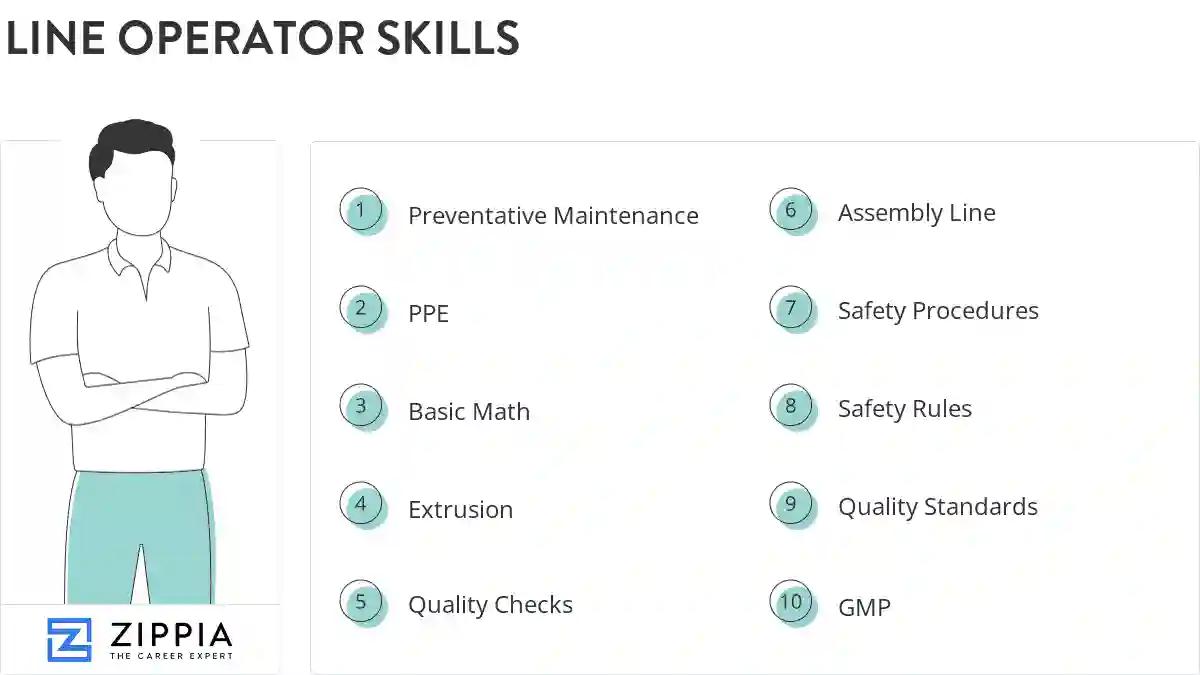
The most important skills for a line operator resume and required skills for a line operator to have include:
- Preventative Maintenance
- PPE
- Basic Math
- Extrusion
- Quality Checks
- Assembly Line
- Safety Procedures
- Safety Rules
- Quality Standards
- GMP
- Safety Regulations
- Pallet Jack
- Quality Products
- Line Equipment
- Production Process
- Production Equipment
- Safety Standards
- Machine Operation
- Quality Inspection
- Production Schedules
- Hoists
- Line Operations
- PVC
- Safety Guidelines
- Line Production
- Computer System
- Etching
- Inventory Control
- Equipment Issues
- ISO
- Routine Maintenance
- Production Reports
- Lot Numbers
- Perform Routine Maintenance
- CNC
- Extruders
- QA
- Customer Specifications
- FDA
- General Maintenance
- Customer Orders
- Lockout Tagout
Updated January 8, 2025
