What does a machine lay out worker do?
Machine lay out worker responsibilities
Here are examples of responsibilities from real machine lay out worker resumes:
- Inspect the media run in the machines and calibration of air gauges.
- Control & troubleshoot automate extrusion line adjusting speed & feed, monitoring temperature, & finish material specification per customers order.
- Work on various vehicle production lines assembling components for Chrysler automobiles.
Machine lay out worker skills and personality traits
We calculated that 78% of Machine Lay Out Workers are proficient in Quality Checks, CNC, and RAN. They’re also known for soft skills such as Computer skills, Dexterity, and Mechanical skills.
We break down the percentage of Machine Lay Out Workers that have these skills listed on their resume here:
- Quality Checks, 78%
Managed special orders, performed quality checks and processed shipping/handling of products to ensure timely delivery of quality products.
- CNC, 10%
Operate CNC machining of ductile iron castings to precision dimensions required by automotive industry.
- RAN, 7%
Worked with/ Ran Machinery Russell Springs, Kentucky
- Assembly Line, 4%
Operated heavy machinery and conducted assembly line
- Unload Machines, 2%
Load and unload machines measuring the parts making sure demintions are accurate
Most machine lay out workers use their skills in "quality checks," "cnc," and "ran" to do their jobs. You can find more detail on essential machine lay out worker responsibilities here:
Computer skills. One of the key soft skills for a machine lay out worker to have is computer skills. You can see how this relates to what machine lay out workers do because "metal and plastic machine workers often must be able to use programmable devices, computers, and robots on the factory floor." Additionally, a machine lay out worker resume shows how machine lay out workers use computer skills: "set up, program, or control computer-aided design (cad) or computer numerical control (cnc) machines. "
Dexterity. Many machine lay out worker duties rely on dexterity. "metal and plastic machine workers who work in metal and plastic machined goods manufacturing use precise hand movements to make the necessary shapes, cuts, and edges that designs require.," so a machine lay out worker will need this skill often in their role. This resume example is just one of many ways machine lay out worker responsibilities rely on dexterity: "use fork lift to load mail containers onto the usps trucks * scan packages and place them to there right location"
Mechanical skills. Another skill that relates to the job responsibilities of machine lay out workers is mechanical skills. This skill is critical to many everyday machine lay out worker duties, as "metal and plastic machine workers set up and operate machinery." This example from a resume shows how this skill is used: "diagnose and resolve issues attributed to electrical or mechanical problems resulting after quality checks fail. "
Physical strength. A big part of what machine lay out workers do relies on "physical strength." You can see how essential it is to machine lay out worker responsibilities because "metal and plastic machine workers must be strong enough to guide and load heavy and bulky parts and materials into machines." Here's an example of how this skill is used from a resume that represents typical machine lay out worker tasks: "create invoices for non-expected inventory, physically/ manually unload trucks, operate forklift to unload/ load trucks. "
The three companies that hire the most machine lay out workers are:
- Caterpillar1 machine lay out workers jobs
- PeopleReady1 machine lay out workers jobs
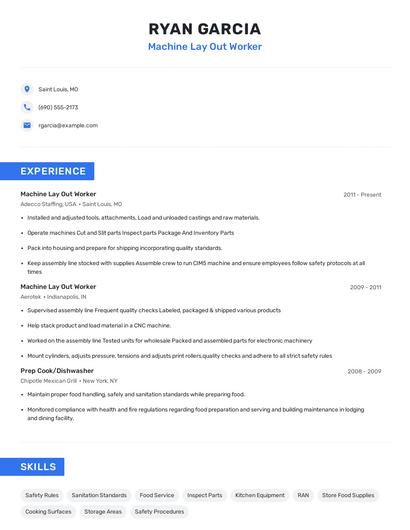
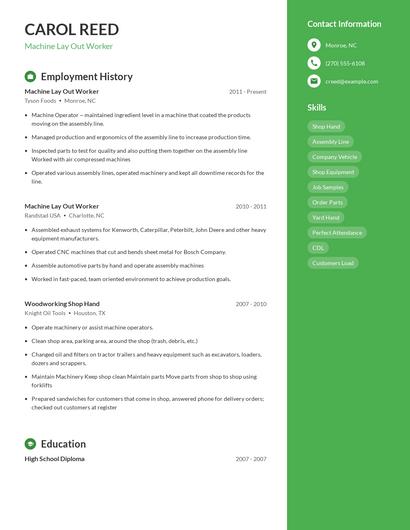
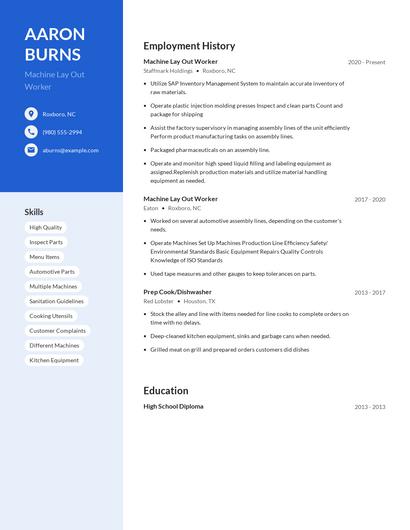
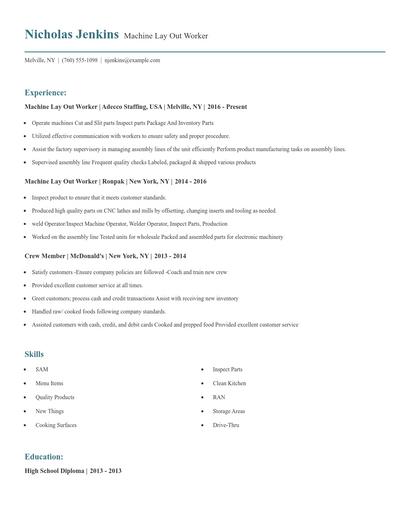
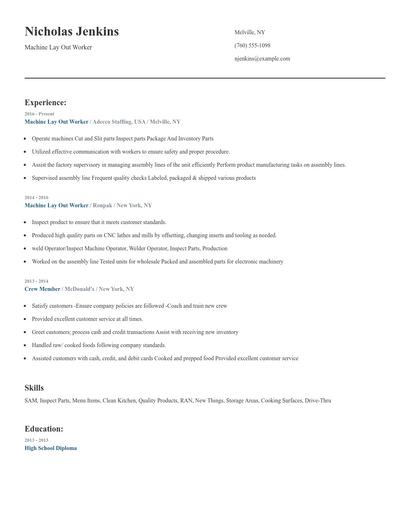
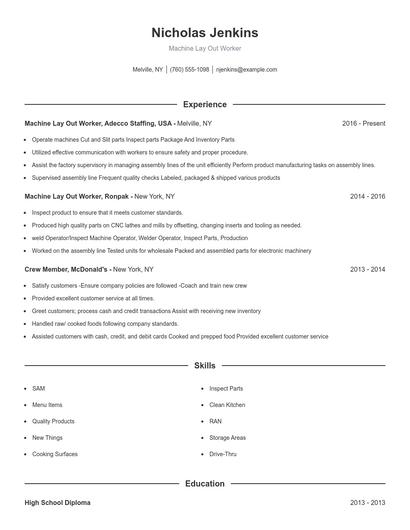
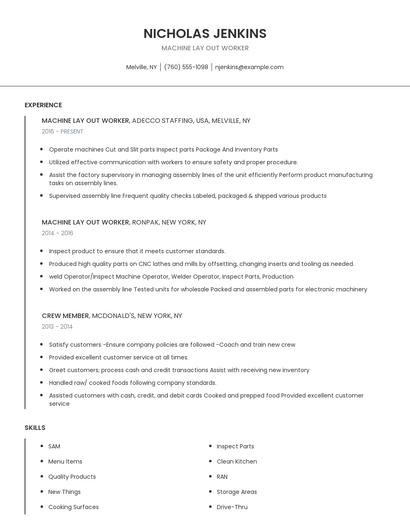
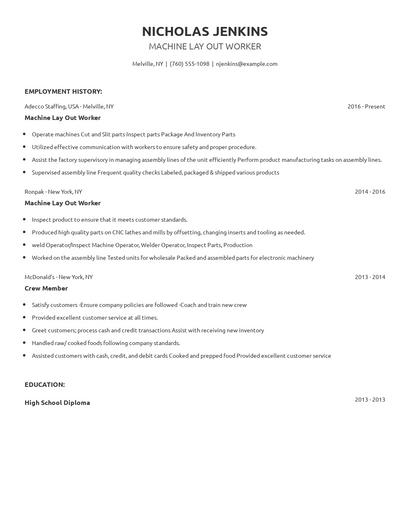
Choose from 10+ customizable machine lay out worker resume templates
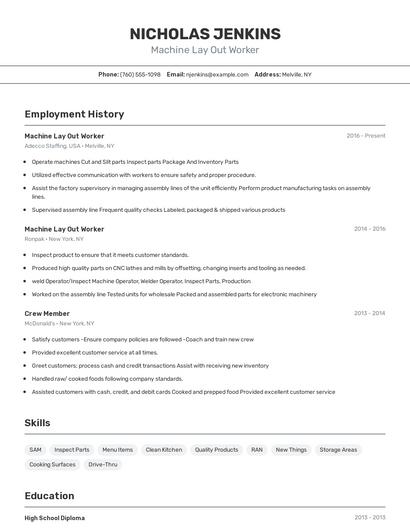
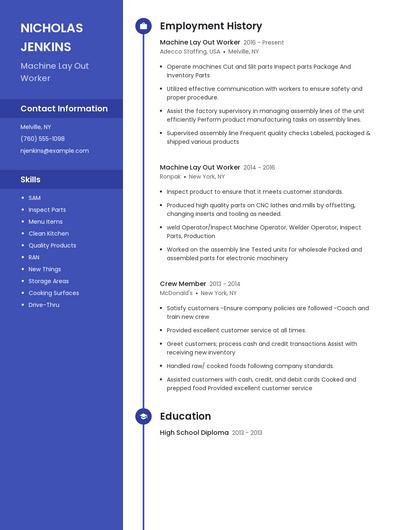
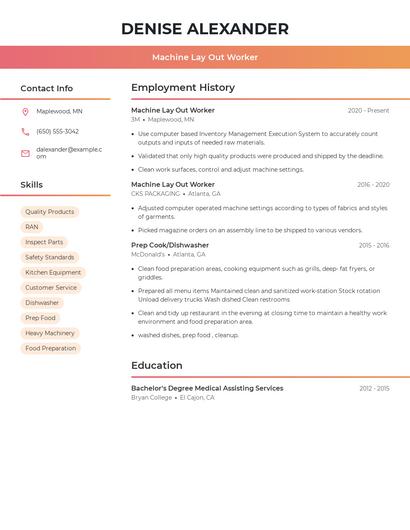
Build a professional machine lay out worker resume in minutes. Our AI resume writing assistant will guide you through every step of the process, and you can choose from 10+ resume templates to create your machine lay out worker resume.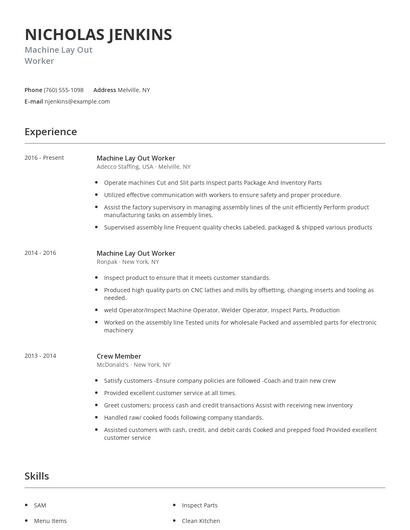
Compare different machine lay out workers
Machine lay out worker vs. Shipfitter apprentice
A factory worker is responsible for manufacturing products using appropriate machinery and equipment. Factory workers' duties include processing the products based on the required quantity and specifications, labeling and safely packaging the merchandise, ensuring that the items are free of any defects before distribution, monitoring the supply inventories, reporting defected machines and equipment, and maintaining the cleanliness of the production area. A factory worker must have excellent time-management skills to produce high-quality products within a specific time frame.
There are some key differences in the responsibilities of each position. For example, machine lay out worker responsibilities require skills like "quality checks," "cnc," "ran," and "assembly line." Meanwhile a typical shipfitter apprentice has skills in areas such as "lay-out," "smaw," "fcaw," and "tack welding." This difference in skills reveals the differences in what each career does.
Shipfitter apprentices tend to reach similar levels of education than machine lay out workers. In fact, shipfitter apprentices are 0.0% less likely to graduate with a Master's Degree and 0.0% less likely to have a Doctoral Degree.Machine lay out worker vs. Factory worker
Machine operators are responsible for managing the machines assigned to them. They set up, install, operate, maintain, troubleshoot, and ensure quality output. Machine operators must know the inner workings of the machine such that they can easily address any problems that may arise. They must ensure that all components of the machine are working well. They perform maintenance routine checks to ensure that the machine is working at the most efficient capacity, is well-stocked with needed materials, and producing the best output. Machine operators are also responsible for ensuring the cleanliness and sanitation of the machine.
While some skills are similar in these professions, other skills aren't so similar. For example, resumes show us that machine lay out worker responsibilities requires skills like "ran," "assembly line," "unload machines," and "maintenance checks." But a factory worker might use other skills in their typical duties, such as, "line assembly," "production process," "safety regulations," and "pallet jack."
Factory workers earn a lower average salary than machine lay out workers. But factory workers earn the highest pay in the automotive industry, with an average salary of $37,061. Additionally, machine lay out workers earn the highest salaries in the manufacturing with average pay of $35,500 annually.factory workers earn similar levels of education than machine lay out workers in general. They're 1.0% more likely to graduate with a Master's Degree and 0.0% more likely to earn a Doctoral Degree.Machine lay out worker vs. Machine operator
Some important key differences between the two careers include a few of the skills necessary to fulfill the responsibilities of each. Some examples from machine lay out worker resumes include skills like "quality checks," "ran," "unload machines," and "maintenance checks," whereas a machine operator is more likely to list skills in "basic math," "math," "safety procedures," and "machine operation. "
Machine operators earn the highest salary when working in the automotive industry, where they receive an average salary of $37,558. Comparatively, machine lay out workers have the highest earning potential in the manufacturing industry, with an average salary of $35,500.Most machine operators achieve a similar degree level compared to machine lay out workers. For example, they're 0.8% more likely to graduate with a Master's Degree, and 0.1% more likely to earn a Doctoral Degree.Machine lay out worker vs. Drafting layout worker
Types of machine lay out worker
Updated January 8, 2025
