What does a manager, accounting operations do?
An accounting operations manager is an executive professional who supervises a customer service team in performing customer billing, collection activities, and other customer services related to finance. Accounting operations managers must prepare and maintain accounting records regularly as well as assist in the preparation and control of operations budgets. Under the supervision of the company's director of finance, accounting operations managers must reconcile monthly bank accounts and prepare reports on monthly revenue and expenditure. They must also train staff members to work on updated accounting systems.
Manager, accounting operations responsibilities
Here are examples of responsibilities from real manager, accounting operations resumes:
- Manage a staff of accountants responsible for ensuring proper recording of billing transactions in accordance with GAAP revenue recognition guidelines.
- Manage day-to-day accounting accuracy and monthly audit of reports using GAAP principals.
- Initiate ongoing departmental projects to automate daily tasks which include the calculations for income distributions and the daily income account reconciliation.
- Prepare and review monthly balance sheet account reconciliations which contribute to the accuracy and reliability of the company's financial statements.
- Cross functional project management for site changes impacting accounting and treasury process flows.
- Facilitate month end close, reconciliation of balance sheet accounts and various accruals and allocations.
- Provide seamless support to treasury, finance, operations, overseas office, and special teams.
- Implement document imaging system to electronically route operating expense invoices for approval, upload into ERP software, and record retention.
- Record investment activity and expense accruals.
- Ensure accurate and timely payroll processing to meet reporting and benefit requirements.
- Develop policies, procedures and SOX internal control processes relate to accounting operations.
- Assist in compiling SOX documentation for manufacturing-relate processes, and developing internal control structure where need.
- Administrate accounting activities that include recording of accounting transactions, reconciliations, as well as financial reporting and analysis.
- Audit inventory adjustments base on material discrepancies between physical counts and inventory accounting system using an ERP software system.
- Assist bookkeeper with monthly financial close responsibilities, including reconciliation of various general ledger accounts, payroll and non-payroll relate.
Manager, accounting operations skills and personality traits
We calculated that 16% of Managers, Accounting Operations are proficient in Customer Service, CPA, and Reconciliations. They’re also known for soft skills such as Analytical skills, Communication skills, and Detail oriented.
We break down the percentage of Managers, Accounting Operations that have these skills listed on their resume here:
- Customer Service, 16%
Developed a paperless delivery database for ordering and tracking which improved restaurant operations and customer service.
- CPA, 12%
Served as key liaison with CPA firm, including reviewing financial posture, updating compliance and benefits, and general direction/advising.
- Reconciliations, 7%
Prepared and reviewed monthly balance sheet account reconciliations which contributed to the accuracy and reliability of the company's financial statements.
- Payroll, 6%
Assist bookkeeper with monthly financial close responsibilities, including reconciliation of various general ledger accounts, payroll and non-payroll related.
- Internal Controls, 4%
Ensured accurate processing of daily transactions, established and monitored internal controls and ensured controls were in compliance with corporate requirements.
- External Auditors, 3%
Own relationship with internal and external auditors relative to audit activities, analysis, rationalization, reporting and remediation.
Most managers, accounting operations use their skills in "customer service," "cpa," and "reconciliations" to do their jobs. You can find more detail on essential manager, accounting operations responsibilities here:
Analytical skills. One of the key soft skills for a manager, accounting operations to have is analytical skills. You can see how this relates to what managers, accounting operations do because "to assist executives in making decisions, financial managers need to evaluate data and information that affects their organization." Additionally, a manager, accounting operations resume shows how managers, accounting operations use analytical skills: "led the peoplesoft erp upgrade implementation in my function areas by reviewing test sample data. "
Communication skills. Another essential skill to perform manager, accounting operations duties is communication skills. Managers, accounting operations responsibilities require that "financial managers must be able to explain and justify complex financial transactions." Managers, accounting operations also use communication skills in their role according to a real resume snippet: "established and maintained effective communication within the accounting, treasury, credit, sales, and it. "
Detail oriented. Another skill that relates to the job responsibilities of managers, accounting operations is detail oriented. This skill is critical to many everyday manager, accounting operations duties, as "in preparing and analyzing reports, such as balance sheets and income statements, financial managers must be precise and attentive to their work in order to avoid errors." This example from a resume shows how this skill is used: "reviewed accurate and timely financial reports including a detailed budget analysis. "
Math skills. A big part of what managers, accounting operations do relies on "math skills." You can see how essential it is to manager, accounting operations responsibilities because "financial managers need strong skills in certain branches of mathematics, including algebra." Here's an example of how this skill is used from a resume that represents typical manager, accounting operations tasks: "analyzed data and statistics to complete financial reports to be submitted to upper management. "
Organizational skills. A commonly-found skill in manager, accounting operations job descriptions, "organizational skills" is essential to what managers, accounting operations do. Manager, accounting operations responsibilities rely on this skill because "because financial managers deal with a range of information and documents, they must have structures in place to be effective in their work." You can also see how manager, accounting operations duties rely on organizational skills in this resume example: "handled monthly tax reports and payroll skills used organizational skills payroll quickbooks tax reports"
The three companies that hire the most manager, accounting operationss are:
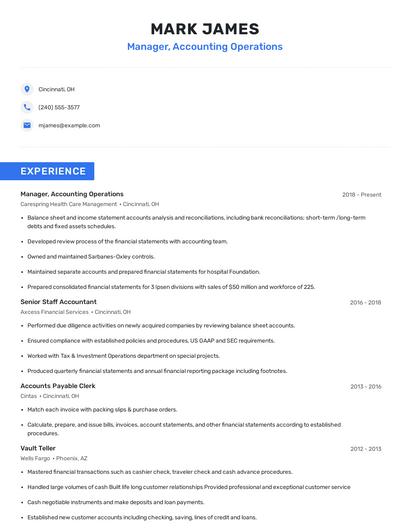
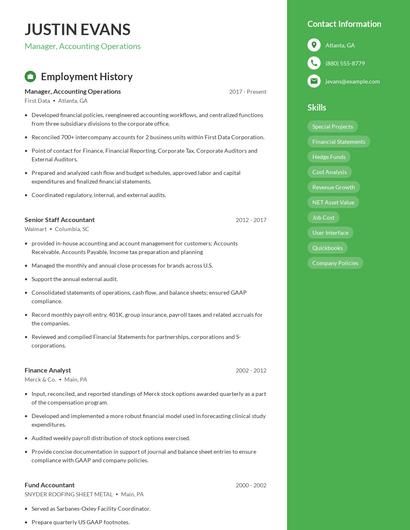
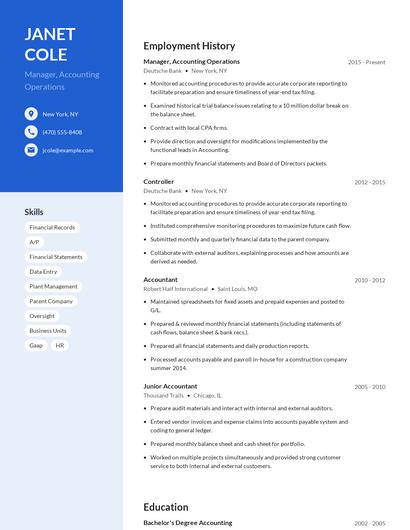
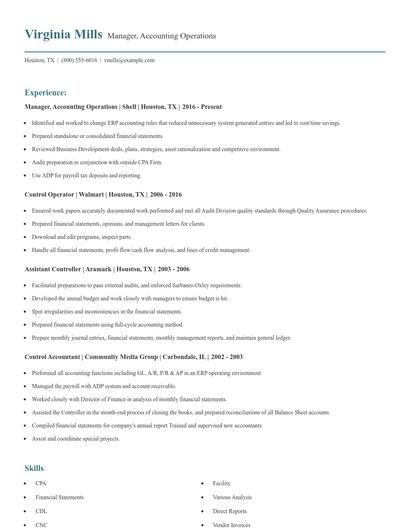
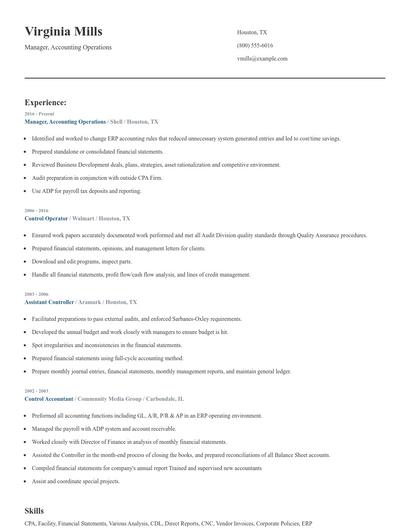
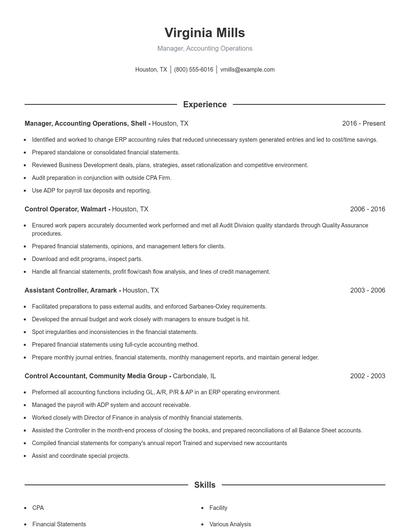
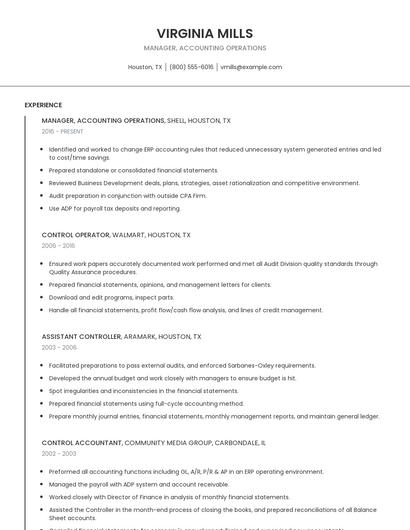
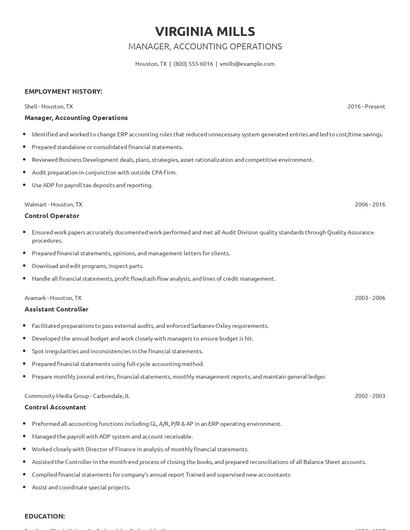
Choose from 10+ customizable manager, accounting operations resume templates
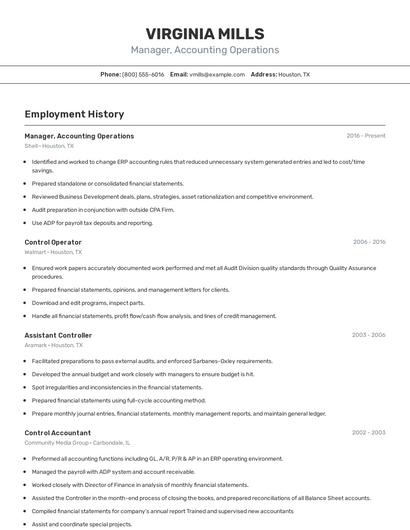
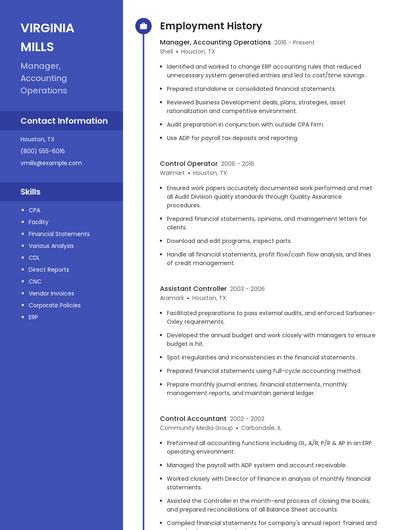
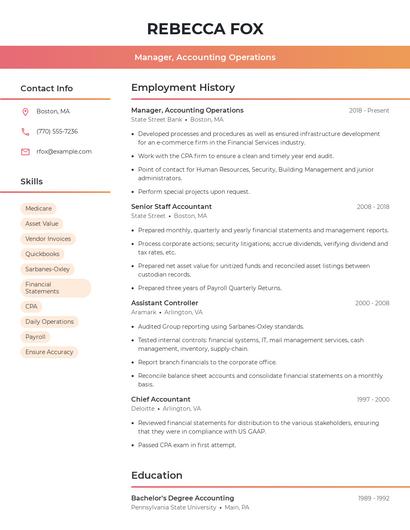
Build a professional manager, accounting operations resume in minutes. Our AI resume writing assistant will guide you through every step of the process, and you can choose from 10+ resume templates to create your manager, accounting operations resume.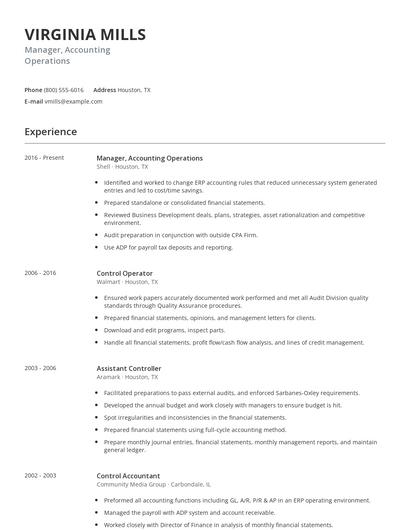
Compare different managers, accounting operations
Manager, accounting operations vs. Finance controller
A financial controller is primarily in charge of the daily finance activities and accounting functions of a company. Their responsibilities typically revolve around preparing and organizing financial reports, analyzing data and looking out for any discrepancies or inconsistencies, and overseeing the company's overall revenues and expenditures. A financial controller must also maintain documentation, participate in risk assessment and budgeting activities, and develop strategies for profit growth. Furthermore, one must coordinate with other department staff to ensure accuracy, all while implementing the company's policies and regulations.
These skill sets are where the common ground ends though. The responsibilities of a manager, accounting operations are more likely to require skills like "customer service," "general ledger accounts," "oversight," and "credit card." On the other hand, a job as a finance controller requires skills like "financial controller," "strong analytical," "excellent interpersonal," and "journal entries." As you can see, what employees do in each career varies considerably.
Finance controllers really shine in the technology industry with an average salary of $119,209. Comparatively, managers, accounting operations tend to make the most money in the finance industry with an average salary of $98,881.On average, finance controllers reach higher levels of education than managers, accounting operations. Finance controllers are 6.9% more likely to earn a Master's Degree and 0.2% more likely to graduate with a Doctoral Degree.Manager, accounting operations vs. Accountant and office manager
An accountant/office manager is responsible for monitoring the organization's accounting records and financial reports, analyzing statistical information, and managing payroll processes. Accountant/office managers must have excellent knowledge of accounting disciplines and principles to perform accounting duties and train accounting staff of the accounting operations, overseeing account receivables, conducting bank reconciliations, and responding to the staff's inquiries and concerns. An accountant/office manager must have excellent communication and leadership skills, helping the management develop practical accounting and financial approach, maintaining the stability of the organization's cash management.
Each career also uses different skills, according to real manager, accounting operations resumes. While manager, accounting operations responsibilities can utilize skills like "payroll," "internal controls," "external auditors," and "process improvement," accountant and office managers use skills like "payroll tax returns," "journal entries," "purchase orders," and "sales tax returns."
Accountant and office managers earn a lower average salary than managers, accounting operations. But accountant and office managers earn the highest pay in the real estate industry, with an average salary of $59,443. Additionally, managers, accounting operations earn the highest salaries in the finance with average pay of $98,881 annually.Average education levels between the two professions vary. Accountant and office managers tend to reach lower levels of education than managers, accounting operations. In fact, they're 6.1% less likely to graduate with a Master's Degree and 0.2% more likely to earn a Doctoral Degree.What technology do you think will become more important and prevalent for manager, accounting operationss in the next 3-5 years?
Michele Flint
Associate Professor Director of Brooklyn Accounting Program, Daemen College
At the same time, technology is evolving so rapidly that what you study today, may not be as relevant tomorrow, as newer software and financial products emerge. The critical thing would be to keep reading about the most recent advancements and emerging technologies to have a conceptual understanding. Learn about industry-specific software (in a general sense), but understand that employers will expect to train you in industry-specific software.
Manager, accounting operations vs. Accounts payable manager
An accounts payable manager is in charge of supervising a company's financial activities, particularly in all payable matters. Their primary responsibilities revolve around managing and assessing staff performances and overseeing check and payroll disbursements. They also take care of maintaining and securing records of employees, clients, and company finances, and implement company objectives while ensuring accuracy in all operations. Furthermore, as a manager, it is essential to uphold all company policies and regulations, all while leading and encouraging staff in a joint effort to accomplish goals and tasks.
Some important key differences between the two careers include a few of the skills necessary to fulfill the responsibilities of each. Some examples from manager, accounting operations resumes include skills like "cpa," "close process," "oversight," and "balance sheet accounts," whereas an accounts payable manager is more likely to list skills in "purchase orders," "vendor invoices," "financial statements," and "data entry. "
Accounts payable managers earn the best pay in the finance industry, where they command an average salary of $70,221. Managers, accounting operations earn the highest pay from the finance industry, with an average salary of $98,881.When it comes to education, accounts payable managers tend to earn lower degree levels compared to managers, accounting operations. In fact, they're 5.5% less likely to earn a Master's Degree, and 0.2% less likely to graduate with a Doctoral Degree.Manager, accounting operations vs. Business manager
A business manager is responsible for directing the overall operations of the company, ensuring that all employees do their tasks efficiently and accurately. Business managers' duties include developing strategic solutions, evaluating employees' performance, identifying business opportunities to grow, monitoring the company's expenses to meet its budget goals, implementing techniques to boost the company's revenue and profitability, and adhering to the company's legal policies and procedures. A business manager must have excellent leadership and interpersonal skills to supervise daily operations.
Types of manager, accounting operations
Updated January 8, 2025
