What does a manager, process development do?
Manager, process development responsibilities
Here are examples of responsibilities from real manager, process development resumes:
- Manage multiple OEM and localization projects simultaneously.
- Prepare account control books used for ISO audits.
- Help procure difficult to build CNC parts and sub-assemblies.
- Qualify raw material supplier (s) for submission to the FDA; manufacture registration lots.
- Identify by FDA as expert in the scale-up of encapsulate dosage forms and lecture to FDA inspectors.
- Develop a method to get AutoCad isometric drawings relevant to relief valve transferred electronically to the relief valve sizing package.
- Aid in design development process for second generation disposable OPCAB products and develop testing experiments for second generation RF products.
Manager, process development skills and personality traits
We calculated that 8% of Managers, Process Development are proficient in Continuous Improvement, Project Management, and CMC. They’re also known for soft skills such as Detail oriented, Analytical skills, and Organizational skills.
We break down the percentage of Managers, Process Development that have these skills listed on their resume here:
- Continuous Improvement, 8%
Re-trained employees and initiated continuous improvement processes within Vehicle Logistics Group to optimize integration of resources.
- Project Management, 7%
Incorporated new technologies and tools that continuously improved the software development process and project management procedures within IT organization.
- CMC, 5%
Led site efforts for CMC Submissions for ANDA Products.
- Process Improvement, 5%
Serve as Subject Matter Expert on process improvement to increase productivity and efficiency within procurement endeavors and initiatives.
- GMP, 4%
Managed in the production of GMP material at contract manufacturing site, drafted production documentation including SOP's and Manufacturing Records.
- R, 4%
Managed design, developed and produced X-Band T/R module using commercial components as demonstrator of complex device fabrication ability.
Most managers, process development use their skills in "continuous improvement," "project management," and "cmc" to do their jobs. You can find more detail on essential manager, process development responsibilities here:
Analytical skills. Another essential skill to perform manager, process development duties is analytical skills. Managers, process development responsibilities require that "architectural and engineering managers evaluate information to solve problems." Managers, process development also use analytical skills in their role according to a real resume snippet: "performed doe analysis to set up key input variables optimal parameters. "
Organizational skills. managers, process development are also known for organizational skills, which are critical to their duties. You can see how this skill relates to manager, process development responsibilities, because "architectural and engineering managers keep track of many workers, schedules, and budgets simultaneously." A manager, process development resume example shows how organizational skills is used in the workplace: "assisted project managers with best project management practices for continuous process improvement, while achieving organizational sei cmm goals. "
Communication skills. A big part of what managers, process development do relies on "communication skills." You can see how essential it is to manager, process development responsibilities because "architectural and engineering managers must effectively convey information and expectations related to projects." Here's an example of how this skill is used from a resume that represents typical manager, process development tasks: "participated in the preparation and presentation of external communications for investors, clinical investigators, fda and scientific community. "
Math skills. Another common skill required for manager, process development responsibilities is "math skills." This skill comes up in the duties of managers, process development all the time, as "architectural and engineering managers use calculus and other mathematics to develop new products and processes." An excerpt from a real manager, process development resume shows how this skill is central to what a manager, process development does: "implemented numerous process improvements in the factory line through persistent failure analysis and outstanding quantitative data analysis. "
The three companies that hire the most manager, process developments are:
- Thermo Fisher Scientific6 managers, process development jobs
- MKS Instruments4 managers, process development jobs
- Google4 managers, process development jobs
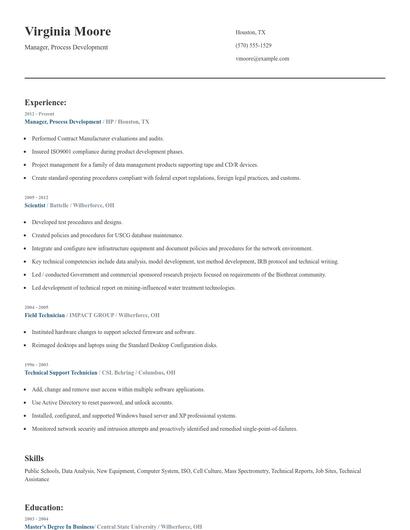
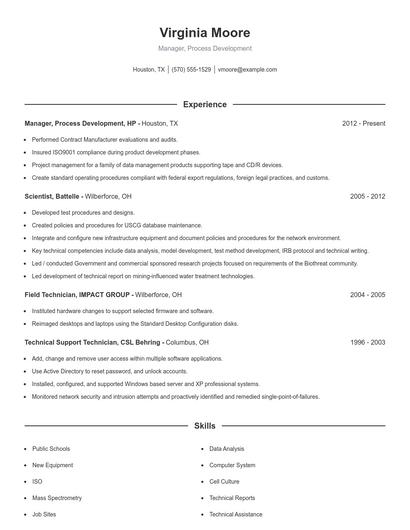
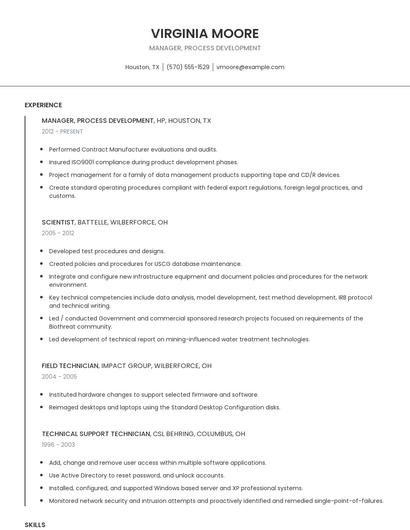
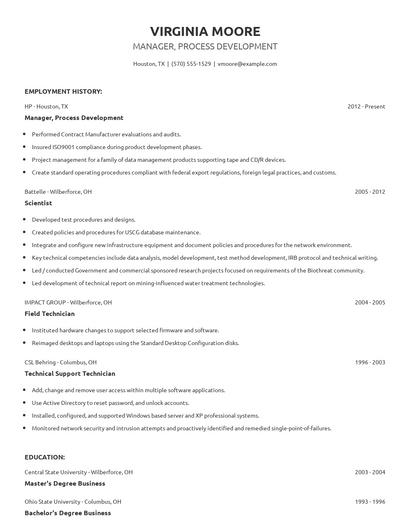
Choose from 10+ customizable manager, process development resume templates
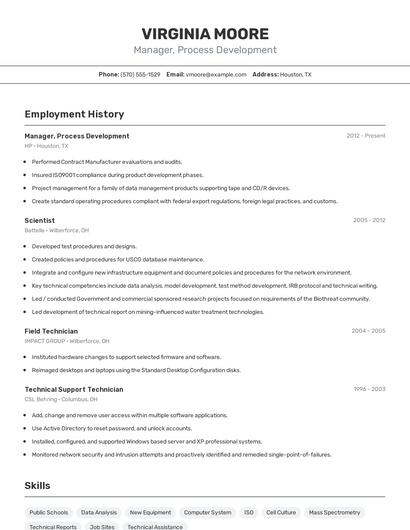
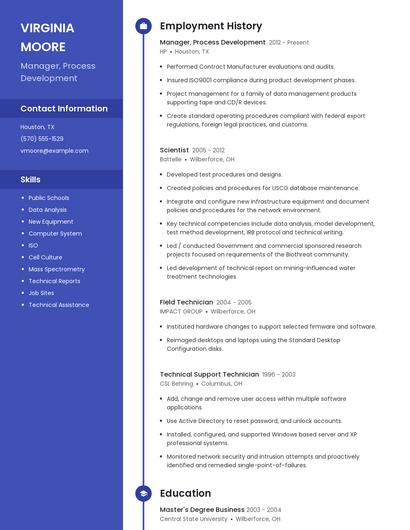
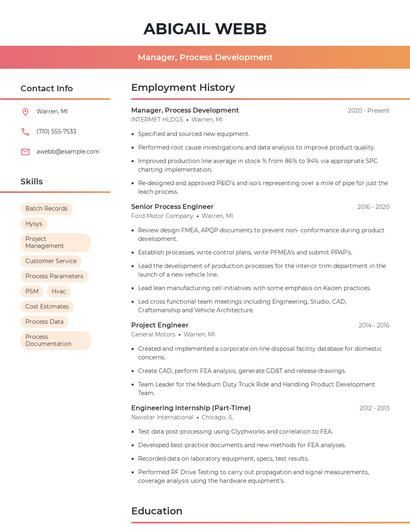
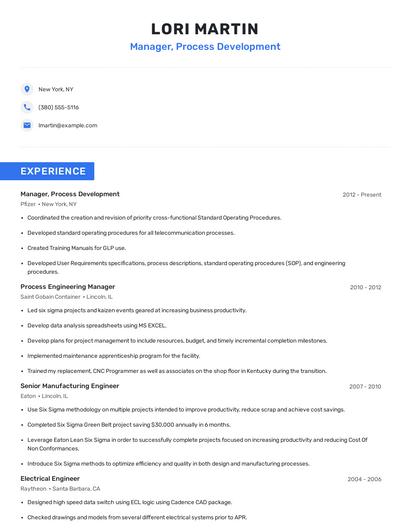
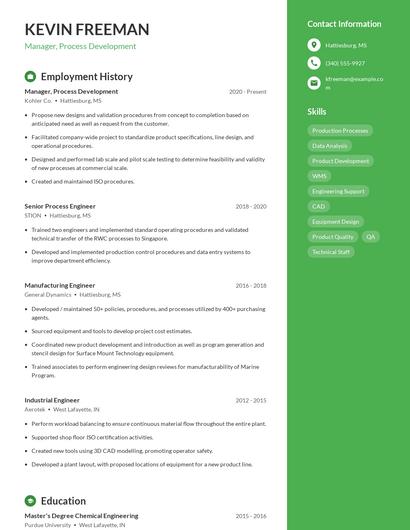
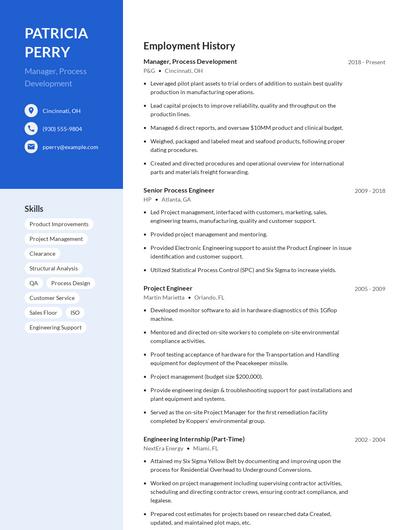
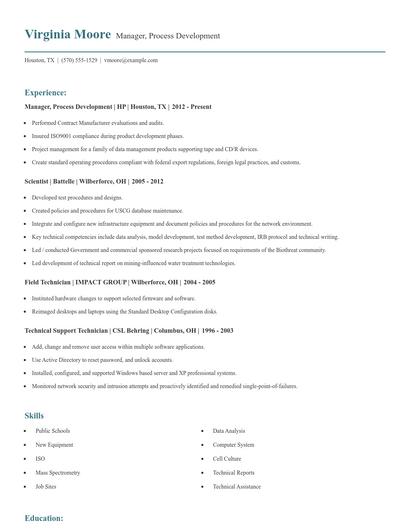
Build a professional manager, process development resume in minutes. Our AI resume writing assistant will guide you through every step of the process, and you can choose from 10+ resume templates to create your manager, process development resume.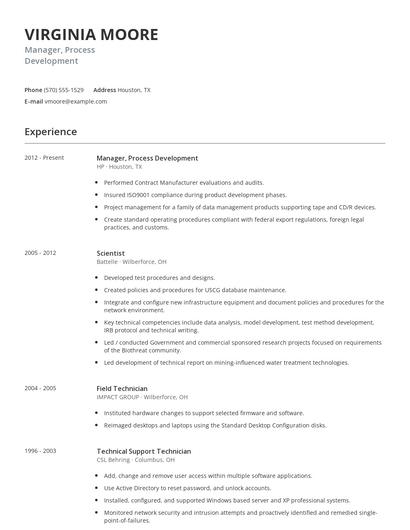
Compare different managers, process development
Manager, process development vs. Supplier quality engineer
A Supplier Quality Engineer ensures that the supplier's quality standards are in accordance with the requirement of the organization. They also report supplier performance and quality to management.
There are some key differences in the responsibilities of each position. For example, manager, process development responsibilities require skills like "project management," "cmc," "gmp," and "business process." Meanwhile a typical supplier quality engineer has skills in areas such as "ppap," "apqp," "gd," and "process control." This difference in skills reveals the differences in what each career does.
Supplier quality engineers earn the highest salaries when working in the professional industry, with an average yearly salary of $87,103. On the other hand, managers, process development are paid more in the telecommunication industry with an average salary of $121,678.The education levels that supplier quality engineers earn slightly differ from managers, process development. In particular, supplier quality engineers are 1.5% less likely to graduate with a Master's Degree than a manager, process development. Additionally, they're 5.9% less likely to earn a Doctoral Degree.Manager, process development vs. Quality control engineer
A quality control engineer is responsible for conducting quality assessments for the company's products and services to ensure adherence to federal regulations and quality standards. Quality control engineers recommend strategic methods by analyzing processes and writing test results. They also identify opportunities for more services that meet public demands and market trends, helping the business generate more resources for revenues. A quality control engineer utilizes various software tools and applications to document findings, requiring them to have excellent communication and technical skills.
While some skills are similar in these professions, other skills aren't so similar. For example, resumes show us that manager, process development responsibilities requires skills like "project management," "cmc," "gmp," and "business process." But a quality control engineer might use other skills in their typical duties, such as, "quality standards," "corrective action," "test procedures," and "quality issues."
Quality control engineers earn a lower average salary than managers, process development. But quality control engineers earn the highest pay in the technology industry, with an average salary of $83,131. Additionally, managers, process development earn the highest salaries in the telecommunication with average pay of $121,678 annually.Average education levels between the two professions vary. Quality control engineers tend to reach lower levels of education than managers, process development. In fact, they're 5.4% less likely to graduate with a Master's Degree and 5.9% less likely to earn a Doctoral Degree.Manager, process development vs. Senior quality engineer
A Senior Quality Engineer ensures that a company's goods meet the quality standards required. They may work in various industries, such as the automobile, textile, clothing, food, and electronics industries.
Some important key differences between the two careers include a few of the skills necessary to fulfill the responsibilities of each. Some examples from manager, process development resumes include skills like "project management," "cmc," "business process," and "process engineering," whereas a senior quality engineer is more likely to list skills in "corrective action," "quality standards," "quality issues," and "capa. "
Senior quality engineers earn the highest salary when working in the professional industry, where they receive an average salary of $100,740. Comparatively, managers, process development have the highest earning potential in the telecommunication industry, with an average salary of $121,678.Most senior quality engineers achieve a similar degree level compared to managers, process development. For example, they're 1.7% less likely to graduate with a Master's Degree, and 5.6% less likely to earn a Doctoral Degree.Manager, process development vs. Senior staff engineer
A senior staff engineer is responsible for supervising a team of engineers, chemists, software developers, or molecular biologists. His/Her or her responsibilities include generating Structured Query Language (SQL) performance audit checklist template, creating SQL data query routines and functions for data extraction, and working directly with stakeholders. The job requires strong mechanical, listening, and mathematical skills and proficiency in Python programming language and computer architecture and hardware. The education requirements for the job include a bachelor's or master's degree in electrical engineering, business, mechanical engineering, or a related field.
Types of manager, process development
Updated January 8, 2025
